All species › Waders, gulls and terns › Skimmers, noddies, terns and gulls › Kelp Gull
Kelp Gull | Larus dominicanus
Kelpmeeuw | Gaviota Dominicana | Gaivotão
Kelp Gull is the large black-backed gull of the southern hemisphere, with breeding areas in South America, southern Africa, Australasia and Antarctica. In the guide area it lives along the coast of Peru and has expanded northwards in recent decades. It is the largest gull in the guide area.
Voice
A long, shrill kee-ow and a series of laughing ha-ha-ha calls; a low kek when disturbed.
Recording: African Bioacoustics Community — CC BY-NC-SA 4.0 · xeno-canto
Identification
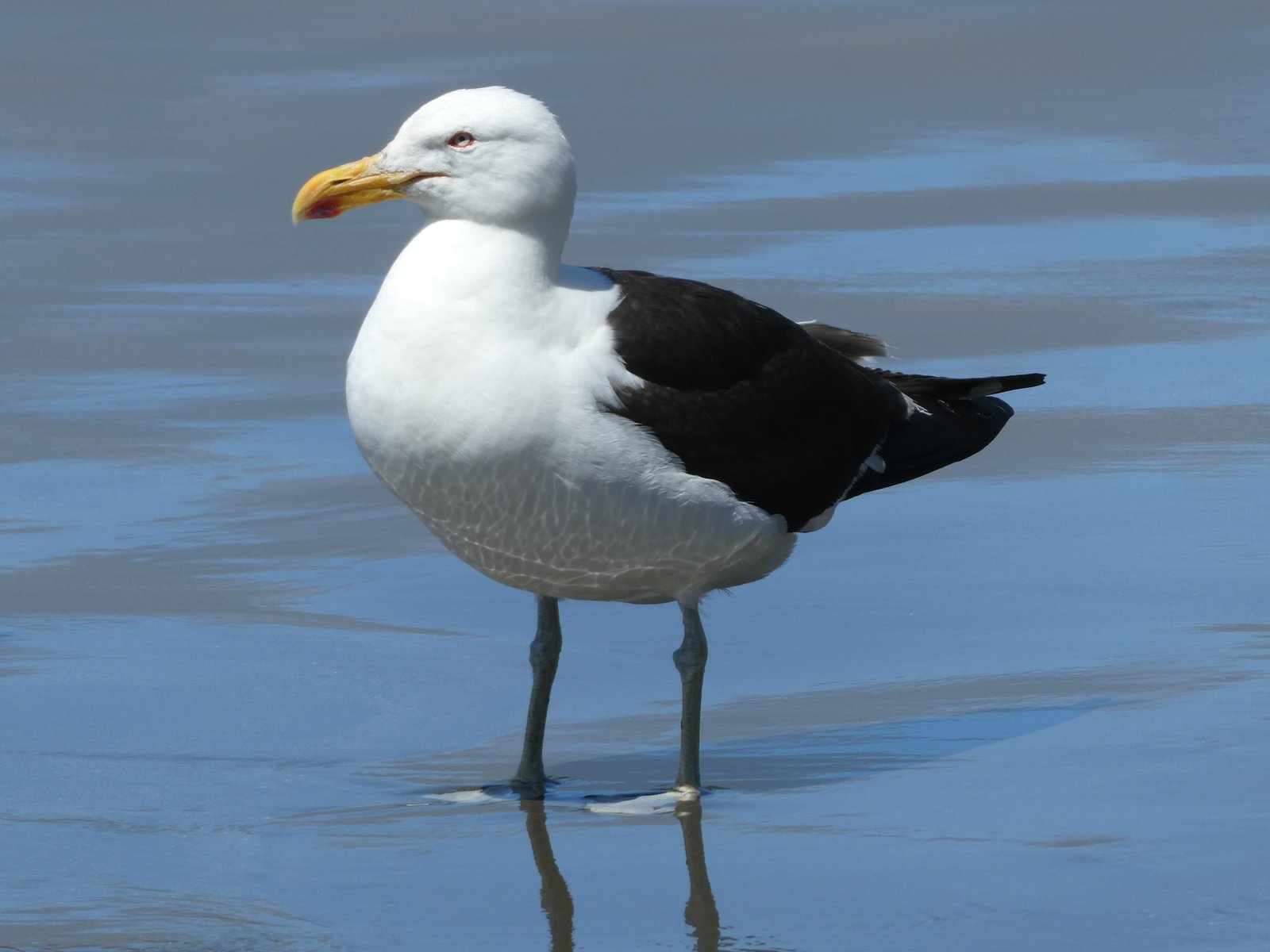
54–62 cm, a heavy gull with a thick yellow bill with a red spot near the tip, a pale iris and greenish yellow legs. Adults have a blackish mantle and upperwing with a broad white trailing edge and small white spots in the black wingtip, and a white head, underparts and tail; the head stays nearly white outside the breeding season too. Juveniles are mottled dark greyish brown, with a black bill and a dark tail; they reach adult plumage in four years and show a mixed brown and black plumage in between. The sexes are alike; the male is larger.
Confusion species
Belcher's Gull Larus belcheri is smaller, with a black tail band, a bill with a black band and a red tip, yellow legs and a dark brown hood in non-breeding plumage. Laughing Gull Leucophaeus atricilla is much smaller, with a dark grey mantle and no white in the wingtip. Ring-billed Gull Larus delawarensis, only on the Caribbean coast, is smaller, with a pale grey mantle and a ringed bill.
Habitat
Rocky shores, sandy beaches, estuaries, harbours and rubbish dumps, also at fish farms; rarely far out at sea. It eats fish, molluscs, crabs, eggs and chicks of other birds, carrion and refuse; it drops shells onto rocks to break them. It breeds in colonies or single pairs on islands, cliffs and beaches; the nest is a heap of plant material.
Where the bird is most at home, classified by the vegetation units of the Andes and the west coast.


Range and movements
In Peru along the coast, mainly in the centre and south, expanding northwards. In Ecuador scarce in the south-west, mainly around the Gulf of Guayaquil. Absent from Colombia, Bolivia and the Galápagos. Outside the guide area along the coasts of Chile, Argentina and southern Brazil, and further in southern Africa, Australia, New Zealand, on subantarctic islands and on the Antarctic Peninsula.
- Resident
- dark = core range, pale = thinly spread
How and when to look
Search fishing harbours and rubbish dumps on the coast of central and southern Peru, for example around Lima, Paracas and Mollendo, where it sits among Belcher's Gulls; note the larger size and the tail without a black band.
Conservation status
Least Concern. The population is increasing in large parts of the range, partly owing to fishery waste and rubbish dumps.
Scientific name
Larus dominicanus | Lichtenstein, 1823
Lichtenstein described the species in 1823 and placed it straight away in the genus where it still stands. The genus Larus was introduced in 1758 by Linnaeus. The genus name comes from Greek laros or Latin larus, a word for a gull or another large seabird. The species name is Latin for 'Dominican': the bird's black and white recalls the habit of Dominican friars. The specimen the first description was based on came from Coast of Brazil.