All species › Waders, gulls and terns › Skimmers, noddies, terns and gulls › American Herring Gull
American Herring Gull | Larus smithsonianus
Amerikaanse zilvermeeuw | Gaviota argéntea americana | Gaivota-prateada-americana
The American Herring Gull is the large, grey-backed gull of North America, where it breeds from Alaska to the north-eastern United States. In winter part of the population moves south as far as the Caribbean and Central America. In the guide area it is a scarce winter visitor, mainly on the Caribbean coast of Colombia; almost all birds are immatures.
Voice
A loud, laughing kyow-kyow-kyow and short ga-ga-ga calls. Wintering birds in the guide area are rarely heard.
Recording: Doug Hynes — CC BY-SA 4.0 · xeno-canto
Identification
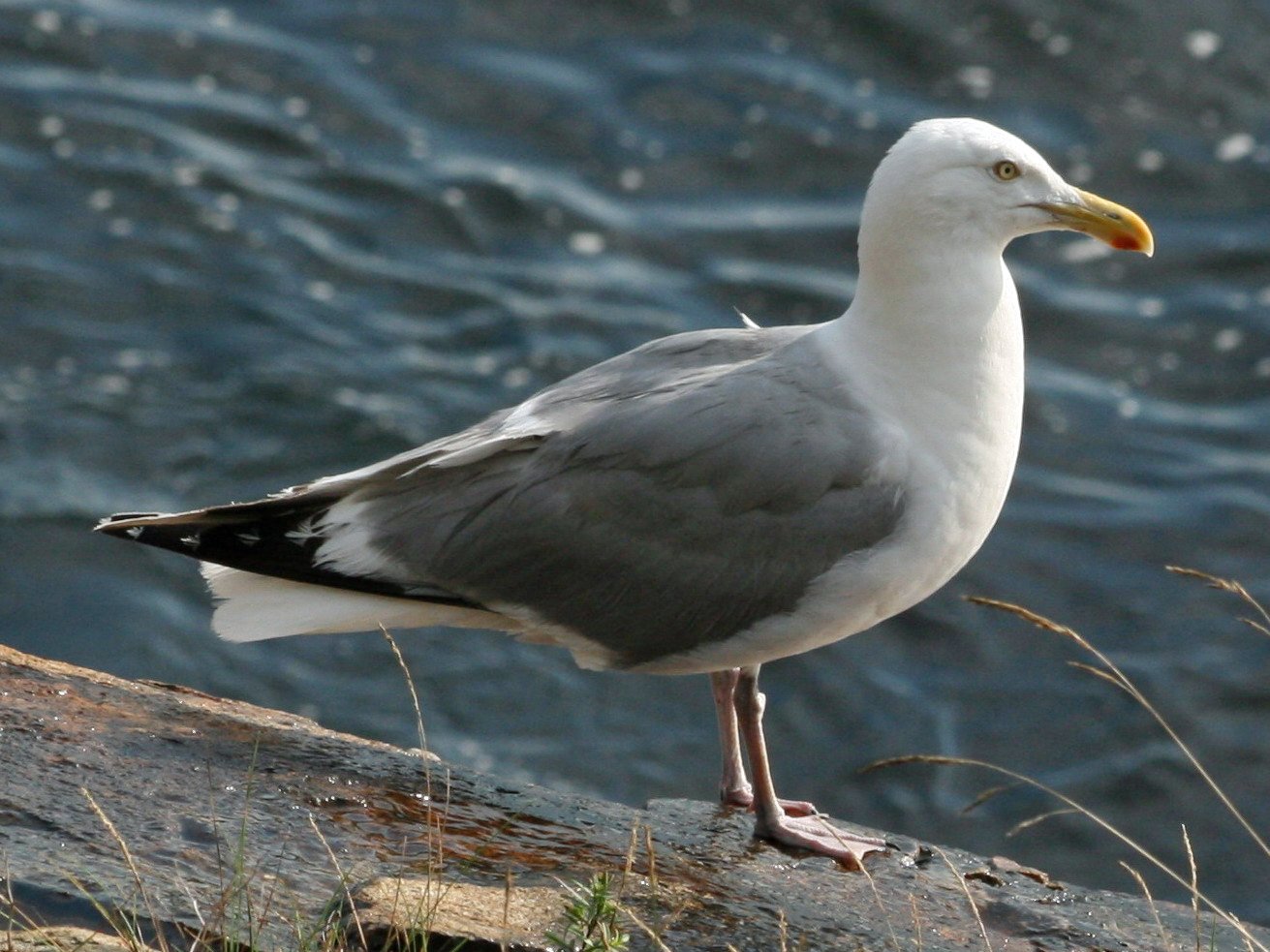
56–64 cm, a large, heavy gull with a stout bill and pink legs. Adults have a pale grey mantle, black wingtips with white spots, a yellow bill with a red spot on the lower mandible and a pale iris; in winter the head is streaked brown. Immatures, the usual age in the guide area, are uniformly greyish brown in their first winter, with an almost entirely dark tail, dark primaries and a dark bill that later becomes pink at the base. Adult plumage is reached only after about four years. The sexes are alike, the male averaging larger.
Confusion species
Adult Kelp Gull Larus dominicanus has a blackish-brown mantle; young birds are browner, with a black bill and a darker tail base. Ring-billed Gull Larus delawarensis is clearly smaller, with a shorter bill; young birds have a paler grey mantle and a narrower tail band. Lesser Black-backed Gull Larus fuscus is slimmer, with longer wings; young birds have a whiter rump and a more sharply defined tail band. European Herring Gull Larus argentatus is very similar; young birds have a paler rump and tail base with a more distinct tail band.
Habitat
Beaches, estuaries, lagoons, harbours and rubbish dumps on the coast, sometimes at large lowland lakes. It eats fish, invertebrates, carrion and refuse and often feeds around fishing boats and markets. It does not breed in the guide area.
Where the bird is most at home, classified by the vegetation units of the Andes and the west coast.


Range and movements
In Colombia scarce but almost annual on the Caribbean coast, rare on the Pacific coast. In Ecuador and Peru rare on the coast; not recorded in Bolivia. Absent from the Galápagos or at most exceptional there. Breeds in Alaska, Canada and the northern United States and winters south to Central America and the Caribbean.
- Winter visitor (c. Oct–Mar)
- dark = core range, pale = thinly spread
How and when to look
Between November and April, check flocks of gulls and terns on beaches, in harbours and at rubbish dumps on the Caribbean coast of Colombia. Look for the large build and the greyish-brown plumage of immatures.
Conservation status
Not evaluated as a separate species. The North American population is large; numbers have declined locally.
Scientific name
Larus smithsonianus | Coues, 1862
Coues described the species in 1862 and placed it straight away in the genus where it still stands. The genus Larus was introduced in 1758 by Linnaeus. The genus name comes from Greek laros or Latin larus, a word for a gull or another large seabird. The species name refers to the Smithsonian Institution in Washington. The specimen the first description was based on came from Coasts of North America.