All species › Waders, gulls and terns › Skimmers, noddies, terns and gulls › Lesser Black-backed Gull
Lesser Black-backed Gull | Larus fuscus
Kleine mantelmeeuw | Gaviota sombría | Gaivota-de-asa-escura
The Lesser Black-backed Gull is a slim, dark-backed gull that breeds in Europe and winters mainly in West Africa and around the Mediterranean. Since the 1970s more and more birds have wintered in North America and the Caribbean. In the guide area it is a very scarce winter visitor, mainly on the Caribbean coast of Colombia.
Voice
A deep, laughing kyow-kyow, slightly lower and more nasal than in the herring gulls. Wintering birds are rarely heard.
Recording: Francesco Sottile — CC BY-NC-SA 4.0 · xeno-canto
Identification
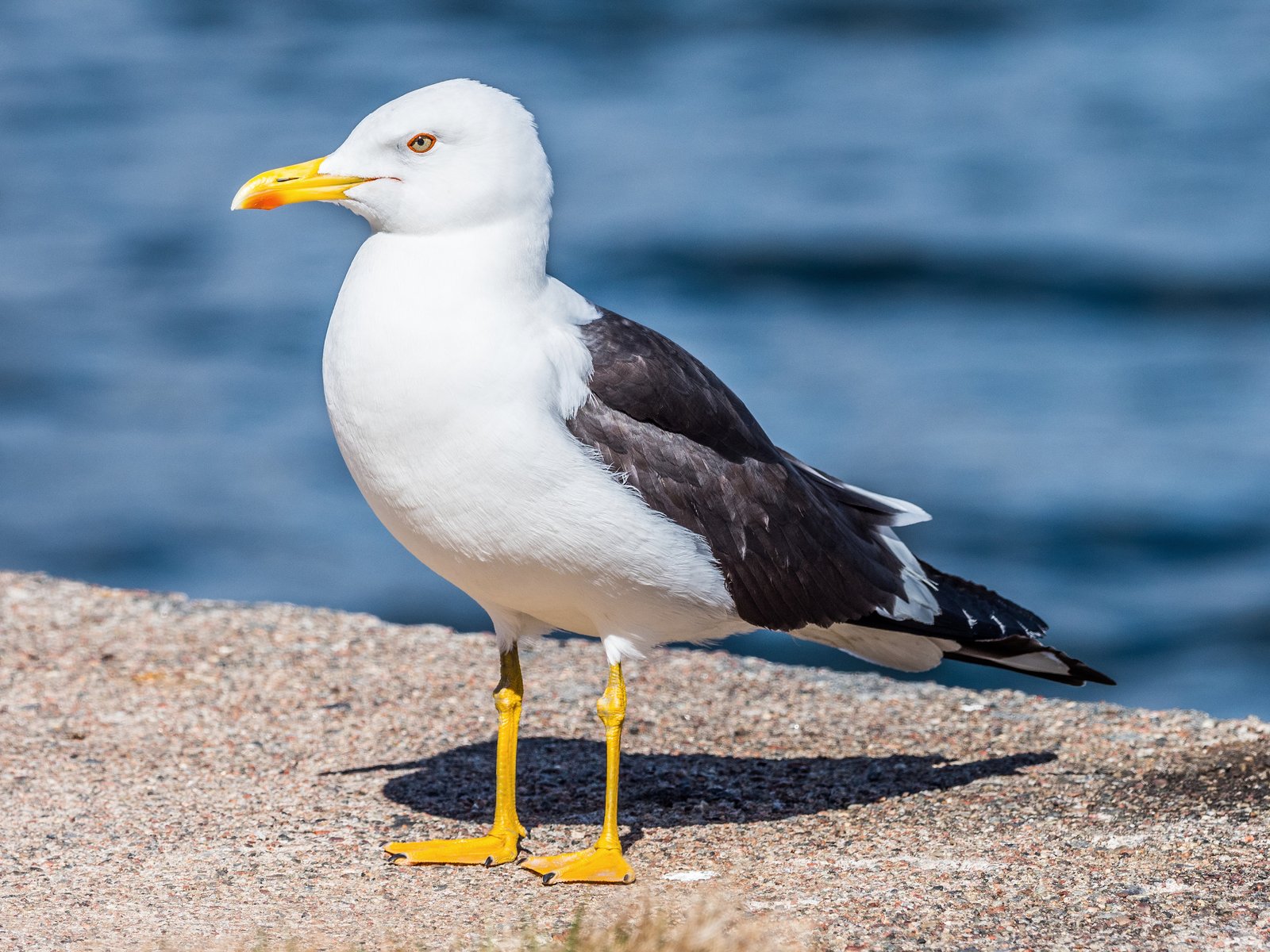
52–64 cm, a rather slim gull with long wings extending well beyond the tail and yellow legs. Adults have a slate-grey to almost black mantle, a black wingtip with small white spots, a yellow bill with a red spot and a pale iris; in winter the head is streaked brown. Immatures are mottled dark brown, with dark wings lacking pale inner primaries, a white rump with a sharply defined black tail band and a black bill. Adult plumage is reached after about four years. The sexes are alike.
Confusion species
Kelp Gull Larus dominicanus is heavier, with a blackish-brown mantle, shorter wings and greenish-yellow legs. American Herring Gull Larus smithsonianus is heavier, with a pale grey mantle and pink legs; young birds have paler inner primaries and a darker rump. Belcher's Gull Larus belcheri has a black tail band and a yellow bill with a black and red tip, and lives on the Pacific coast. Great Black-backed Gull Larus marinus is much larger, with flesh-coloured legs.
Habitat
Beaches, estuaries, lagoons, harbours and rubbish dumps on the coast, sometimes at large lowland lakes. It eats fish, invertebrates and refuse and often feeds at sea. It does not breed in the guide area.
Where the bird is most at home, classified by the vegetation units of the Andes and the west coast.


Range and movements
In Colombia very scarce but with increasing records on the Caribbean coast. In Ecuador and Peru at most a few records on the coast; not known from Bolivia or the Galápagos. Breeds in Europe, from Iceland to Scandinavia and north-western Russia; winters from western Europe to West Africa and in growing numbers in eastern North America and the Caribbean.
- Resident
- Winter visitor (c. Oct–Mar)
- Passage (Mar–Apr, Oct–Nov)
- dark = core range, pale = thinly spread
How and when to look
Between November and April, check flocks of Laughing Gulls and terns on beaches and in harbours on the Caribbean coast of Colombia. Look for the dark mantle, long wings and yellow legs.
Conservation status
Least Concern. The world population is large and has grown in the west of the range.
Scientific name
Larus fuscus | Linnaeus, 1758
Linnaeus described the species in 1758 and placed it straight away in the genus where it still stands. He introduced the genus Larus in that same work. The genus name comes from Greek laros or Latin larus, a word for a gull or another large seabird. The species name comes from Latin fuscus, 'dusky', for the dark mantle. The specimen the first description was based on came from Sweden.