All species › Waders, gulls and terns › Skimmers, noddies, terns and gulls › Blue-billed White Tern
Blue-billed White Tern | Gygis candida
Zuidzeeopaalstern | Charrán blanco piquiazul | Grazina-de-bico-azul
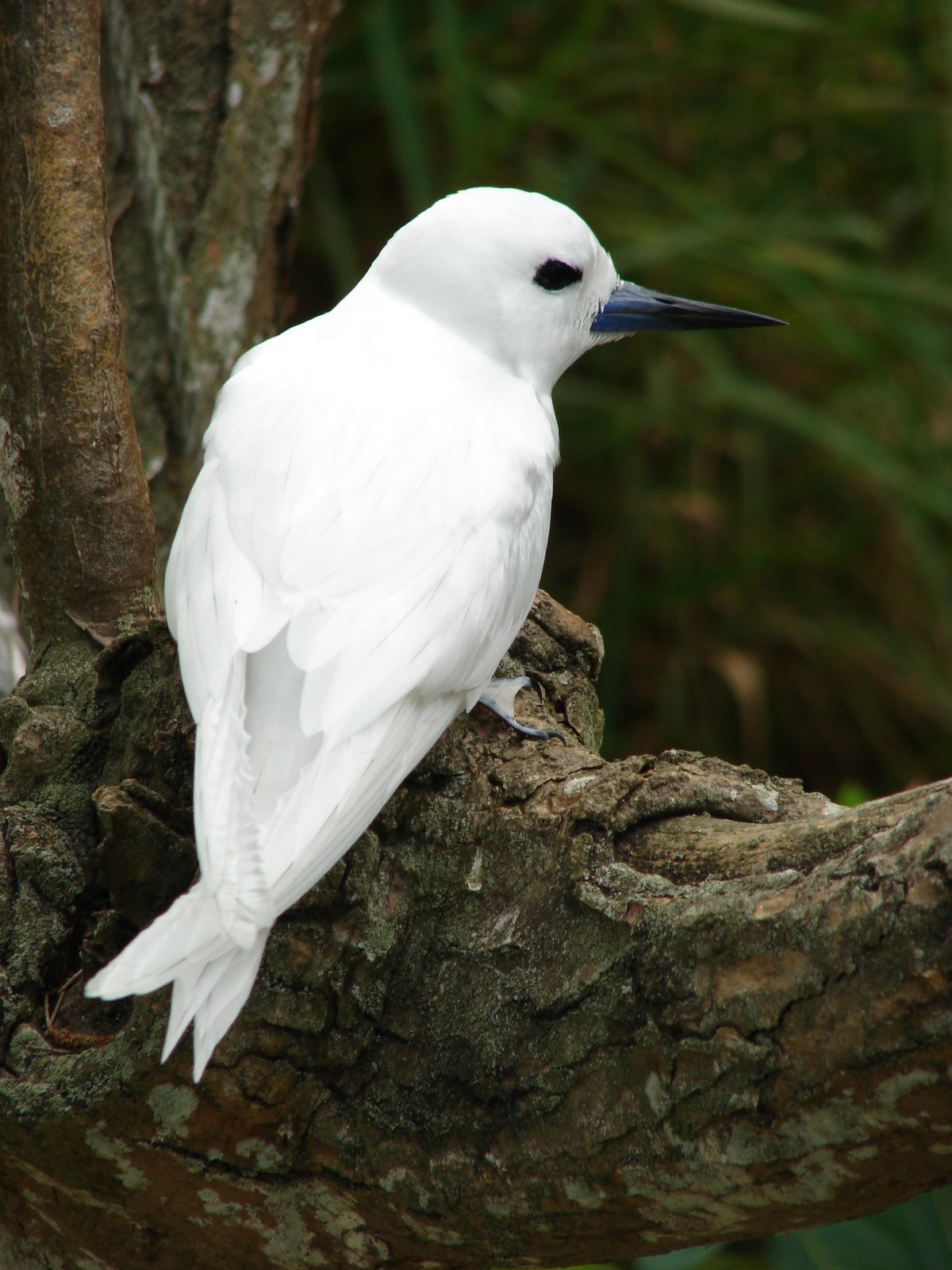
The Blue-billed White Tern is a small, all-white tern of tropical ocean islands, with large black eyes and a dark bill with a blue base. In the guide area it occurs only as a very rare vagrant at sea. The species builds no nest: its single egg is laid on a bare branch or ledge.
Voice
Rasping, buzzing calls, roughly hech-hech, mainly at the breeding site; usually silent at sea.
No recording with a suitable Creative Commons licence is available for this species yet.
Identification
28–33 cm, with broad, rounded wings and a slightly forked tail. The entire plumage is white; the wings are translucent against the light. A narrow black ring around the large black eye makes the eye look even larger. The bill is black with a distinctly blue base, slightly upturned. The legs are bluish grey with pale webs. The sexes are alike. Juveniles have brown spotting and barring on the back and wings and a dark spot behind the eye. The flight is light and fluttering.
Confusion species
No other tern in the guide area is entirely white. Tropicbirds (Phaethon) are larger, with a red or yellow bill, black markings on the head and wings and long central tail feathers. White terns with a black cap, such as Common Tern Sterna hirundo, have a grey back and a black cap.
Habitat
Open tropical ocean and islands with trees, shrubs or rocks. It takes small fish and squid, picked from the surface or caught in a short plunge, often with other seabirds over shoals of predatory fish. The egg is laid without a nest in the fork of a branch, on a ledge or on a rock.
Where the bird is most at home, classified by the vegetation units of the Andes and the west coast.

Range and movements
In the guide area only a very rare vagrant at sea off the Pacific coast; there are only a few records. Absent from Bolivia. Outside the guide area it breeds on tropical islands in the Pacific and Indian Oceans.
How and when to look
Expected only exceptionally on trips at sea far off the Pacific coast; watch for a small white tern with fluttering flight.
Conservation status
Least Concern. On some islands introduced rats and cats threaten the breeding birds.
Scientific name
Gygis candida | (Gmelin, 1789) (GBIF: Gygis alba)
Gmelin described the species in 1789 as Sterna Candida; because it was later moved to another genus, the author and year stand in brackets. The genus Gygis was introduced in 1832 by Wagler. The genus name comes from Greek gugēs, a mythical water bird mentioned by Dionysius. The species name is Latin candidus, 'shining white', after the white plumage. The specimen the first description was based on came from Kiritimati (Christmas Island), Kiribati.