All species › Waders, gulls and terns › Skimmers, noddies, terns and gulls › Forster's Tern
Forster's Tern | Sterna forsteri
Forsters stern | Charrán de Forster | Trinta-réis-de-forster
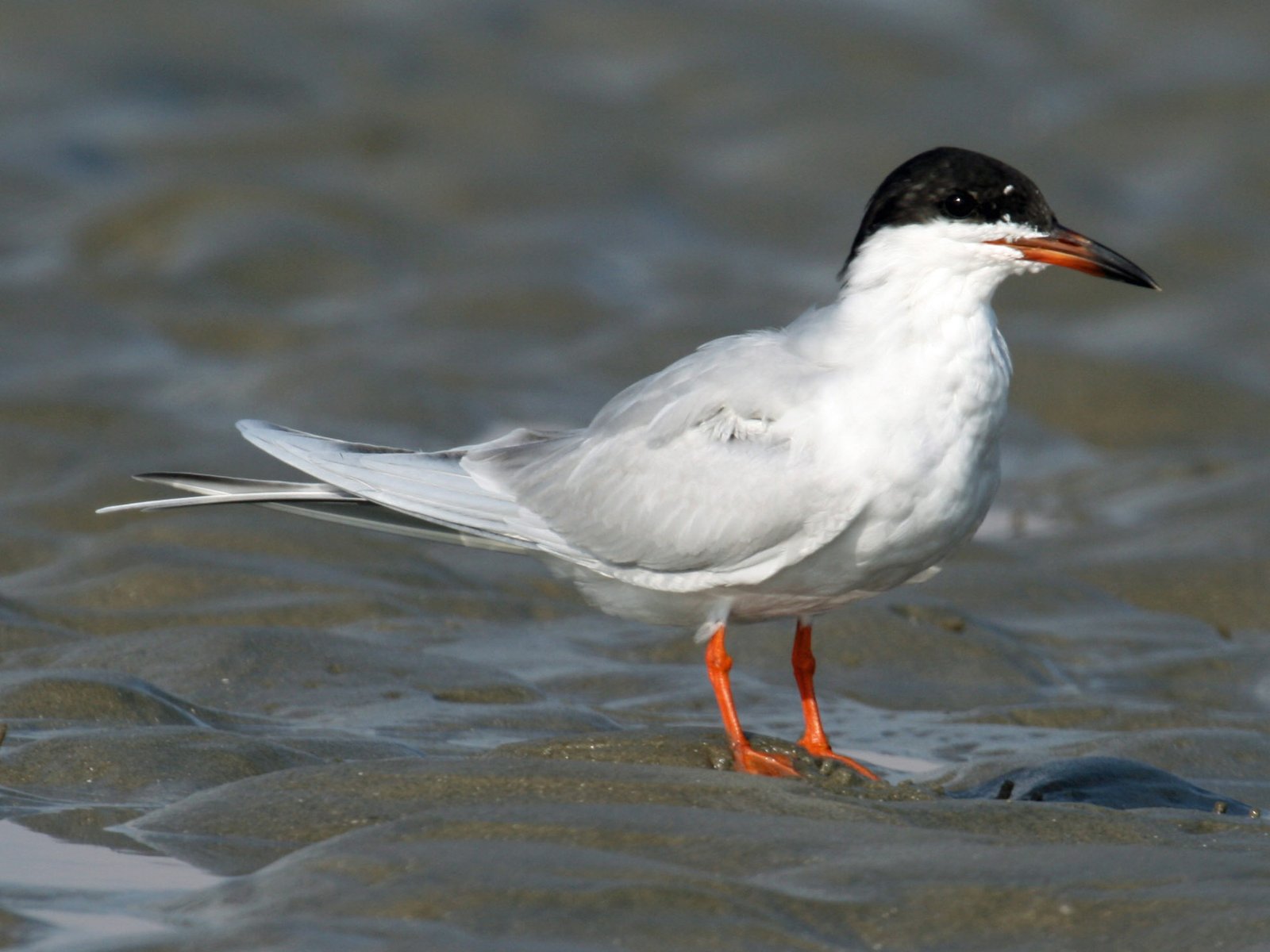
Forster's Tern is a medium-sized tern of marshes and coastal waters in North America, wintering from the United States to Central America. In the guide area it is a very rare vagrant, with only a few records. In non-breeding plumage it is recognised by a well-defined black eye mask on an otherwise white head.
Voice
A low, hoarse kyerr, harsher and lower than in Common Tern, and a short kit.
Recording: Valerie Heemstra — CC BY-NC-SA 4.0 · xeno-canto
Identification
33–36 cm, with a fairly long tail with long grey outer tail feathers, and long legs. In non-breeding plumage the head is white with a well-defined black mask around and behind the eye, the bill is black and the legs orangish. The upperparts and upperwing are pale grey, the primaries silvery white and paler than the back; the underparts are white. In breeding plumage it has a fully black cap and an orange bill with a black tip. Juveniles have a brownish-tinged crown and mantle and a dark tail tip. The sexes are alike.
Confusion species
Common Tern Sterna hirundo has in non-breeding plumage a black hindcrown that extends onto the nape, a dark bar along the leading edge of the wing and dark outer primaries. Snowy-crowned Tern Sterna trudeaui has a similar mask but grey underparts and a yellow bill with a black band; in the guide area it occurs only in Peru. Arctic Tern Sterna paradisaea has shorter legs, a smaller bill and in non-breeding plumage a black hindcrown.
Habitat
In winter lagoons, estuaries, salt pans and sheltered coastal waters, also freshwater lakes. It dives from a low height for small fish and also catches insects in flight. It breeds in fresh and salt marshes in North America, with nests on floating vegetation or on piles of plant debris. It does not breed in the guide area.
Where the bird is most at home, classified by the vegetation units of the Andes and the west coast.


Range and movements
A very rare vagrant to the guide area; the few records come from the north of the guide area. Not a regular species in Colombia, Ecuador, Peru, Bolivia or the Galápagos. Breeds in the interior and along the coasts of North America and winters from the United States to Central America and the Caribbean.
How and when to look
A tern with a black eye mask among Common Terns on the coast in the northern winter is worth checking; note the silvery white primaries, the well-defined mask and the long legs. Document any record with photographs.
Conservation status
Least Concern. The North American population is fairly stable; the species depends on marshes, which are disappearing locally.
Scientific name
Sterna forsteri | Nuttall, 1834
Nuttall described the species in 1834 and placed it straight away in the genus where it still stands. The genus Sterna was introduced in 1758 by Linnaeus. The genus name comes from Old English stearn, a word for a tern; the Frisians had a similar word. The species name honours Johann Reinhold Forster (1729–1798), German naturalist who first suggested that this tern differs from the Common Tern. The specimen the first description was based on came from Saskatchewan River between Cumberland House and Lake Winnipeg, Canada.