All species › Swifts › Hummingbirds › Andean Hillstar
Andean Hillstar | Oreotrochilus estella
Estellabergnimf | Estrella andina | Estrela-andina
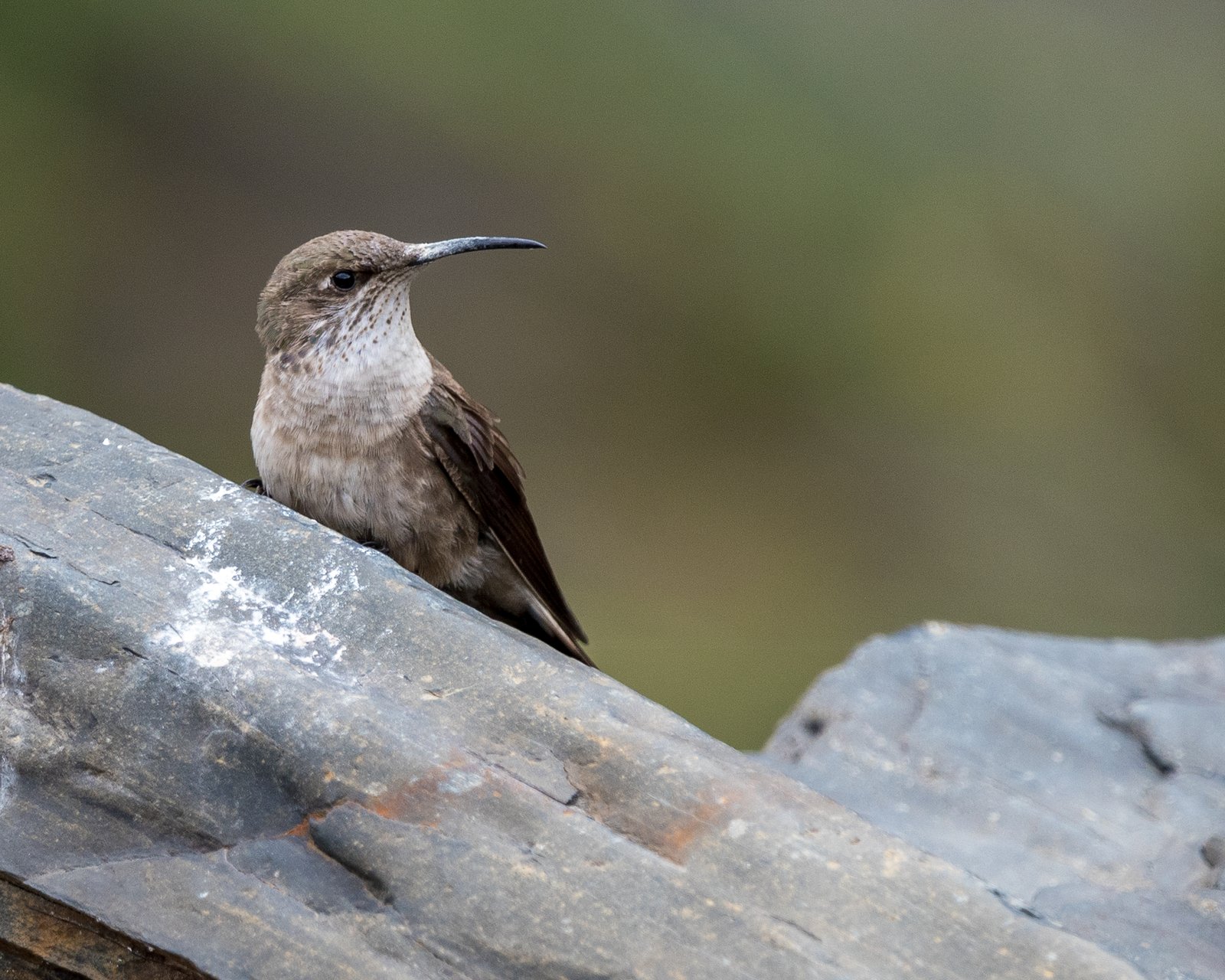
The Andean Hillstar is a sturdy hummingbird of the high plateaus of the southern Andes, where it freezes almost every night. It survives the cold nights by entering a deep torpor in which its body temperature drops sharply. Unlike most hummingbirds it often clings to a flower rather than hovering in front of it.
Voice
A high, sharp tseet and a dry twitter, especially in chases.
Recording: Dan Lane — CC BY-NC-SA 4.0 · xeno-canto
Identification
12–14 cm, with a short, slightly decurved black bill and strong feet. The male is greyish brown to olive-grey above, with a glittering emerald-green throat bordered below by a narrow black band. The underparts are white, with a dark chestnut stripe down the centre of the belly. The tail is largely white, with dark outer edges and greenish central feathers. The female is greyish brown above and dingy white below, with a finely spotted throat; the tail is dark with white corners.
Confusion species
Green-headed Hillstar Oreotrochilus stolzmanni replaces it further north; the male has a greener head and a darker belly stripe. Black-breasted Hillstar Oreotrochilus melanogaster of central Peru has a black breast and belly. Wedge-tailed Hillstar Oreotrochilus adela of Bolivia has a chestnut belly and a wedge-shaped tail. Females of these species are very similar; range is the best guide.
Habitat
Puna grassland, rocky slopes and ravines, Polylepis groves, the edges of bofedales and shrubby slopes with flowering plants, roughly between 3500 and 4500 m, locally lower. It visits mainly low flowering shrubs and herbs, such as Chuquiraga, and catches small insects. It roosts and nests in shelter under rock overhangs, in caves or in buildings; the nest is attached to a rock face.
Where the bird is most at home, classified by the vegetation units of the Andes and the west coast.


Range and movements
In Peru in the highlands of the south. In Bolivia in the Andes of the west of the country, on the altiplano and the high slopes around it. Absent from Colombia, Ecuador and the Galápagos. Outside the guide area in northern Chile and north-western Argentina.
- Resident
- dark = core range, pale = thinly spread
How and when to look
At flowering shrubs on rocky slopes and in ravines high on the puna, early in the morning when the birds become active after the cold night. It often perches on a boulder or low in a shrub.
Conservation status
Least Concern. Its habitat is extensive and little affected, although grazing and firewood collection can locally make flowering shrubs scarce.
Scientific name
Oreotrochilus estella | (d'Orbigny, ACVMD, 1838)
D'Orbigny, ACVMD described the species in 1838 as Trochilus Estella; because it was later moved to another genus, the author and year stand in brackets. The genus Oreotrochilus was introduced in 1847 by Gould. The genus name combines Greek oros, 'mountain', with the hummingbird genus Trochilus. The species name honours Estelle-Marie Dessalines d'Orbigny (1800–1893), elder sister of the French zoologist Alcide d'Orbigny. The specimen the first description was based on came from La Paz and Potosí, Bolivia.