All species › Swifts › Hummingbirds › White-sided Hillstar
White-sided Hillstar | Oreotrochilus leucopleurus
Witflankbergnimf | Picaflor cordillerano | Estrela-de-flanco-branco
The White-sided Hillstar is a hillstar of the southern Andes that occurs in the guide area only in the far south of Bolivia. The core of its range lies in Chile and Argentina. Like its relatives it often clings to flowers and survives cold nights in a deep torpor.
Voice
A high, sharp tseet and a dry twitter in chases.
Recording: Cristian Pinto — CC BY-NC-SA 4.0 · xeno-canto
Identification
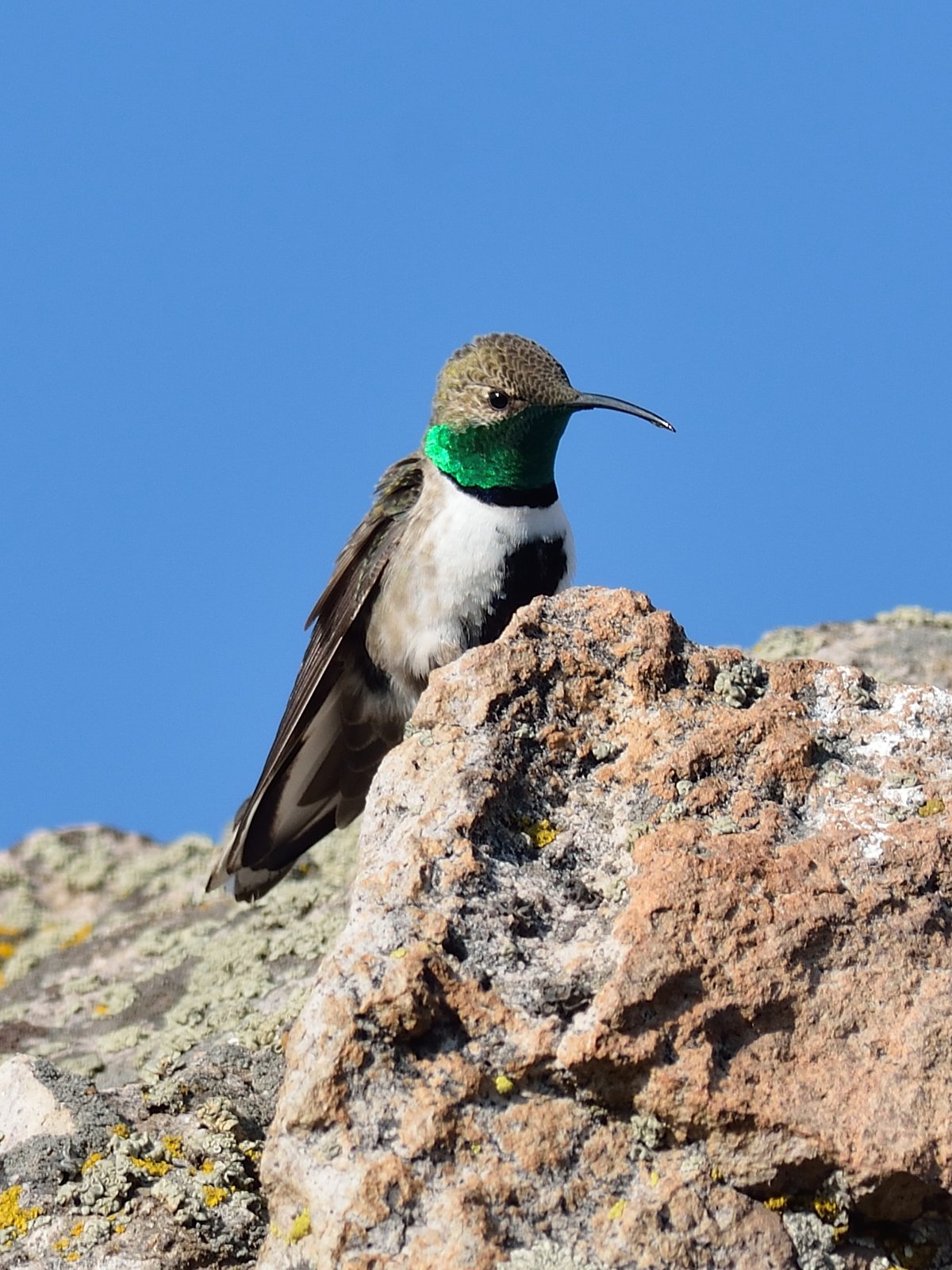
12–13 cm, with a short, slightly decurved black bill. The male is greyish brown to olive-green above, with a glittering green throat bordered below by a narrow black band. A broad dark blue to blue-black stripe runs down the centre of the breast and belly; the flanks are white. The tail is largely white, with dark central feathers and outer edges. The female is greyish brown above and dingy white below, with a spotted throat and white corners to the dark tail.
Confusion species
Andean Hillstar Oreotrochilus estella has a chestnut rather than a blue-black belly stripe. Wedge-tailed Hillstar Oreotrochilus adela has a chestnut belly and a dark, wedge-shaped tail. Females of these hillstars are very similar; note range and tail pattern.
Habitat
Dry, rocky slopes, ravines and high valleys with shrubs and cacti, and open grassland in the high mountains, in the breeding season mainly above 2500 m and lower in winter. It visits flowering shrubs, herbs and cacti and catches small insects. The nest is attached to a rock face, under an overhang or in a ravine.
Where the bird is most at home, classified by the vegetation units of the Andes and the west coast.


Range and movements
In Bolivia only in the far south, in the highlands near the border with Argentina. Absent from Colombia, Ecuador, Peru and the Galápagos. Outside the guide area in the Andes of Chile and Argentina, south into Patagonia.
- Resident
- dark = core range, pale = thinly spread
How and when to look
In southern Bolivia in dry valleys and on rocky slopes with flowering shrubs; in the austral winter more often at lower elevations.
Conservation status
Least Concern. The species has a large range outside the guide area, and no major threats are known.
Scientific name
Oreotrochilus leucopleurus | Gould, 1847
Gould described the species in 1847 and placed it straight away in the genus where it still stands. He introduced the genus Oreotrochilus in that same work. The genus name combines Greek oros, 'mountain', with the hummingbird genus Trochilus. The species name combines Greek leukos, 'white', with pleura, 'side'. The specimen the first description was based on came from Andes, Chile.