All species › Swifts › Hummingbirds › Wedge-tailed Hillstar
Wedge-tailed Hillstar | Oreotrochilus adela
Wigstaartbergnimf | Colibrí de Cochabamba | Estrela-de-cauda-cunha
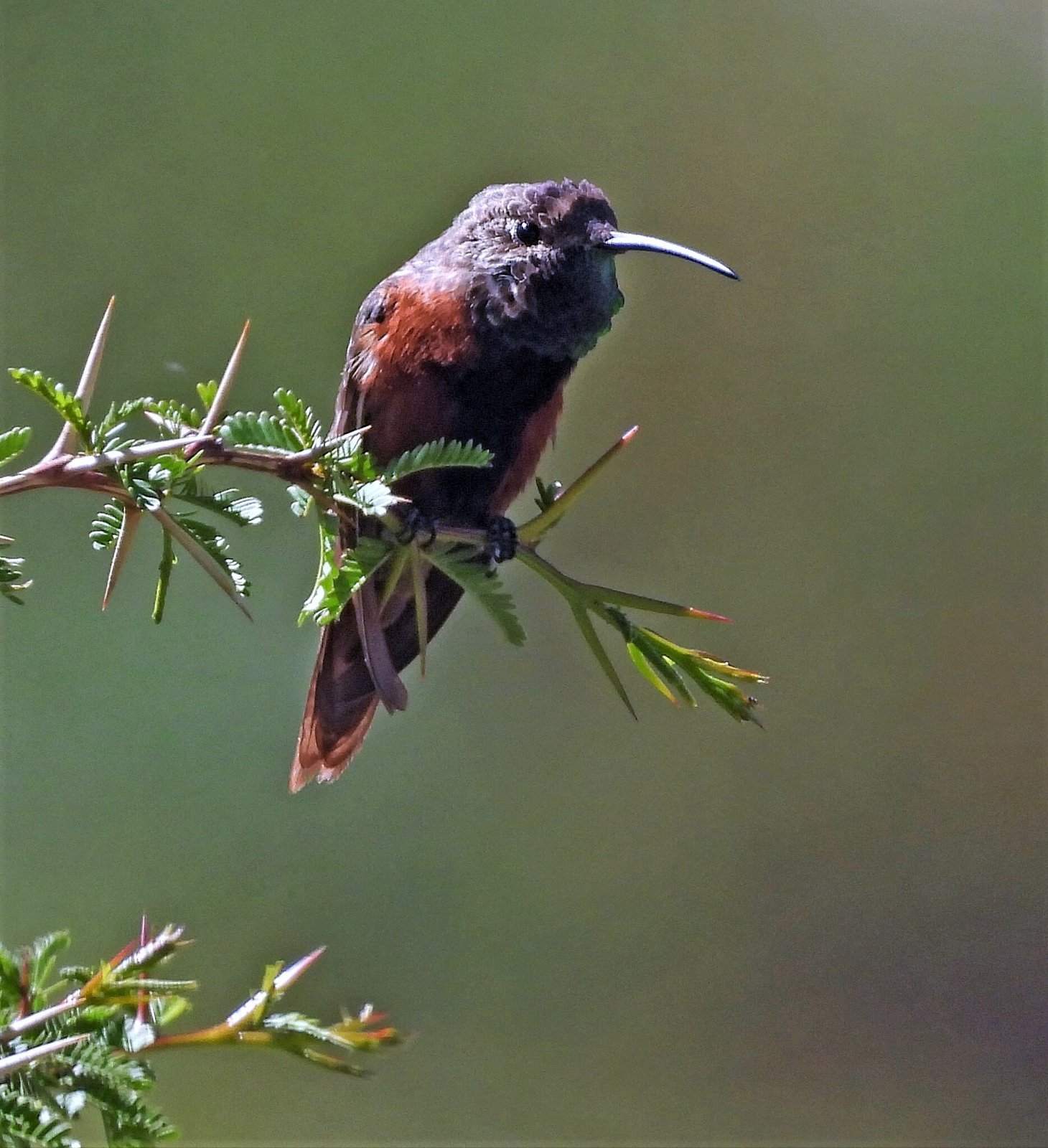
The Wedge-tailed Hillstar lives in the dry valleys and on the slopes of the Andes of Bolivia, with a small extension into the far north-west of Argentina. The male differs from the other hillstars in its chestnut belly and dark, wedge-shaped tail. The Spanish name refers to Cochabamba, where the species occurs.
Voice
A high, sharp tseet and a dry twitter in chases.
Recording: Andrew Spencer — CC BY-NC-SA 3.0 · xeno-canto
Identification
12–13 cm, with a short, slightly decurved black bill. The male is olive-brown above, with a glittering green throat bordered below by a narrow black band. The breast is white, the belly largely chestnut with a dark stripe down the centre. The tail is dark; the central feathers are the longest, giving the tail a wedge shape. The female is greyish brown above and pale brown to cinnamon below, with a spotted throat.
Confusion species
Andean Hillstar Oreotrochilus estella has white underparts with a narrow chestnut belly stripe and a largely white tail. White-sided Hillstar Oreotrochilus leucopleurus has white flanks, a blue-black belly stripe and a white tail. Giant Hummingbird Patagona gigas also has a brownish belly, but is much larger, with a longer bill and a slow, gliding flight.
Habitat
Dry, rocky slopes and valleys with shrubs, cacti and small Polylepis groves, also field edges and the surroundings of villages, roughly between 2500 and 4000 m. It visits flowering shrubs, herbs and cacti and catches small insects. The nest is attached in shelter under a rock overhang, against the wall of a ravine or to a building.
Where the bird is most at home, classified by the vegetation units of the Andes and the west coast.


Range and movements
In Bolivia in the Andes of the centre and south, among others in Cochabamba, Chuquisaca, Potosí and Tarija. Absent from Colombia, Ecuador, Peru and the Galápagos. Outside the guide area only in the far north-west of Argentina.
- Resident
- dark = core range, pale = thinly spread
How and when to look
In the dry valleys in and south of the department of Cochabamba, at flowering shrubs and cacti on rocky slopes; outside the breeding season more often in lower valleys.
Conservation status
Least Concern. Its range is limited; grazing and the cutting of shrubs and Polylepis groves for firewood locally affect its habitat.
Scientific name
Oreotrochilus adela | (d'Orbigny, ACVMD, 1839)
D'Orbigny, ACVMD described the species in 1839 as Trochilus Adela; because it was later moved to another genus, the author and year stand in brackets. The genus Oreotrochilus was introduced in 1847 by Gould. The genus name combines Greek oros, 'mountain', with the hummingbird genus Trochilus. The species name probably refers to Adelaide, mother-in-law of the French zoologist Alcide d'Orbigny; a derivation from Greek adēlos, 'obscure', has also been suggested. The specimen the first description was based on came from Chuquisaca, Bolivia.