All species › Swifts › Hummingbirds › Bronze-tailed Comet
Bronze-tailed Comet | Polyonymus caroli
Bronsstaartkomeetkolibrie | Colibrí colibronce | Cometa-de-cauda-bronzeada
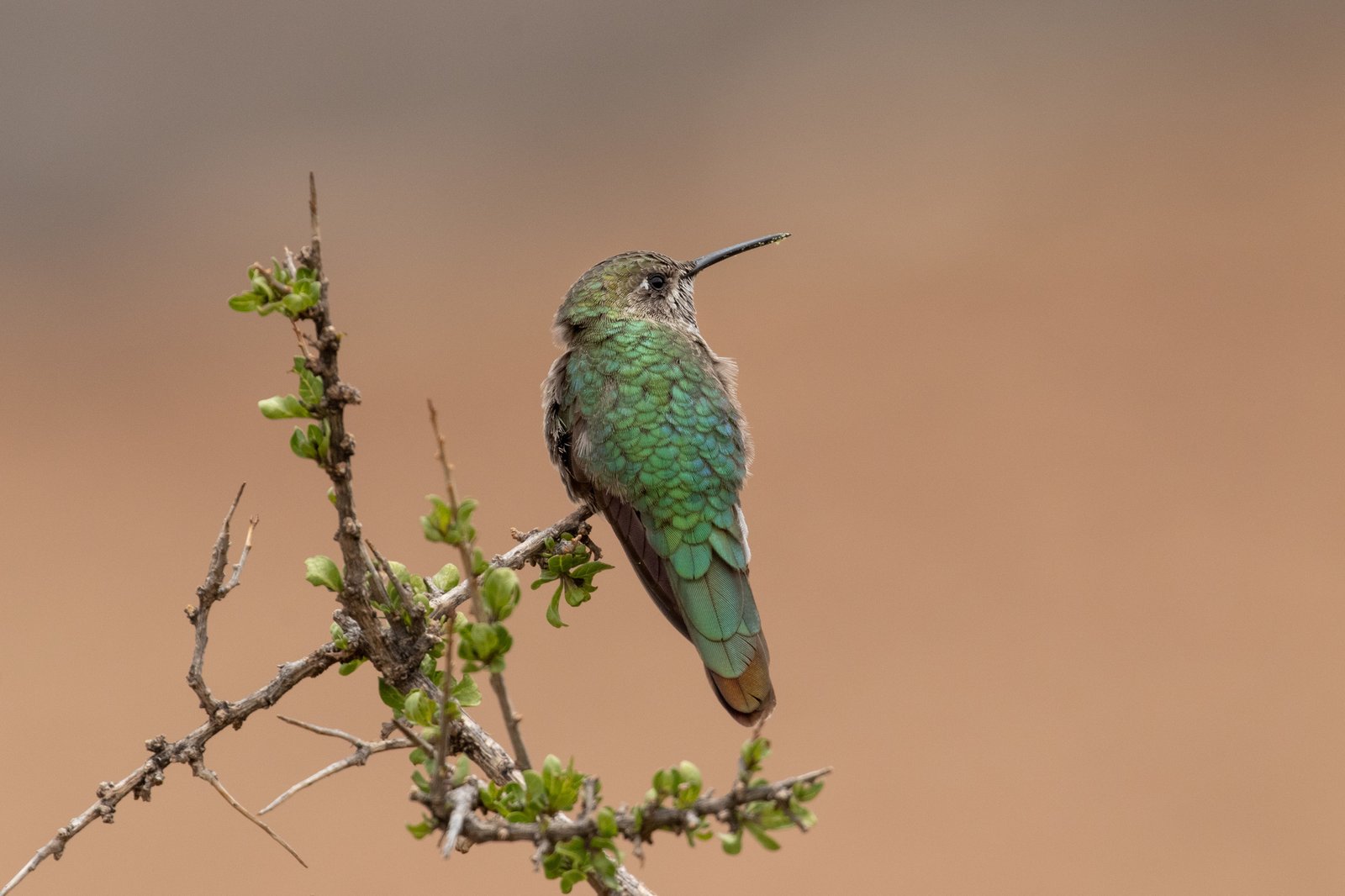
The Bronze-tailed Comet lives only in Peru, in the dry valleys and on the western slopes of the Andes. The male has a long, forked, bronze-coloured tail and a glittering rose-red throat. It is the only species in its genus.
Voice
A high, dry tsit and a rapid, high twitter.
Recording: Daniel Lane — CC BY-NC-SA 3.0 · xeno-canto
Identification
11–13 cm including the forked tail, with a short, straight black bill. The male is bronzy green above and greenish below, with a glittering rose-red gorget. The tail is deeply forked and glossed coppery bronze. The female has a shorter tail, paler, brownish underparts and at most a small coloured throat patch.
Confusion species
Red-tailed Comet Sappho sparganurus of southern Peru has a much longer, red-gold tail. Grey-bellied Comet Taphrolesbia griseiventris is larger, with grey underparts and a long, deeply forked tail, and is very local. The trainbearers of the genus Lesbia have a very long, narrow tail with crossing feathers. Bearded Mountaineer Oreonympha nobilis is larger, with white underparts and a white tail with a dark centre.
Habitat
Dry, shrubby slopes and valleys, cactus scrub, groves along streams, field edges and gardens, roughly between 1500 and 3800 m. It visits flowering shrubs, herbs and cacti and catches insects in flight. Little has been published on the nest.
Where the bird is most at home, classified by the vegetation units of the Andes and the west coast.


Range and movements
In Peru on the western slope of the Andes and in the dry inter-Andean valleys, from the north to the south of the country. Absent from Colombia, Ecuador, Bolivia and the Galápagos. Does not occur outside the guide area.
- Resident
- dark = core range, pale = thinly spread
How and when to look
In dry, shrubby valleys on the western side of the Andes and in the inter-Andean valleys, where males guard flowering shrubs from a regular perch.
Conservation status
Least Concern. The species also occurs in human-modified landscapes with shrubs, hedges and gardens.
Scientific name
Polyonymus caroli | (Bourcier, 1847)
Bourcier described the species in 1847 as Trochilus Caroli; because it was later moved to another genus, the author and year stand in brackets. The genus Polyonymus was introduced in 1863 by Heine. The genus name comes from Greek poluōnumos, 'having many names'. The specific name is the Latin genitive of Carolus, 'of Charles', and honours Charles Lucien Bonaparte (1803–1857), French ornithologist. The specimen the first description was based on came from (per the description).