All species › Swifts › Hummingbirds › Mountain Avocetbill
Mountain Avocetbill | Opisthoprora euryptera
Wipsnavelkolibrie | Colibrí piquiavoceta | Bico-de-avoceta-da-montanha
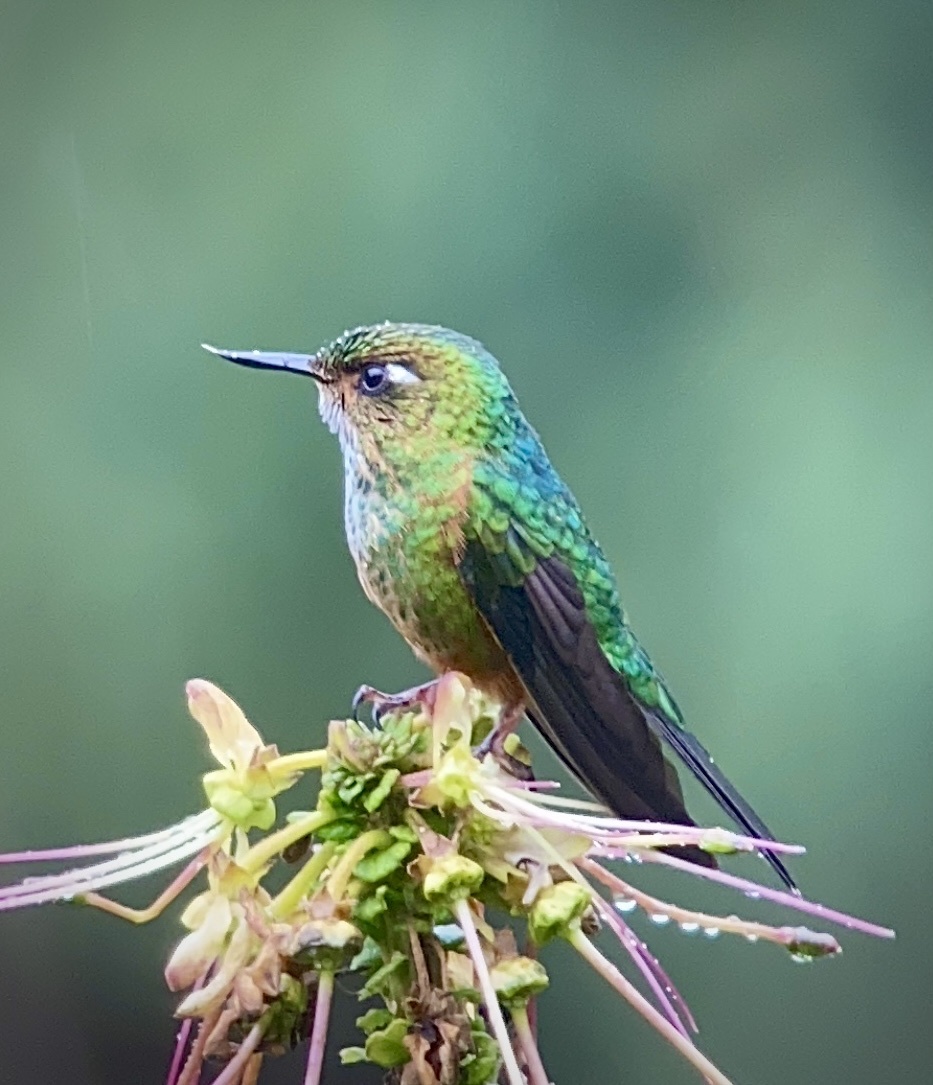
The Mountain Avocetbill owes its name to the short bill with an upturned tip, a shape not found in any other hummingbird of the Andean forest. It lives in high cloud forest and at the treeline of the Andes from Colombia to northern Peru. The bird is inconspicuous and often feeds low in the vegetation.
Voice
Little described; short, high tsit calls.
Recording: Niels Krabbe — CC BY-NC-SA 3.0 · xeno-canto
Identification
10–11 cm, with a short black bill whose tip clearly curves upwards. Green to bronzy green above, with a small white spot behind the eye. The underparts are white, densely streaked green, most heavily on the throat and breast. The tail is fairly long and blue-black, with white tips to the outer feathers. The sexes are alike.
Confusion species
Thornbills of the genera Ramphomicron and Chalcostigma also have a short bill, but it is straight, and the underparts are not white with green streaks. The female Tyrian Metaltail Metallura tyrianthina has a straight bill, a cinnamon throat and a rufous tail. Pufflegs of the genus Eriocnemis have a straight bill and white or coloured leg puffs.
Habitat
High cloud forest, elfin forest and shrubbery at the treeline, and the transition to páramo, roughly between 2500 and 3600 m. It feeds low to mid-level at flowers and catches small insects. Little is known about the nest.
Where the bird is most at home, classified by the vegetation units of the Andes and the west coast.


Range and movements
In Colombia in the Andes, mainly in the Central Andes and the south of the country. In Ecuador on both slopes of the Andes. In Peru only in the far north. Absent from Bolivia and the Galápagos. Does not occur outside the guide area.
- Resident
- dark = core range, pale = thinly spread
How and when to look
Along forest edges and clearings in high montane forest in Ecuador and Colombia; the bird often perches low and quietly and is most often seen at flowering shrubs.
Conservation status
Least Concern, but locally scarce. Clearing of high montane forest for pasture and fields affects its habitat.
Scientific name
Opisthoprora euryptera | (Loddiges, 1832)
Loddiges described the species in 1832 as Trochilus eurypterus; because it was later moved to another genus, the author and year stand in brackets. The genus Opisthoprora was introduced in 1860 by Cabanis & Heine. The genus name combines Greek opisthen, 'backwards', with prōira, 'prow', after the upturned bill tip. The species name combines Greek eurus, 'broad', with pteron, 'wing'. The specimen the first description was based on came from Popayán, Colombia.