All species › Swifts › Hummingbirds › Perija Metaltail
Perija Metaltail | Metallura iracunda
Perijáglansstaartkolibrie | Metalura de Perijá | Metalura-de-perijá
The Perija Metaltail lives only in the highest parts of the Serranía de Perijá, the border range between Colombia and Venezuela. For a long time little was known about the species; only in this century has it been studied more closely in the field. The species name iracunda means 'the wrathful one'.
Voice
Little described; short, high tsit calls, as in related metaltails.
Recording: Hernán Arias — CC BY-NC-SA 4.0 · xeno-canto
Identification
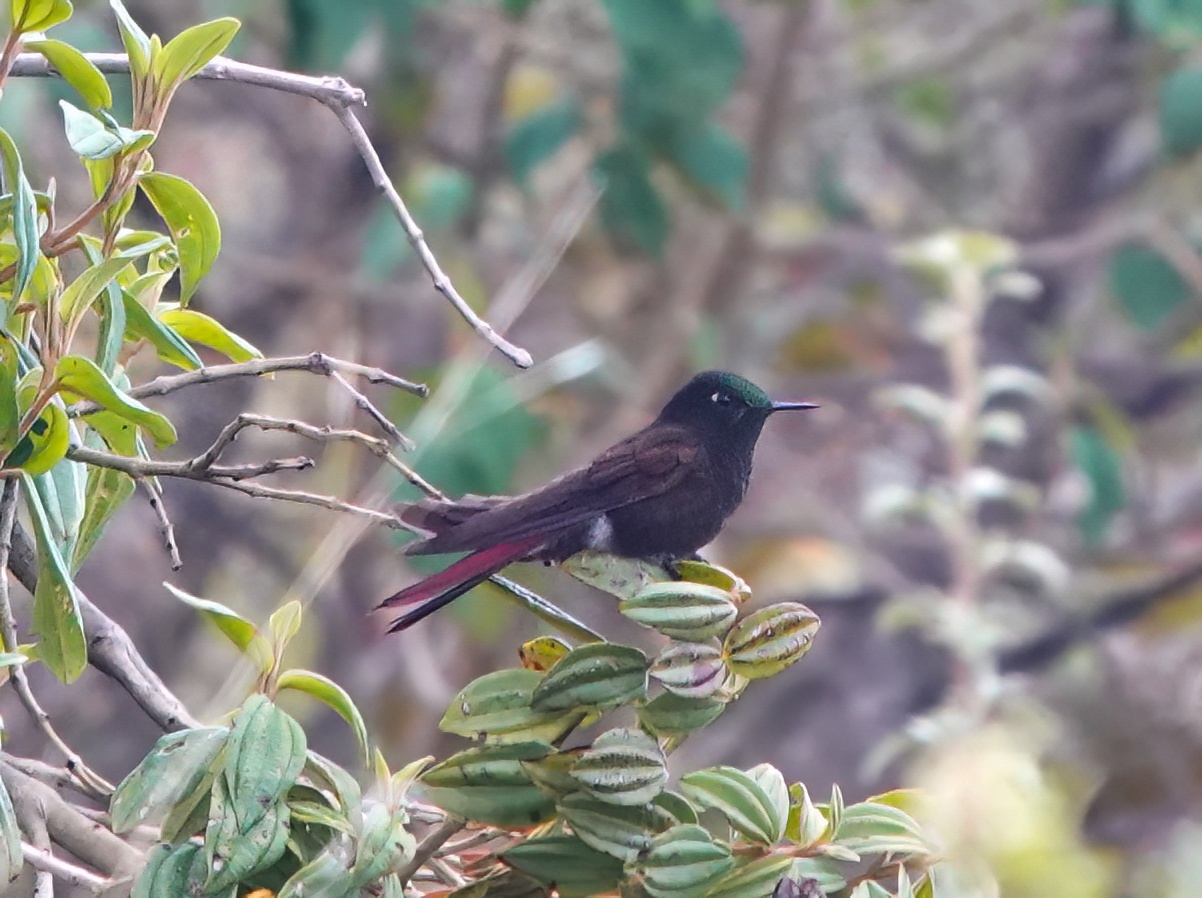
10–11 cm, with a short, straight black bill. The male is very dark green, almost black, with a glittering green throat patch and a tail glossed dark wine-red to purple-red above. The female is duller, with a smaller throat patch and paler, spotted underparts.
Confusion species
Tyrian Metaltail Metallura tyrianthina is brighter green, with a coppery red tail; the female has a cinnamon throat. Perija Starfrontlet Coeligena consita lives in the same range, but is larger, with a long, straight bill.
Habitat
Páramo, shrubbery and elfin forest at the treeline, roughly between 2800 and 3500 m. It visits the flowers of low shrubs and herbs and catches small insects. Little is known about the nest.
Where the bird is most at home, classified by the vegetation units of the Andes and the west coast.


Range and movements
In Colombia only in the Serranía de Perijá, on the border of the departments of Cesar and La Guajira. Absent from Ecuador, Peru, Bolivia and the Galápagos. Outside the guide area on the Venezuelan side of the same range.
- Resident
- dark = core range, pale = thinly spread
How and when to look
The Chamicero de Perijá reserve above Manaure in Cesar protects part of the high forest and páramo of the Serranía de Perijá. Look at flowering shrubs at the treeline.
Conservation status
Near Threatened. Its range is very small; fires, grazing and the conversion of forest and páramo to farmland threaten its habitat, which is only partly protected.
Scientific name
Metallura iracunda | Wetmore, 1946
Wetmore described the species in 1946 and placed it straight away in the genus where it still stands. The genus Metallura was introduced in 1847 by Gould. The genus name combines Latin metallum, 'metal', with Greek oura, 'tail', after the metallic tail. The species name is Latin iracundus, 'irascible, wrathful'; it is not clear why this name was chosen. The specimen the first description was based on came from Serranía del Perijá, Colombia.