All species › Swifts › Hummingbirds › Tyrian Metaltail
Tyrian Metaltail | Metallura tyrianthina
Smaragdglansstaartkolibrie | Metalura tiria | Metalura-tíria
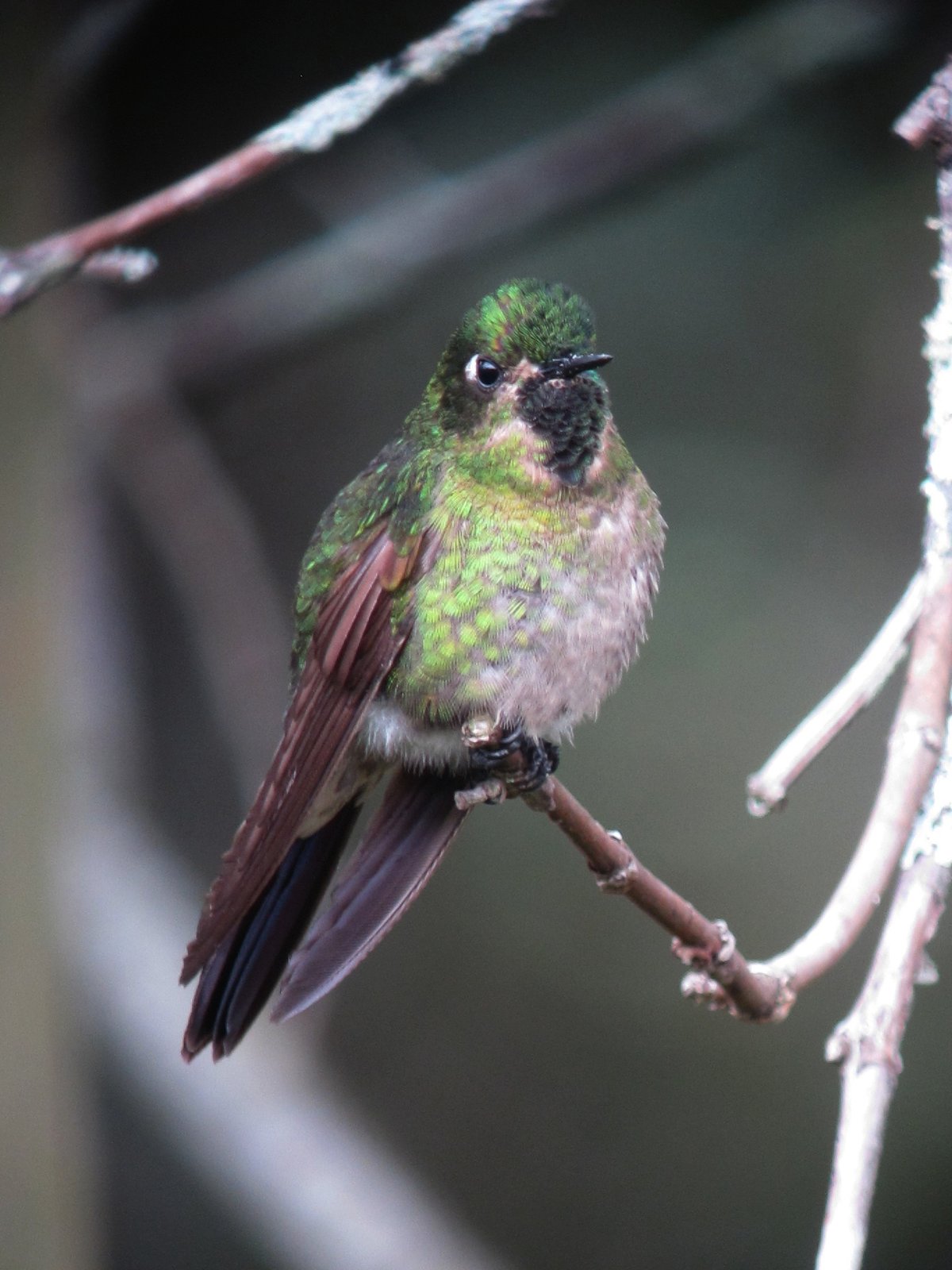
The Tyrian Metaltail is one of the most numerous hummingbirds of the high montane forest of the Andes, from Venezuela to Bolivia. It is small, with a short bill and a reddish-glossed tail. Across its large range the subspecies differ mainly in the hue of the tail.
Voice
A high, dry tsit or tsik, often in series, and a rapid twitter in chases.
Recording: Mauricio Cuellar Ramirez (@Birding.travel) — CC BY-NC-SA 4.0 · xeno-canto
Identification
9–10 cm, with a short, straight black bill. The male is glossy green, with a glittering green throat and a tail glossed coppery red to purple-red; in some subspecies the tail is more violet. The female is green above, with a cinnamon throat and breast and a paler belly spotted green; the tail is as in the male, with buffy tips.
Confusion species
Viridian Metaltail Metallura williami of Colombia and Ecuador is darker green, with a blue-green tail, and lives mainly higher. Scaled Metaltail Metallura aeneocauda of southern Peru and Bolivia is larger, with scaly underparts and a bronzy green tail. Coppery Metaltail Metallura theresiae of northern and central Peru is largely copper-coloured. Black Metaltail Metallura phoebe of western Peru is blackish. Mountain Avocetbill Opisthoprora euryptera has an upturned bill tip and white underparts streaked green.
Habitat
Cloud forest, elfin forest, forest edges, shrubbery and the transition to páramo and puna, also hedges and gardens, roughly between 1800 and 4000 m, mainly between 2500 and 3500 m. It visits small flowers in the lower and middle strata and catches small insects. The nest is a cup of moss, often sheltered against a steep bank or rock.
Where the bird is most at home, classified by the vegetation units of the Andes and the west coast.


Range and movements
In Colombia in the Andes and in the Sierra Nevada de Santa Marta. In Ecuador on both slopes of the Andes and in the inter-Andean valleys. In Peru throughout the Andes. In Bolivia in the Andes of the west. Absent from the Galápagos. Outside the guide area in the Andes and coastal mountains of Venezuela.
- Resident
- dark = core range, pale = thinly spread
How and when to look
Along forest edges and in shrubbery in high montane forest, for example along the roads over the Andean passes in Ecuador; males and females often feed low at flowering shrubs.
Conservation status
Least Concern. The species is widespread and tolerates some degradation of the forest, as long as shrubs and forest edges remain.
Scientific name
Metallura tyrianthina | (Loddiges, 1832)
Loddiges described the species in 1832 as Trochilus tyrianthinus; because it was later moved to another genus, the author and year stand in brackets. The genus Metallura was introduced in 1847 by Gould. The genus name combines Latin metallum, 'metal', with Greek oura, 'tail', after the metallic tail. The species name is Latin tyrianthinus, 'Tyrian purple' or 'violet', after the colour of the tail. The specimen the first description was based on came from Popayán, Colombia.