All species › Swifts › Hummingbirds › Viridian Metaltail
Viridian Metaltail | Metallura williami
Williams glansstaartkolibrie | Metalura verde | Metalura-verde
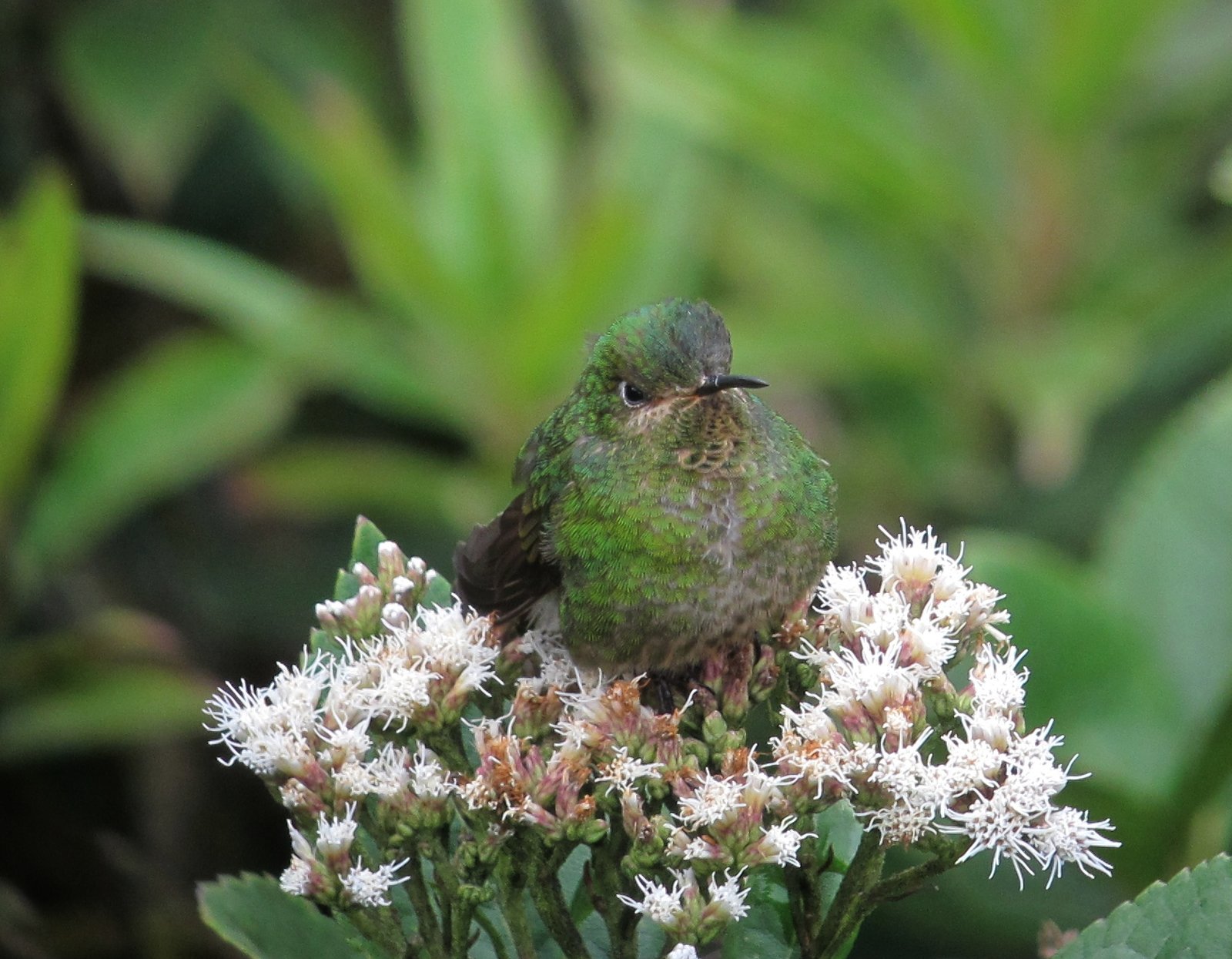
The Viridian Metaltail is a dark green hummingbird of the treeline and shrubby páramo in Colombia and Ecuador. It is slightly larger than the Tyrian Metaltail, with which it often occurs. The four subspecies differ mainly in the colour of the tail and throat.
Voice
A descending series of three to five squeaky notes, often followed by a jumbled, dry, buzzy trill. Also repeated dry, buzzy or gravelly calls.
Recording: John V. Moore — CC BY-NC-SA 4.0 · xeno-canto
Identification
11–12 cm, with a short, straight black bill. The male is bottle-green above and below, with a glittering green gorget. The slightly forked tail is purplish blue in the nominate form; in birds of southern Colombia and northern and central Ecuador it is reddish black above and shining green below. In the subspecies of southern Ecuador the green gorget has a black centre. The female is green above and mottled green and white below, with whitish tips to the outer tail feathers.
Confusion species
Tyrian Metaltail Metallura tyrianthina is smaller, with a shorter bill and, in Colombia and Ecuador, a coppery-red tail; the female has a rufous throat. Violet-throated Metaltail Metallura baroni has a purple-violet gorget and lives only in the Cajas area of Ecuador. Glowing Puffleg Eriocnemis vestita has conspicuous white leg puffs and blue undertail coverts.
Habitat
Shrubby páramo, the shrubby edges of cloud forest and elfin forest and small Polylepis groves, in Ecuador mostly between 2700 and 3600 m, in Colombia up to 4000 m, sometimes lower. It takes nectar at all levels of the vegetation, especially at heaths (Ericaceae) and Melastomataceae; males defend a feeding territory. It also catches small insects.
Where the bird is most at home, classified by the vegetation units of the Andes and the west coast.


Range and movements
In Colombia in the Central Andes, very locally in the Western Andes in Antioquia, and in the south in Nariño. In Ecuador in the Andes from the north to the south, to near the border with Peru. Absent from Peru, Bolivia and the Galápagos. Does not occur outside the guide area.
- Resident
- dark = core range, pale = thinly spread
How and when to look
At flowering shrubs on the Papallacta Pass in Ecuador and in Los Nevados National Park in Colombia. Check the tail colour to separate it from Tyrian Metaltail.
Conservation status
Least Concern. The range is large and partly protected, but much páramo is burned to create cattle pasture.
Scientific name
Metallura williami | (Delattre & Bourcier, 1846)
Delattre & Bourcier described the species in 1846 as Trochilus Williami; because it was later moved to another genus, the author and year stand in brackets. The genus Metallura was introduced in 1847 by Gould. The genus name combines Latin metallum, 'metal', with Greek oura, 'tail', after the metallic tail. The species name honours William Wilson, an amateur living in Paris to whom De Lattre and Bourcier dedicated the species in 1846; he is identified as the American financier William Savory Wilson. The specimen the first description was based on came from near Popayán, Colombia.