All species › Swifts › Hummingbirds › Violet-throated Metaltail
Violet-throated Metaltail | Metallura baroni
Violetkeelglansstaartkolibrie | Metalura gorgivioleta | Metalura-de-garganta-violeta
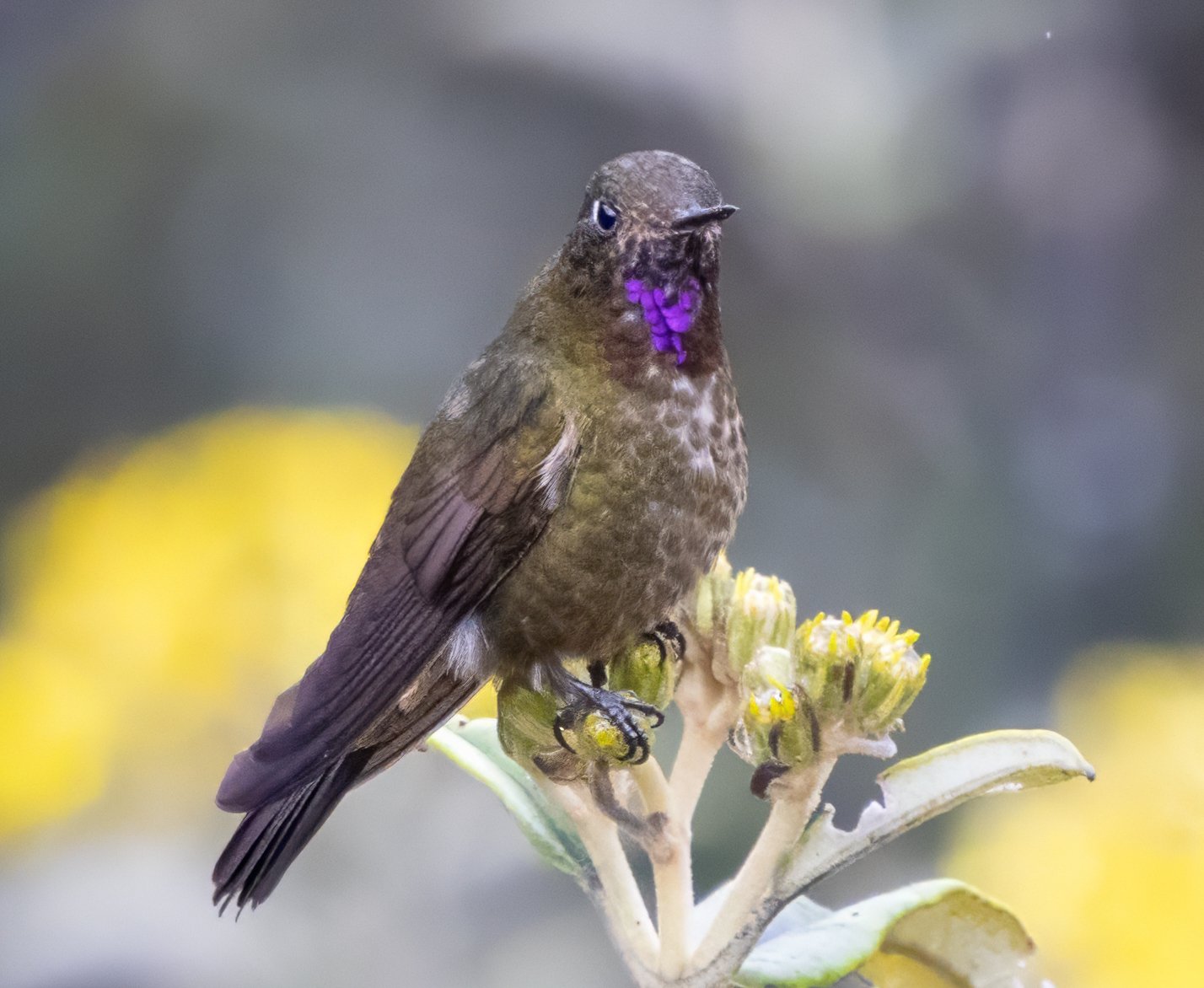
The Violet-throated Metaltail lives only on the Cajas plateau, west of Cuenca in Ecuador. Its entire range covers only a few hundred square kilometres of elfin forest, Polylepis woodland and páramo. The male is the only metaltail in the guide area with a purple-violet throat.
Voice
A descending series of squeaky notes, followed by a few jumbled notes; possibly song or a chase call.
Recording: Mitch Lysinger — CC BY-NC-SA 4.0 · xeno-canto
Identification
10–11 cm, with a short, straight black bill. The male is dark olive-green above and below, with a glittering purple-violet gorget. The slightly forked tail is violaceous sky-blue above and yellow-green below. The female is dark olive-green above, with a duller version of the violet throat and a greyish white breast and belly spotted olive-green; the outer tail feathers have whitish tips below.
Confusion species
Tyrian Metaltail Metallura tyrianthina is smaller, with a green throat and a coppery-red tail, and lives mainly somewhat lower. Viridian Metaltail Metallura williami occurs in the vicinity and has a green throat, with a black centre in birds of southern Ecuador. The male Rainbow-bearded Thornbill Chalcostigma herrani has a narrow, multicoloured beard, a rufous crown and a very short bill.
Habitat
Edges of elfin forest and Polylepis woodland and the adjacent páramo, often near boulders covered with bromeliads, heaths, ferns and mosses, mostly between 3000 and 3900 m. It hovers to take nectar from flowers at all levels of the vegetation; males defend a feeding territory.
Where the bird is most at home, classified by the vegetation units of the Andes and the west coast.


Range and movements
Only in Ecuador, on the Cajas plateau in the provinces of Azuay and Cañar. Absent from Colombia, Peru, Bolivia and the Galápagos. Does not occur outside the guide area.
- Resident
- dark = core range, pale = thinly spread
How and when to look
In Cajas National Park, along the road from Cuenca to the coast, at Polylepis groves and shrubby edges around the lakes. Birds are most active when the sun breaks through the mist.
Conservation status
Vulnerable. The population is estimated at 1000 to 2500 mature individuals and is declining. Burning of páramo to create pasture damages the habitat, also within the national park.
Scientific name
Metallura baroni | Salvin, 1893
Salvin described the species in 1893 and placed it straight away in the genus where it still stands. The genus Metallura was introduced in 1847 by Gould. The genus name combines Latin metallum, 'metal', with Greek oura, 'tail', after the metallic tail. The species name honours Oscar Theodor Baron (1847–1926), a German engineer and collector of birds and insects in Ecuador and Peru. The specimen the first description was based on came from near Cuenca, Azuay, Ecuador.