All species › Passerines › Tityras, becards and allies › Andean Laniisoma
Andean Laniisoma | Laniisoma buckleyi
Andesklauwiercotinga | Lanisoma andina | Chibante-andino
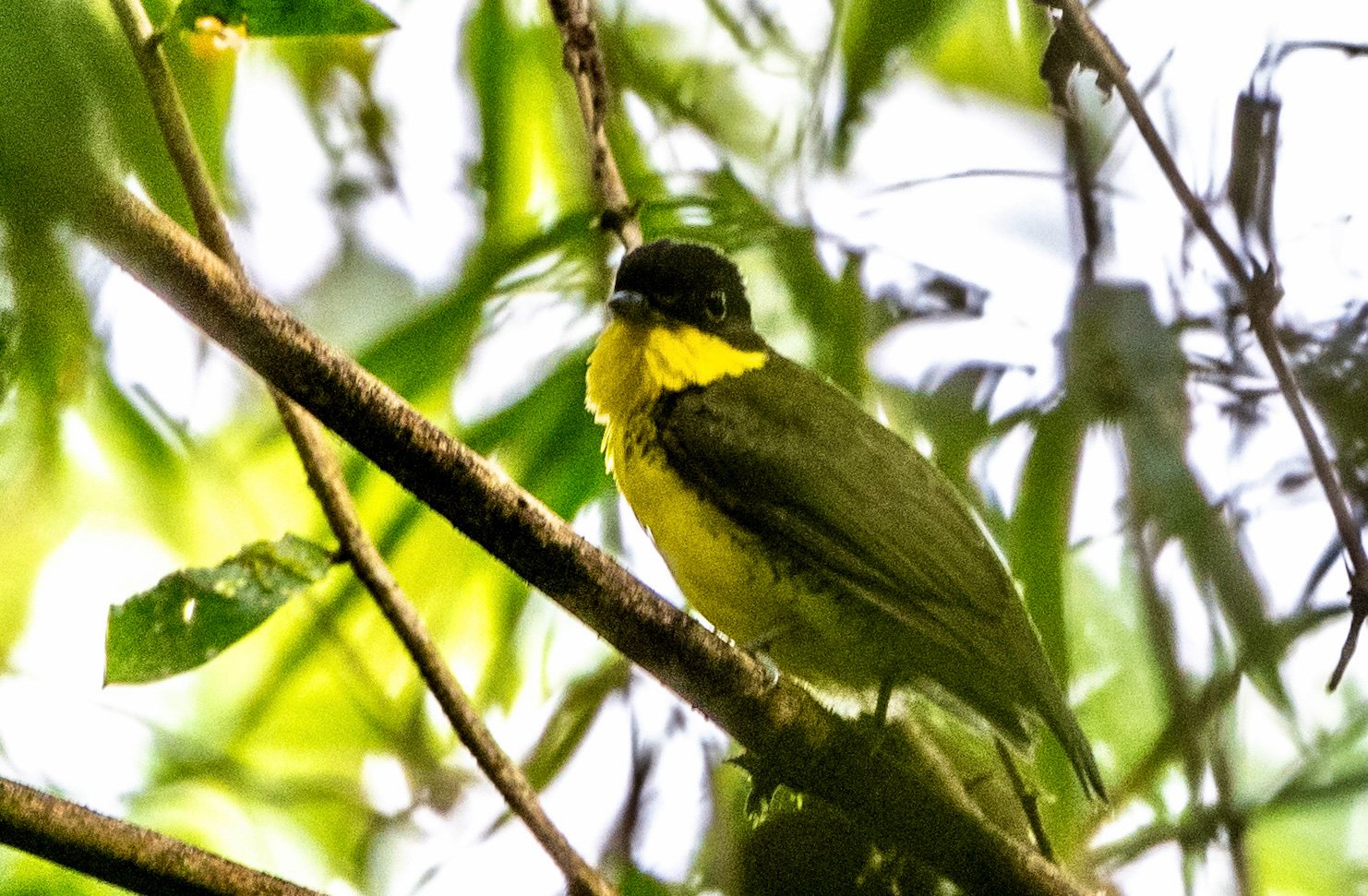
The Andean Laniisoma is a green-and-yellow, scaly bird of the foothills and lower montane forests along the Andes. It sits still for long periods in the middle level of the forest and is usually noticed by its very high, drawn-out whistle. Until recently it was treated as a subspecies of the Brazilian Laniisoma.
Voice
A very high, thin, sibilant whistle that swells and fades, repeated at long intervals. The bird often sings for a long time from the same perch.
Recording: Juan Freile — CC BY-NC-SA 4.0 · xeno-canto
Identification
17–18 cm, stocky, with a fairly large head and a short, rather broad bill. The male has a black crown, olive-green upperparts and yellow underparts with black scaling on the sides of the breast and the flanks. The female has a green crown and is more heavily scaled. Young birds have rufous spots on the wing coverts.
Confusion species
Scaled Fruiteater Ampelioides tschudii is larger and heavier, with a heavily scaled back and a pale patch below the eye. Barred Fruiteater Pipreola arcuata is much larger, with fine black barring below and a red bill, and lives higher up. Female Green-and-black Fruiteaters Pipreola riefferii have a red bill and red legs. Barred Becard Pachyramphus versicolor is much smaller and finely barred rather than scaled.
Habitat
Humid foothill forest and lower montane forest, mainly on the eastern slope of the Andes, roughly between 300 and 1500 m. It sits still in the middle and upper levels, often in dense growth. It eats fruit and insects. There appear to be seasonal movements up and down the slope. Little is known about the nest.
Where the bird is most at home, classified by the vegetation units of the Andes and the west coast.


Range and movements
In Colombia very local, on the slopes of the Andes. In Ecuador scarce on the eastern slope of the Andes. In Peru scattered along the eastern slope. In Bolivia local in the Yungas. Absent from the Galápagos. Outside the guide area in western Venezuela.
- Resident
- dark = core range, pale = thinly spread
How and when to look
Early in the morning, listen in foothill forest on the eastern slope, for example in eastern Ecuador, for the very high whistle and then patiently scan the middle level; the bird moves little.
Conservation status
Least Concern. The species is rare and local, and clearing of foothill forest is a risk.
Scientific name
Laniisoma buckleyi | (Sclater & Salvin, 1880)
Sclater & Salvin described the species in 1880 as Ptilochloris buckleyi; because it was later moved to another genus, the author and year stand in brackets. The genus Laniisoma was introduced in 1832 by Swainson. The genus name combines Lanius, the shrike genus, with Greek sōma, 'body': a bird with the build of a shrike. The species name honours C. Buckley, a collector who gathered birds in eastern Ecuador around 1880. The specimen the first description was based on came from Pindo, Pastaza, Ecuador.