All species › Passerines › Tityras, becards and allies › Brazilian Laniisoma
Brazilian Laniisoma | Laniisoma elegans
Braziliaanse klauwiercotinga | Lanisoma elegante | Chibante
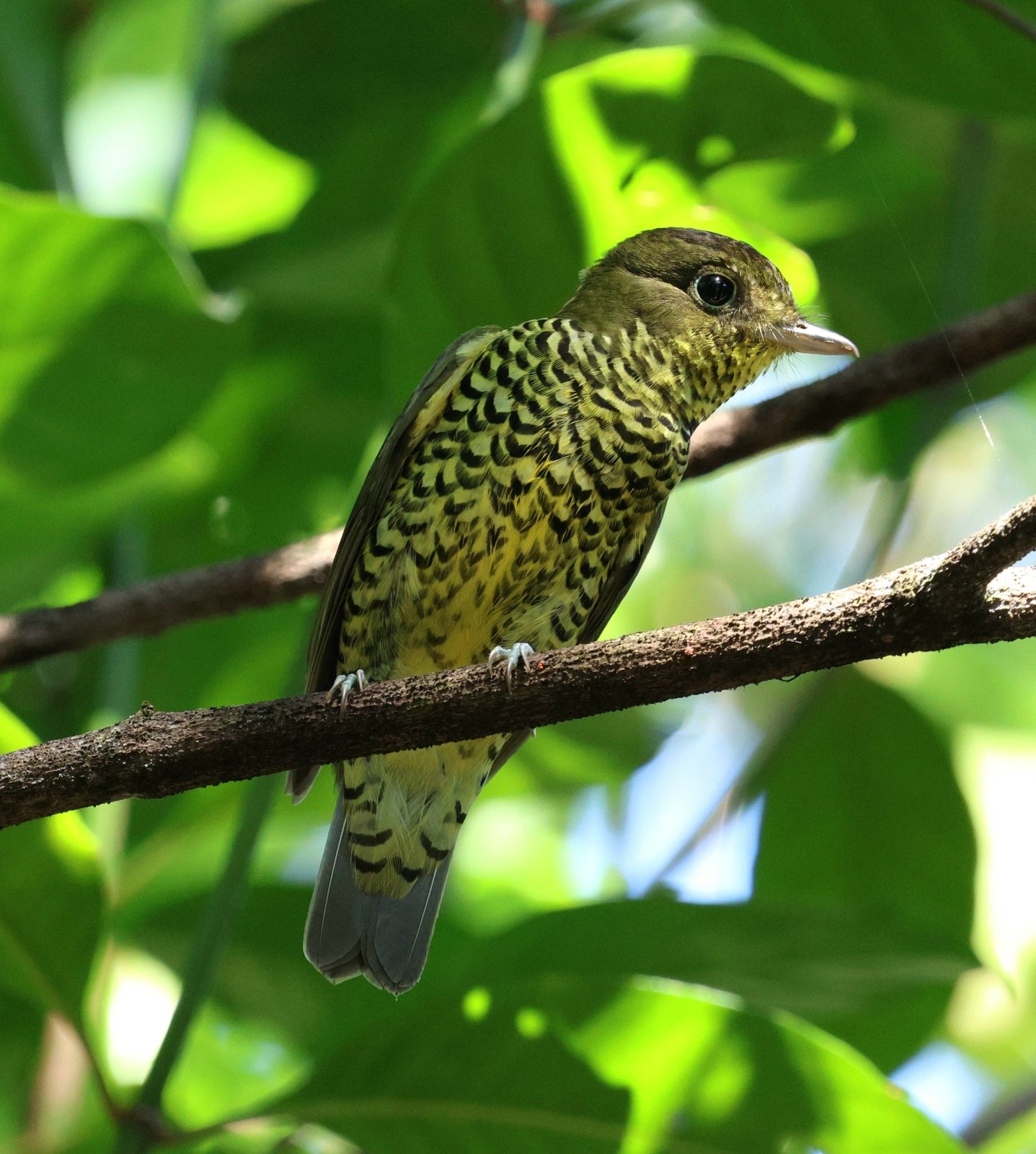
The Brazilian Laniisoma is a green-and-yellow, scaly bird of the Atlantic Forest of south-eastern Brazil. For a long time it formed one species with the Andean Laniisoma; since the split it is restricted to Brazil. It does not occur in the guide area: the laniisomas of the Andes belong to the Andean Laniisoma.
Voice
A very high, thin, drawn-out whistle that swells and fades, repeated at long intervals. The bird often sings for a long time from the same hidden perch.
Recording: Augusto Matheus dos Santos — CC BY-NC-SA 4.0 · xeno-canto
Identification
17–18 cm, stocky, with a fairly large head and a short, rather broad bill. The male has a black crown, olive-green upperparts and yellow underparts with black scaling, especially on the sides of the breast and the flanks. The female has a green crown and is more heavily scaled. Young birds have rufous spots on the wing coverts.
Confusion species
Andean Laniisoma Laniisoma buckleyi is almost identical; in the field location decides, as it lives only in the Andes. Green-and-black Fruiteater Pipreola riefferii of the Andes has a red bill and red legs and a dark head without a black crown cap.
Habitat
Humid forest in the hills and lower mountains of the Atlantic Forest, also forest edges; outside the breeding season also lower down. It sits quietly in the middle and upper levels of the forest. It eats fruit and insects. Little is known about the nest.
Where the bird is most at home, classified by the vegetation units of the Andes and the west coast.


Range and movements
Does not occur in Colombia, Ecuador, Peru, Bolivia or the Galápagos. Outside the guide area only in the Atlantic Forest of south-eastern Brazil. Records from the Andes refer to the Andean Laniisoma.
How and when to look
For this species you need to visit the Atlantic Forest of Brazil. There, listen in hill and montane forest for the high, drawn-out whistle and search for the source in the middle level of the forest.
Conservation status
Least Concern. The species depends on the heavily fragmented Atlantic Forest, where further deforestation is a risk.
Scientific name
Laniisoma elegans | (Thunberg, 1823)
Thunberg described the species in 1823 as Ampelis elegans; because it was later moved to another genus, the author and year stand in brackets. The genus Laniisoma was introduced in 1832 by Swainson. The genus name combines Lanius, the shrike genus, with Greek sōma, 'body': a bird with the build of a shrike. The species name is Latin elegans, 'refined, choice'. The specimen the first description was based on came from Mountains of Rio de Janeiro, Brazil.