All species › Passerines › Cotingas › Bearded Bellbird
Bearded Bellbird | Procnias averano
Baardklokvogel | Campanero barbudo | Araponga-do-nordeste
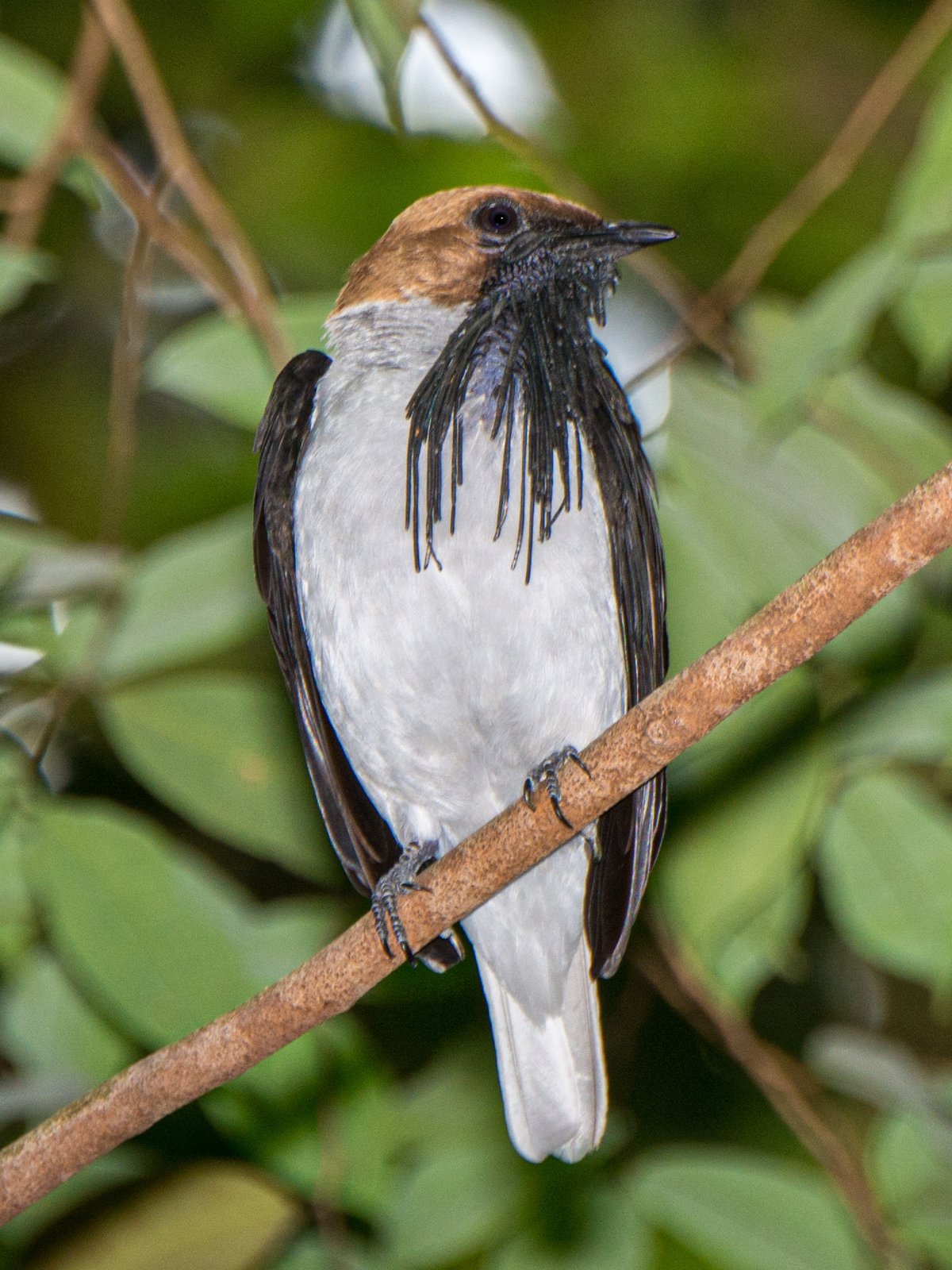
The Bearded Bellbird is a large cotinga of northern South America, known for the extremely loud, metallic call of the male. The male has a beard of black, string-like wattles hanging from its bare throat. In the guide area the species is only a rare vagrant in north-eastern Colombia, on the border with Venezuela.
Voice
From a high perch the male gives an extremely loud, dry bock, like a hammer striking an anvil, and series of metallic tink notes. The call carries over a great distance.
Recording: JAYRSON ARAUJO DE OLIVEIRA — CC BY-NC-SA 4.0 · xeno-canto
Identification
27–28 cm, stocky, with a broad, flat bill. The male is greyish white, with a coffee-brown head, black wings and a bare throat from which hangs a cluster of black, string-like wattles. The female is olive-green above and yellow below with broad olive streaks, with yellow undertail coverts. Young males resemble the female and acquire adult plumage only after several years.
Confusion species
No other bellbirds occur in the guide area. The male White Bellbird Procnias albus of Venezuela and the Guianas is entirely white, with a single long wattle above the bill. The streaked female may recall a large olive flycatcher, but is larger and stockier, with a broad bill and yellow undertail coverts.
Habitat
Humid montane and foothill forest, also tall lowland forest and forest edges, from sea level to about 1900 m. It feeds mainly on fruit, especially of the laurel family, picked in the crown. The nest is a shallow, loose cup of twigs in a tree; the female incubates and raises the young alone.
Where the bird is most at home, classified by the vegetation units of the Andes and the west coast.


Range and movements
In Colombia only a few records in the north-east, near the border with Venezuela. Not known from Ecuador, Peru, Bolivia or the Galápagos. Outside the guide area in northern Venezuela, on Trinidad, locally in Guyana and in north-eastern Brazil.
How and when to look
There is no regular site for this species in the guide area. A sighting in north-eastern Colombia deserves documentation with a photo or sound recording; in forest near the Venezuelan border the loud call gives the male away.
Conservation status
Near Threatened. The population is declining because of trapping for the cage-bird trade and deforestation.
Scientific name
Procnias averano | (Hermann, 1783)
Hermann described the species in 1783 as Ampelis Averano; because it was later moved to another genus, the author and year stand in brackets. The genus Procnias was introduced in 1811 by Illiger. The genus name refers to Procne (Proknē), who in Greek mythology was turned into a swallow; Strickland (1841) saw it as an allusion to the swallow-like form of Tersa (now Tersina). The species name comes from 'Averano', the French name Buffon gave the bird, after Brazilian Portuguese ave de verão, 'bird of summer', because it was believed to call only during the six weeks of high summer. The specimen the first description was based on came from northeastern Brazil.