All species › Passerines › Cotingas › Scimitar-winged Piha
Scimitar-winged Piha | Lipaugus uropygialis
Sikkelvleugelpiha | Guardabosques alicurvo | Cricrió-de-asa-curva
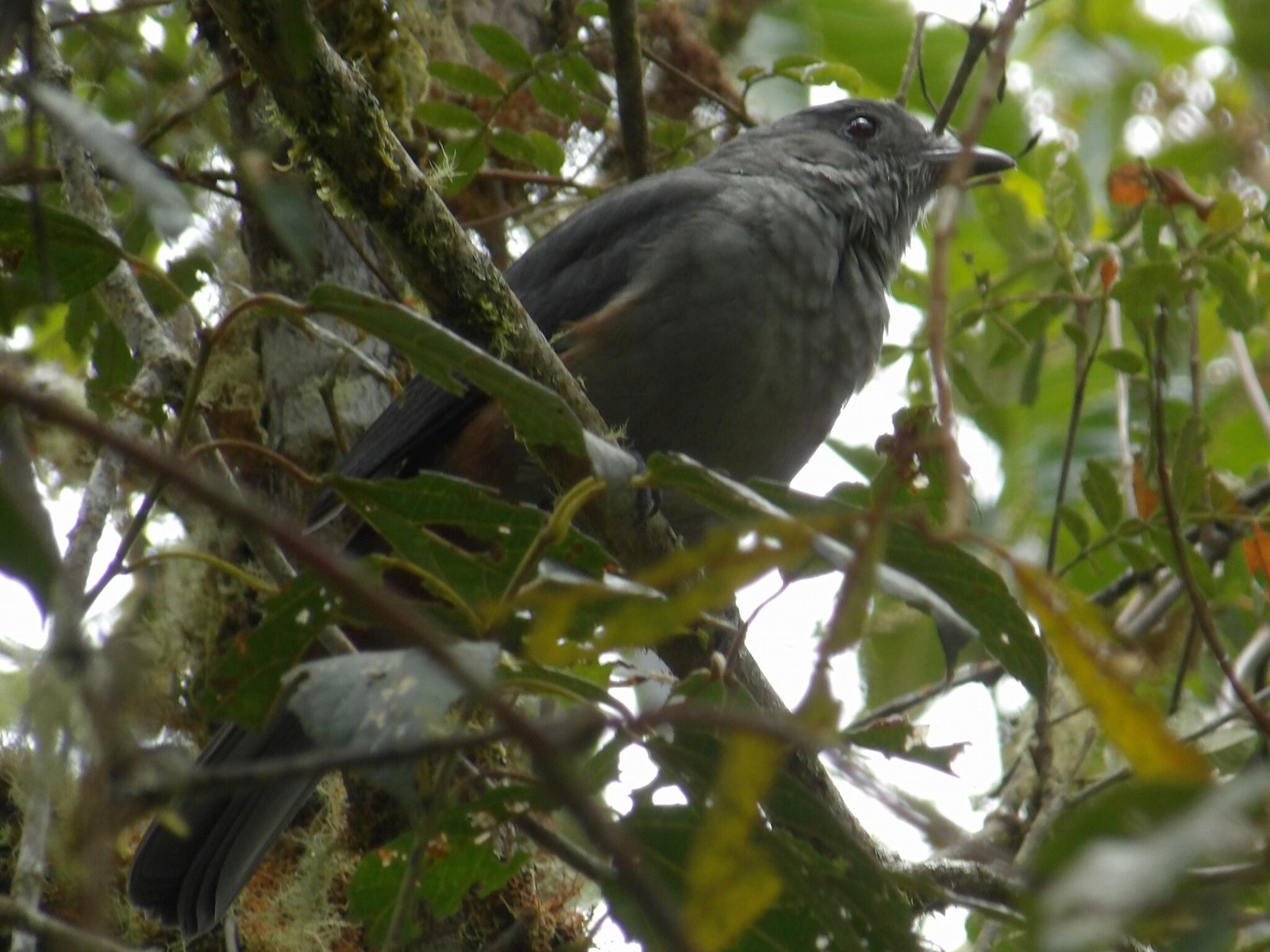
The Scimitar-winged Piha is a grey piha with a rufous rump, found in the montane Yungas forest of south-eastern Peru and Bolivia. The name refers to the sickle-shaped, curved primaries of the male. The species is scarce and local and little studied.
Voice
The song is given during a spiralling, descending display flight: a loud, piercing, high whistle with three mechanical fft sounds. Also an explosive chorus of loud, squeaky, chattering calls.
Recording: Daniel Lane — CC BY-NC-SA 3.0 · xeno-canto
Identification
About 30 cm, slender, with a long tail. Mid-grey above, with a rufous-chestnut rump and slightly darker grey wings and tail. Paler grey below, with rufous-chestnut lower flanks and undertail coverts. In the male most primaries curve outward and the outer ones narrow sharply at the tip; in the female they are only slightly curved. Otherwise the sexes are alike.
Confusion species
Dusky Piha Lipaugus fuscocinereus lacks the rufous rump and undertail and lives much farther north. Smoke-colored Pewee Contopus fumigatus is much smaller, with a short crest and a broad bill. Other grey birds of the montane forest lack the combination of a long tail and a rufous rump and undertail.
Habitat
The interior and edges of humid montane forest and cloud forest of the Yungas, mostly between 1800 and 2750 m, in Peru up to about 2400 m. It probably feeds mainly on fruit. Little is known about the nest.
Where the bird is most at home, classified by the vegetation units of the Andes and the west coast.


Range and movements
Absent from Colombia and Ecuador. In Peru only on the east slope in the south-east, on the Cuzco–Madre de Dios border and in eastern Puno, rare and local. In Bolivia on the east slope in La Paz and Cochabamba. Absent from the Galápagos. Does not occur outside the guide area.
- Resident
- dark = core range, pale = thinly spread
How and when to look
In the cloud forest of the Yungas of La Paz in Bolivia or in south-eastern Peru, listen for loud, chattering groups in the canopy.
Conservation status
Vulnerable. The population is estimated at 600 to 1700 mature birds and is probably declining because of road building, small-scale farming, selective logging and clearance for tea, coffee and coca on the lower slopes; climate change may shrink its habitat further.
Scientific name
Lipaugus uropygialis | (Sclater & Salvin, 1876)
Sclater & Salvin described the species in 1876 as Lathria uropygialis; because it was later moved to another genus, the author and year stand in brackets. The genus Lipaugus was introduced in 1828 by Boie. The genus name comes from Ancient Greek lipaugēs, 'dark' or 'devoid of light'. The species name comes from uropygium, 'rump', for the rufous rump. The specimen the first description was based on came from Tilotilo, La Paz, Bolivia.