All species › Potoos › Potoos › Andean Potoo
Andean Potoo | Nyctibius maculosus
Andesreuzennachtzwaluw | Nictibio andino | Urutau-andino
The Andean Potoo is the potoo of montane forest: a dark species of cloud forest on the slopes of the Andes, higher than all other members of its family. It is known mainly from its hoarse nocturnal call and from birds sitting on a lookout at night in torchlight. It has rarely been found by day.
Voice
A loud, hoarse, somewhat rough call, such as raaah or waaah, repeated at long intervals, mainly at night and more often in moonlight.
Recording: Arcadio Marin — CC BY-NC-SA 4.0 · xeno-canto
Identification
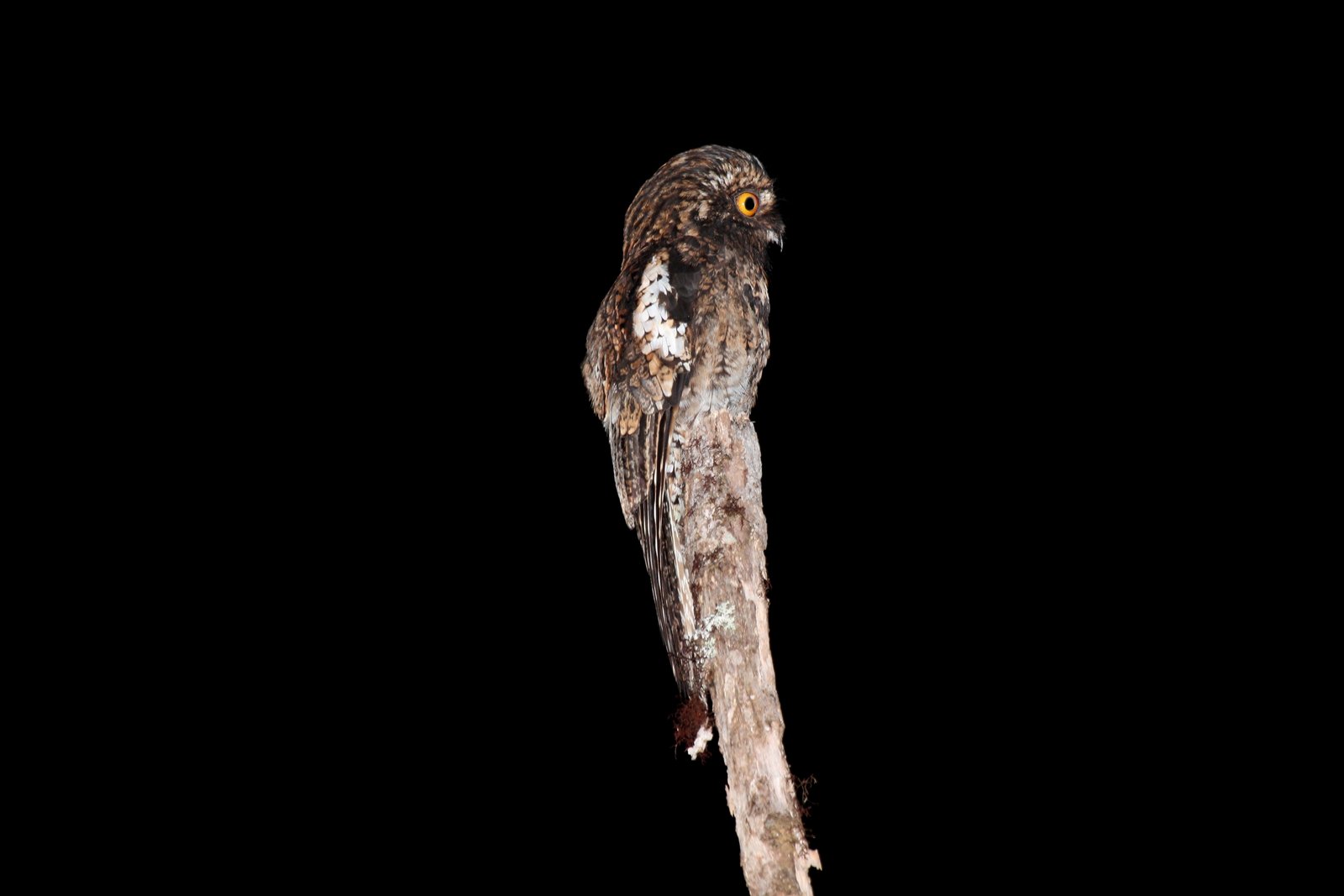
35–38 cm, with a large head, a wide gape and a long tail. The plumage is dark greyish brown to blackish brown, finely mottled and streaked with grey, buff and black, with a row of large black spots on the breast. On the wing-coverts a conspicuous white or whitish patch, which at rest shows as a pale band on the wing. The eyes are large and yellow to orange and shine orange in torchlight. The sexes are alike.
Confusion species
Common Potoo Nyctibius griseus is paler grey, without a white wing patch, with a descending series of whistles as song, and lives lower, in the lowlands and foothills. Long-tailed Potoo Nyctibius aethereus is larger and warmer brown, with a much longer tail, and lives lower. White-winged Potoo Nyctibius leucopterus also has white on the wing, but is smaller and lives in the Amazonian lowlands.
Habitat
Humid montane forest and cloud forest, forest edges and clearings with tall trees, roughly between 1800 and 2800 m, locally lower or higher. At night it sallies from a lookout at the forest edge or over a clearing for flying insects, such as moths and beetles. Little is known of its breeding biology; the egg is presumably laid without a nest on a branch, as in its relatives.
Where the bird is most at home, classified by the vegetation units of the Andes and the west coast.


Range and movements
In Colombia scattered in the Andes, mainly on the eastern slope of the Eastern Andes. In Ecuador on the eastern slope of the Andes. In Peru on the eastern slope of the Andes along the whole length of the country. In Bolivia on the eastern slope of the Andes in the Yungas. Absent from the lowlands, the west coast and the Galápagos. Outside the guide area in western Venezuela.
- Resident
- dark = core range, pale = thinly spread
How and when to look
At night search with a torch along mountain roads through cloud forest for the orange eyeshine on dead branches at the forest edge, especially on moonlit nights when the birds call.
Conservation status
Least Concern. The species is scarce and poorly known; deforestation on the Andean slopes may threaten it locally.
Scientific name
Nyctibius maculosus | Ridgway, 1912
Ridgway described the species in 1912 and placed it straight away in the genus where it still stands. The genus Nyctibius was introduced in 1816 by Vieillot. The genus name comes from Greek nuktibios, 'night-feeding', from nux, 'night', and bios, 'life'. The species name is Latin maculosus, 'spotted'. The specimen the first description was based on came from Ambato, Tungurahua, Ecuador.