All species › Potoos › Potoos › White-winged Potoo
White-winged Potoo | Nyctibius leucopterus
Witvleugelreuzennachtzwaluw | Nictibio aliblanco | Urutau-de-asa-branca
The White-winged Potoo is a small, greyish-brown potoo of the high canopy of Amazonian forest. It lives so inconspicuously that for a long time it remained almost unknown; most records are based on its song, a long, descending whistle in the night. The taxonomy of the species is not yet fully resolved.
Voice
A long, soft, melancholy whistle that slowly falls in pitch, such as feeeeuuuu, repeated at intervals from the canopy, mainly at dusk and at night.
Recording: Felipe Arantes — CC BY-NC-SA 4.0 · xeno-canto
Identification
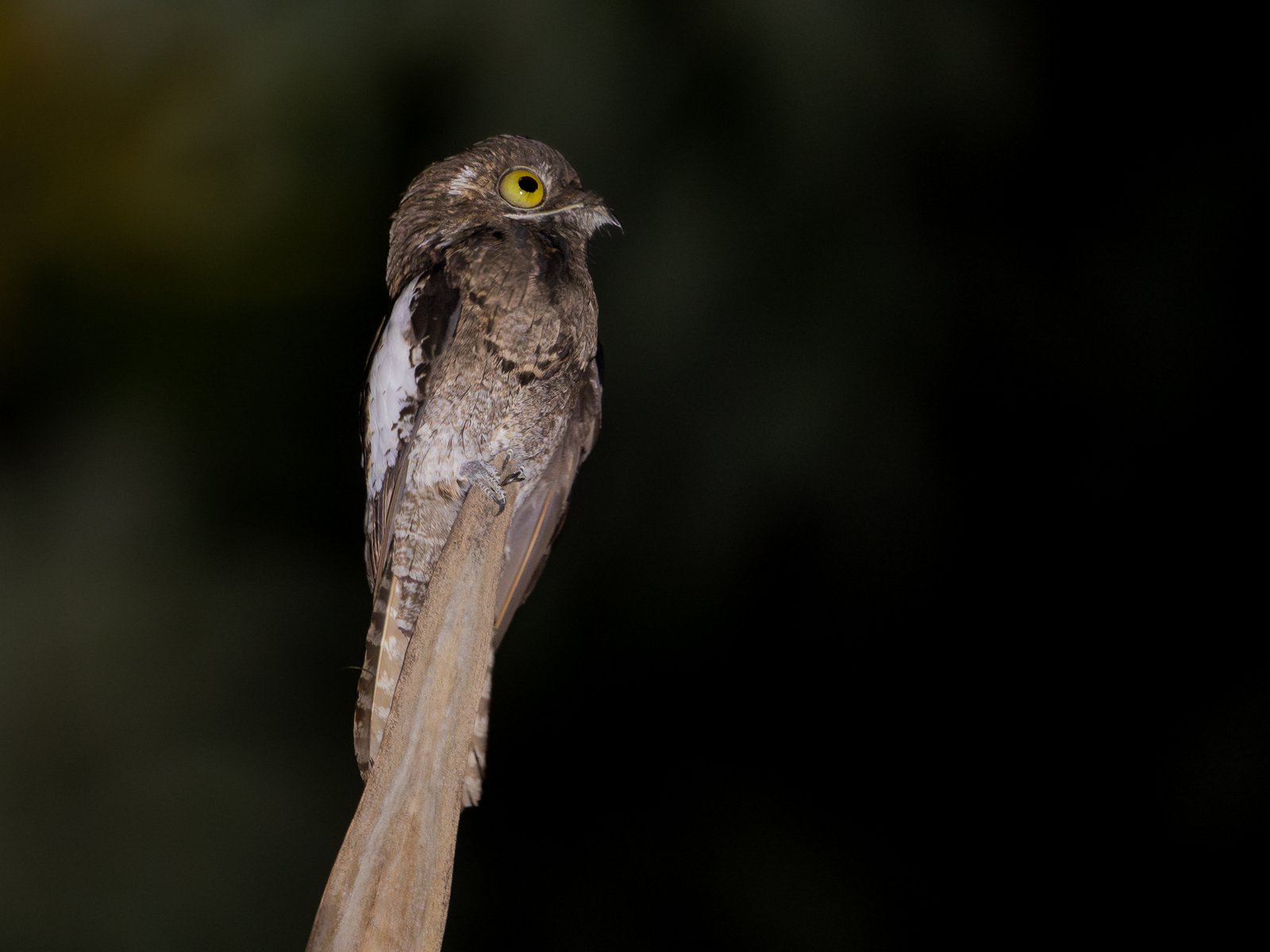
25–29 cm, small and fairly slim for a potoo, with a large head, a wide gape and a medium-length tail. The plumage is greyish brown to dark brown, finely mottled and streaked with black and grey. On the wing-coverts a distinct white patch, which at rest shows as a white band on the wing. The eyes are large and yellow and shine orange in torchlight. The sexes are alike.
Confusion species
Common Potoo Nyctibius griseus is larger and greyer, without a white wing patch, and has a series of descending whistles as song. Rufous Potoo Phyllaemulor bracteatus is warm rufous with white teardrop spots on the underparts and sits low in the forest. Andean Potoo Nyctibius maculosus also has a white wing patch, but is larger and lives in montane forest.
Habitat
The high canopy of humid lowland terra firme forest, often on poor sandy soils, up to about 500 m. By day it roosts high in a tree crown and at night it sallies from a high perch for flying insects. Little is known of its diet and breeding biology.
Where the bird is most at home, classified by the vegetation units of the Andes and the west coast.

Range and movements
In Colombia very few records from Amazonia in the south-east. In Ecuador few records from the eastern lowlands. In Peru mainly in the north-eastern lowlands. In Bolivia not confirmed. Absent from the Andes, west of them and from the Galápagos. Outside the guide area in Brazilian Amazonia, the Guianas and southern Venezuela, with an isolated population in the Atlantic Forest of eastern Brazil.
- Resident
- dark = core range, pale = thinly spread
How and when to look
At dusk listen from a canopy tower or a clearing in terra firme forest for the long, descending whistle; the bird then sits high in the canopy and can be found with a strong torch.
Conservation status
Least Concern. The species is poorly known and probably more often present than the records suggest; deforestation in Amazonia is the main threat.
Scientific name
Nyctibius leucopterus | (Wied-Neuwied, 1821)
Wied-Neuwied described the species in 1821 as Caprimulgus leucopterus; because it was later moved to another genus, the author and year stand in brackets. The genus Nyctibius was introduced in 1816 by Vieillot. The genus name comes from Greek nuktibios, 'night-feeding', from nux, 'night', and bios, 'life'. The species name comes from Greek leukos, 'white', and pteron, 'wing'. The specimen the first description was based on came from Vitória da Conquista, Bahia, Brazil.