All species › Potoos › Potoos › Northern Potoo
Northern Potoo | Nyctibius jamaicensis
Noordelijke reuzennachtzwaluw | Nictibio norteño | Urutau-do-norte
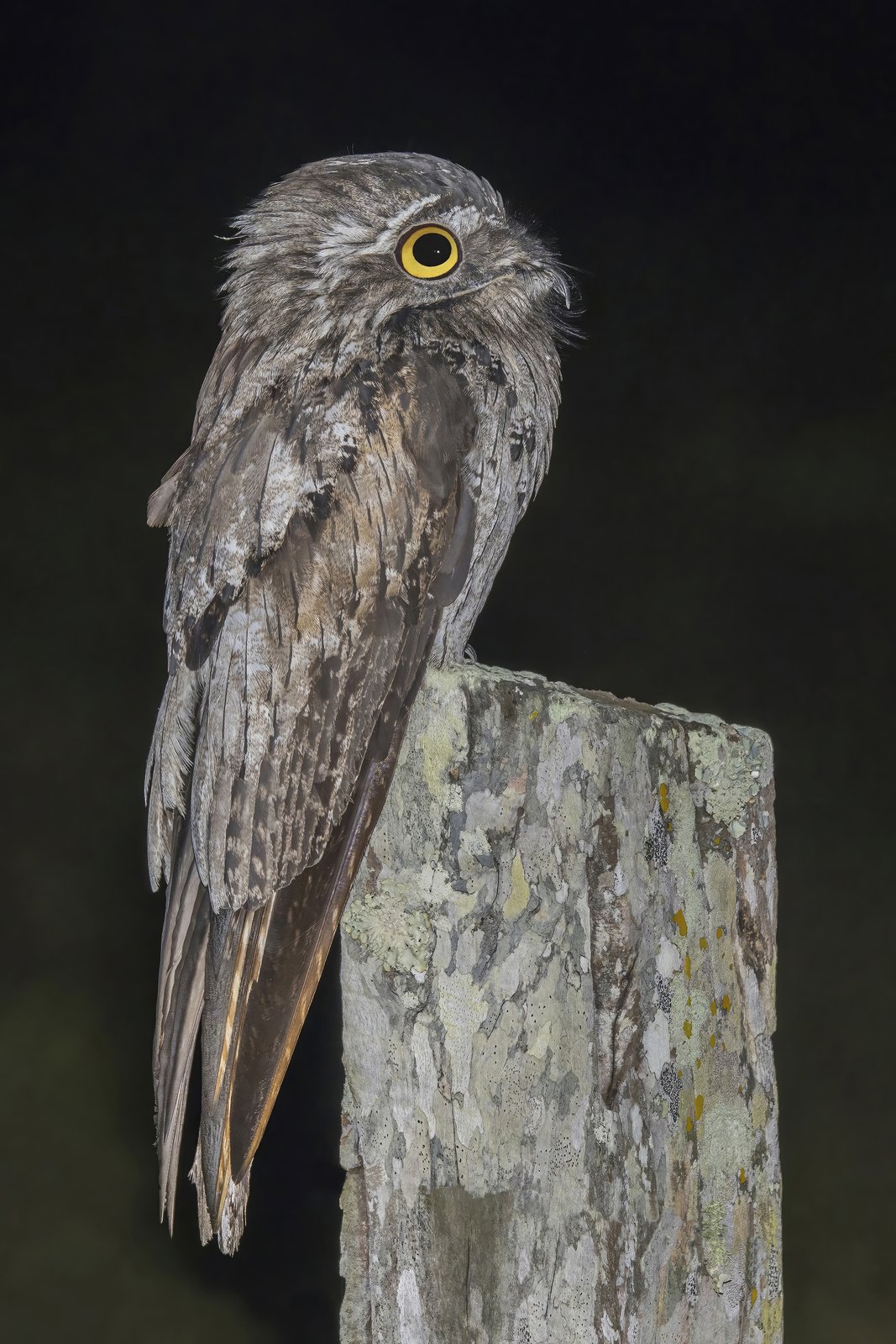
The Northern Potoo is the Central American and Caribbean counterpart of Common Potoo and was long treated as the same species. It differs mainly in voice: a hoarse, guttural croak instead of whistles. In the guide area it is only a very rare vagrant.
Voice
A hoarse, guttural and raw kwaa or waaah-waah, often in short series, mainly at night. It lacks the melodious, descending whistles of Common Potoo.
Recording: Paul Driver — CC BY-NC-SA 4.0 · xeno-canto
Identification
38–45 cm, slightly larger and heavier than Common Potoo, with a large head, a wide gape and a long tail. The plumage is grey to greyish brown, finely mottled and streaked with black, brown and white, with a row of black spots on the breast. The eyes are large and yellow and shine orange in torchlight. The sexes are alike.
Confusion species
Common Potoo Nyctibius griseus is almost identical in the field, but slightly smaller and lighter in build; a safe separation is only possible by voice, as that species gives a series of descending whistles. Great Potoo Nyctibius grandis is much larger and whiter, with dark eyes.
Habitat
Outside the guide area in open woodland, dry forest, forest edges, savanna and pasture with scattered trees, from sea level to about 1500 m. At night it sallies from a lookout for flying insects. The single egg is laid without a nest on top of a broken branch.
Where the bird is most at home, classified by the vegetation units of the Andes and the west coast.


Range and movements
In the guide area recorded only as a very rare vagrant, expected in north-western Colombia, close to Central America. Absent from the rest of the guide area. Outside the guide area from Mexico to Costa Rica and on Jamaica and Hispaniola.
How and when to look
A potoo in north-western Colombia that gives a hoarse croak instead of descending whistles deserves attention; record the sound.
Conservation status
Least Concern. The species is widespread in Central America and tolerates open, human-modified landscape with trees.
Scientific name
Nyctibius jamaicensis | (Gmelin, 1789)
Gmelin described the species in 1789 as Caprimulgus jamaicensis; because it was later moved to another genus, the author and year stand in brackets. The genus Nyctibius was introduced in 1816 by Vieillot. The genus name comes from Greek nuktibios, 'night-feeding', from nux, 'night', and bios, 'life'. The species name refers to Jamaica. The specimen the first description was based on came from Jamaica.