All species › Swifts › Swifts › Chestnut-collared Swift
Chestnut-collared Swift | Streptoprocne rutila
Bruinkraaggierzwaluw | Vencejo cuello castaño | Taperuçu-de-coleira-castanha
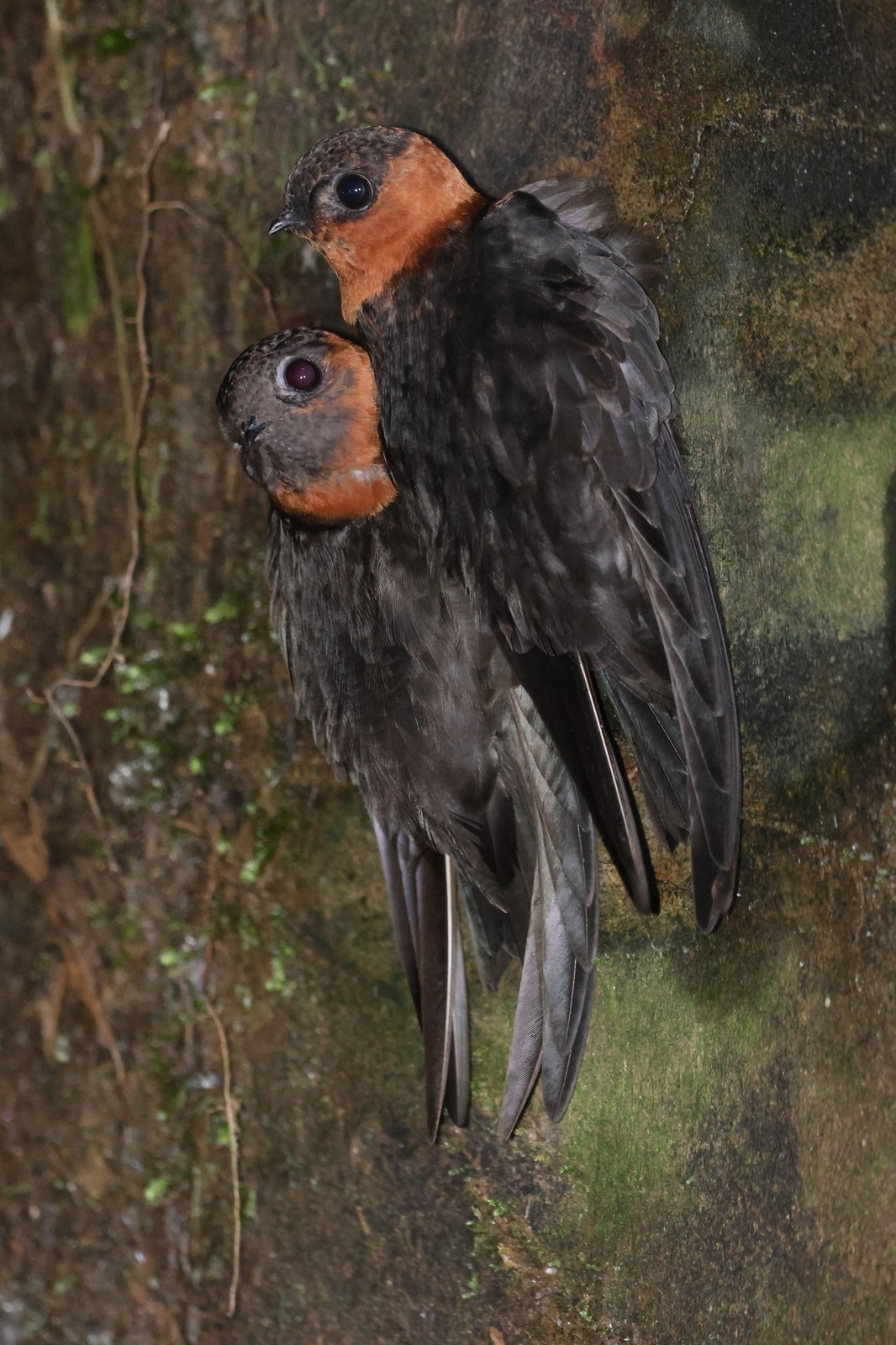
The Chestnut-collared Swift is a small, dark mountain swift; the male has a rufous band around the neck and throat. It hunts in flocks, often together with other swifts, over forested slopes and valleys. It nests on wet rock faces in ravines and at waterfalls.
Voice
A dry, buzzy chatter and rapid series of shrill chee-chee-chee calls, mainly in flocks and at the nest site.
Recording: Nathan Pieplow — CC BY-NC-SA 4.0 · xeno-canto
Identification
12–13 cm, with fairly broad wings and a short, slightly notched tail. The plumage is blackish brown, with the wings and tail slightly darker. The male has a rufous collar that includes the throat, the sides of the neck and the nape. In the female the collar is narrower, incomplete or absent; some females are entirely dark. Juveniles lack the collar or show only a trace of it, and have pale fringes to the feathers of the underparts.
Confusion species
White-collared Swift Streptoprocne zonaris is much larger, with a white collar. Dark females without a collar resemble other Cypseloides species, such as White-chinned Swift Cypseloides cryptus, which is bulkier, with a larger head and a short, square tail, and Spot-fronted Swift Cypseloides cherriei, which has white spots near the bill and eye. Grey-rumped Swift Chaetura cinereiventris is smaller, with a grey rump and narrower wings.
Habitat
Airspace over montane forest, forest edges, ravines and open valleys, mostly between about 1000 and 2800 m, but foraging higher and lower as well. It catches small flying insects, often in mixed flocks with other swifts. The nest is a cup of moss, ferns and mud on a damp rock face, in a gorge, at a waterfall or in a tunnel.
Where the bird is most at home, classified by the vegetation units of the Andes and the west coast.


Range and movements
In Colombia in the Andes and in the Sierra Nevada de Santa Marta. In Ecuador on both slopes of the Andes. In Peru along the Andes, mainly on the eastern slope. In Bolivia on the eastern slope of the Andes. Absent from the Galápagos. Outside the guide area from Mexico through Central America to Venezuela and Trinidad.
- Resident
- dark = core range, pale = thinly spread
How and when to look
Watch above forested ravines and along mountain roads, especially at waterfalls and wet rock faces. In cloudy weather flocks often hunt low over the slopes, so that the collar of the males can be seen.
Conservation status
Least Concern. The species occurs over a large area; nest sites on rock faces are little disturbed.
Scientific name
Streptoprocne rutila | (Vieillot, 1817)
Vieillot described the species in 1817 as Hirundo rutila; because it was later moved to another genus, the author and year stand in brackets. The genus Streptoprocne was introduced in 1906 by Oberholser. The genus name combines Greek streptos, 'collar', with Prokne, the figure from Greek mythology who was turned into a swallow. The species name comes from Latin rutilus, 'reddish', after the chestnut collar. The specimen the first description was based on came from the Guianas.