All species › Swifts › Swifts › White-collared Swift
White-collared Swift | Streptoprocne zonaris
Witkraaggierzwaluw | Vencejo cuello blanco | Taperuçu-de-coleira-branca
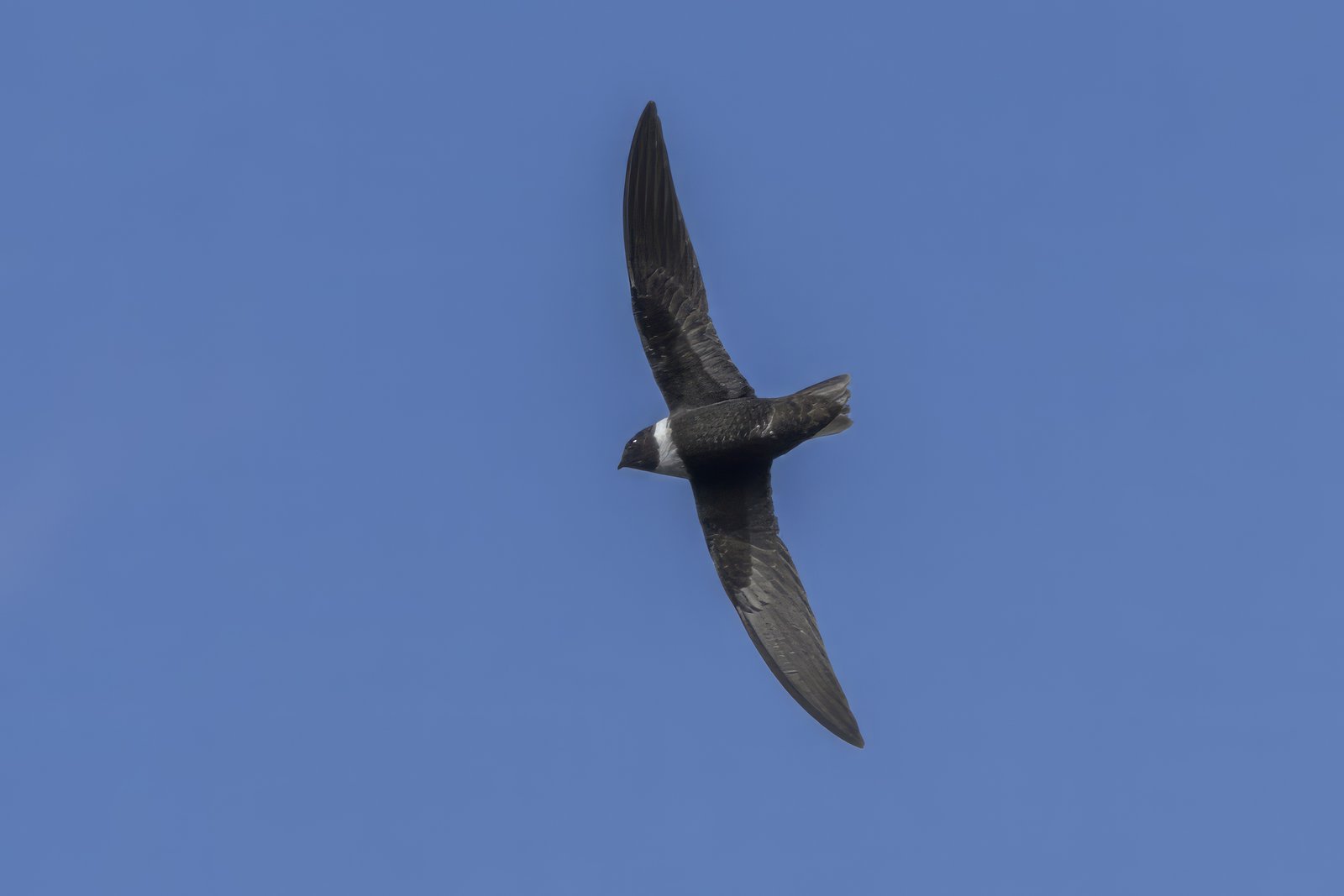
The White-collared Swift is the largest swift in the guide area, black with a complete white collar. It lives in flocks of tens to hundreds of birds that sweep at high speed and with loud calls over mountains and lowlands. At night the birds roost and breed on rock faces behind waterfalls and in caves.
Voice
Loud, shrill, grating screams and chatter, often from the whole flock at once and audible from high in the sky. A continuous chatter at the roost.
Recording: Ricardo José Mitidieri — CC BY-NC-SA 4.0 · xeno-canto
Identification
20–22 cm, with long, broad, sickle-shaped wings and a slightly forked tail that looks almost square when spread. The plumage is black, with a white collar that is broader on the breast than on the nape. The sexes are alike. Juveniles have a narrower, incomplete or mottled collar and pale fringes to the belly and wing feathers.
Confusion species
Chestnut-collared Swift Streptoprocne rutila is much smaller, with a rufous collar in the male. White-chested Swift Cypseloides lemosi is smaller and has only a white patch on the breast, without a band on the nape. Juvenile White-collared Swifts with a faint collar resemble large Cypseloides species, but are larger and broader-winged.
Habitat
Airspace over almost all landscapes, from the lowlands to above 4000 m, most often over montane forest, ravines and foothills. Flocks hunt flying insects, often ahead of an approaching storm. It roosts and breeds in colonies on wet rock faces behind or beside waterfalls and in caves; the nest is a mound of moss and mud.
Where the bird is most at home, classified by the vegetation units of the Andes and the west coast.


Range and movements
In Colombia widespread in the Andes, the Sierra Nevada de Santa Marta and the adjacent lowlands. In Ecuador on both slopes of the Andes and beyond into the lowlands. In Peru along the Andes and over the adjacent lowlands in the east, locally on the western slope. In Bolivia in the Andes and the eastern lowlands. Absent from the Galápagos. Outside the guide area from Mexico to northern Argentina and south-eastern Brazil, and in the Greater Antilles.
- Resident
- dark = core range, pale = thinly spread
How and when to look
Flocks often appear suddenly over ridges and valleys, especially ahead of a rain shower. Waterfalls in montane forest are good places to watch birds come in at dusk.
Conservation status
Least Concern. The species is widespread and locally numerous; colonies at waterfalls can be disturbed by tourism and hydroelectric projects.
Scientific name
Streptoprocne zonaris | (Shaw, 1796)
Shaw described the species in 1796 as Hirundo zonaris; because it was later moved to another genus, the author and year stand in brackets. The genus Streptoprocne was introduced in 1906 by Oberholser. The genus name combines Greek streptos, 'collar', with Prokne, the figure from Greek mythology who was turned into a swallow. The species name comes from Latin zona, 'band, girdle', after the white collar. The specimen the first description was based on came from Brazil.