All species › Swifts › Swifts › White-chested Swift
White-chested Swift | Cypseloides lemosi
Caucagierzwaluw | Vencejo pechiblanco | Taperuçu-de-peito-branco
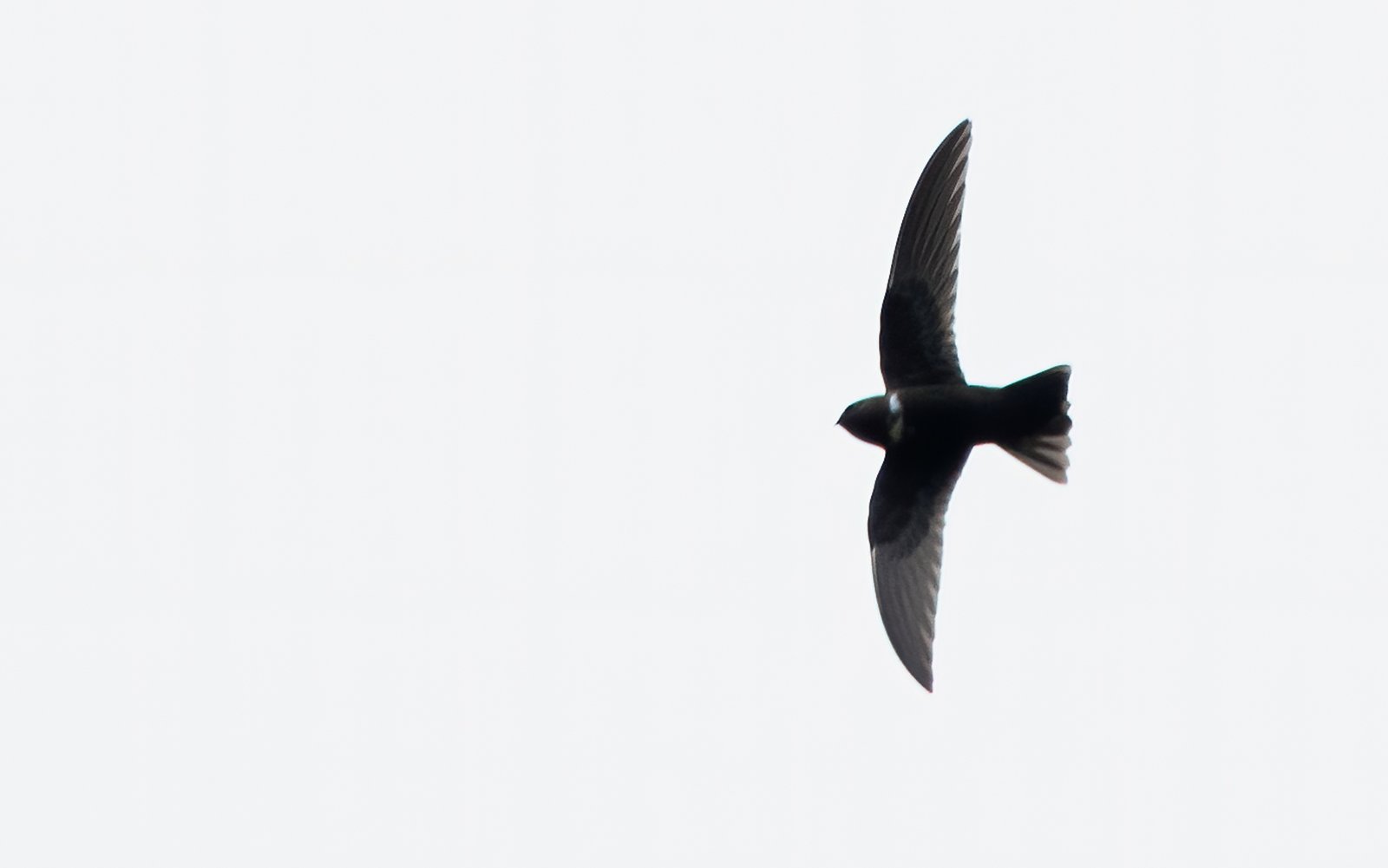
The White-chested Swift is a dark swift with a large white patch on the breast. The species was described from the upper Cauca Valley in Colombia, to which its Dutch name refers, and was later also found along the eastern slope of the Andes from Ecuador to Bolivia. Little is known about its breeding sites and movements.
Voice
Poorly known; high, chirping calls in flocks.
Recording: Mitch Lysinger — CC BY-NC-SA 4.0 · xeno-canto
Identification
14–15 cm, with a slightly forked tail. The plumage is sooty black with a faint greenish gloss on the crown and back; the underparts are slightly browner and paler than the upperparts. A large white patch crosses the breast and is broadest in the middle. The lores are black. The sexes are alike; in some birds, possibly females, the breast patch is smaller. Juveniles lack the white patch and are dark slate grey with white fringes to the feathers of the underparts.
Confusion species
White-collared Swift Streptoprocne zonaris is much larger and has a complete white collar, including the nape. White-chinned Swift Cypseloides cryptus has only a small white chin patch. Juvenile White-chested Swifts without the breast patch can hardly be separated from other dark Cypseloides species.
Habitat
Airspace over open, grassy slopes, pastures, young secondary forest and forest edges in the foothills and lower mountain slopes, roughly between 400 and 1800 m. It hunts flying insects, often in flocks with other swifts. The nest has not been described; like related species it presumably breeds on wet rock faces.
Where the bird is most at home, classified by the vegetation units of the Andes and the west coast.


Range and movements
In Colombia mainly in the upper Cauca Valley in the south-west. In Ecuador along the eastern slope of the Andes. In Peru along the eastern slope south to Cusco, with scattered records. In Bolivia only a few records in the north-west. Absent from the Galápagos. Outside the guide area only an unconfirmed record from Brazil.
- Resident
- dark = core range, pale = thinly spread
How and when to look
Search over open pasture and forest edges in the foothills of the eastern slope and in the Cauca Valley, especially on days with low cloud, when flocks of swifts hunt low. Look for the white breast patch on birds flying towards you.
Conservation status
Least Concern. The known range is small and the population is presumably declining; no direct threats have been identified.
Scientific name
Cypseloides lemosi | Eisenmann & Lehmann V, 1962
Eisenmann & Lehmann V described the species in 1962 and placed it straight away in the genus where it still stands. The genus Cypseloides was introduced in 1848 by Streubel. The genus name combines the genus Cypselus (from Greek kupselos, 'swift') with Greek -oidēs, 'resembling'. The species name honours Antonio José Lemos-Guzmán (1900–1967), Colombian physician, historian and politician, governor of Cauca. The specimen the first description was based on came from Santander de Quilichao, Cauca, Colombia.