All species › Passerines › Finches, euphonias and allies › Andean Siskin
Andean Siskin | Spinus spinescens
Andessijs | Jilguero andino | Pintassilgo-andino
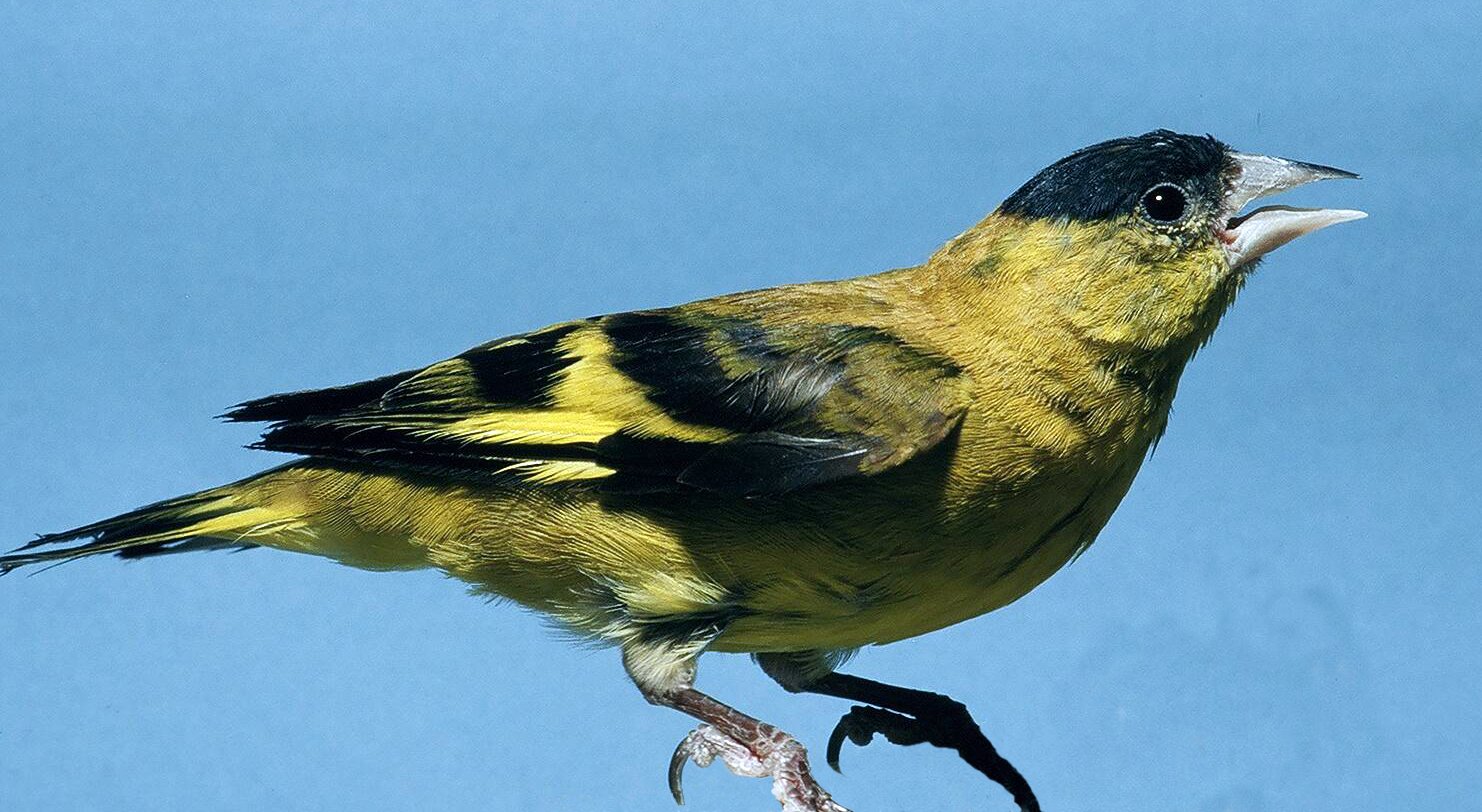
The Andean Siskin is a small siskin of the high Andes of Colombia and western Venezuela, which just reaches northern Ecuador. The male combines a black cap with olive-green upperparts and a yellow wing band. It lives in small flocks at the edges of cloud forest and in the transition to páramo.
Voice
High, thin tsee calls and a rapid, varied, twittering song with trills, recalling that of a canary.
Recording: GABRIEL LEITE — CC BY-NC-SA 4.0 · xeno-canto
Identification
10–11 cm, with a short, pointed bill and a notched tail. The male has a black crown and forehead, olive-green cheeks, nape and back, a yellow to olive-yellow rump and yellow-green underparts. The wings are black with a broad yellow band at the base of the flight feathers; the tail is black with yellow at the base. The female lacks the black cap and is duller olive-green, with a narrower yellow wing band. Young birds resemble the female and are faintly streaked.
Confusion species
Hooded Siskin Spinus magellanicus has a black hood that also includes the throat and cheeks, rather than just a black crown. Yellow-bellied Siskin Spinus xanthogastrus is glossy black above and on the throat and breast. Olivaceous Siskin Spinus olivaceus resembles Hooded Siskin and lives lower, on the east slope. Females are best identified by the company of males.
Habitat
Edges of cloud forest and elfin forest, shrubby clearings, the transition from forest to páramo, pastures and field edges with shrubs, mainly between about 2000 and 4000 m. It eats seeds of composites, grasses and alders. The nest is a small cup in a shrub or tree.
Where the bird is most at home, classified by the vegetation units of the Andes and the west coast.


Range and movements
In Colombia in all three Andean ranges, in the Sierra Nevada de Santa Marta and the Serranía del Perijá. In Ecuador only rarely in the far north, in Carchi. Absent from Peru, Bolivia and the Galápagos. Outside the guide area in the Andes and the coastal cordillera of Venezuela.
- Resident
- dark = core range, pale = thinly spread
How and when to look
At the treeline and in shrubby pastures in the Colombian Andes, look for small flocks of small green finches on seeding composites; the high tsee calls are often the first sign.
Conservation status
Least Concern. The species is locally common and tolerates a semi-open agricultural landscape; it is sometimes trapped as a cage bird.
Scientific name
Spinus spinescens | (Bonaparte, 1850)
Bonaparte described the species in 1850 as Chrysomitris spinescens; because it was later moved to another genus, the author and year stand in brackets. The genus Spinus was introduced in 1816 by Koch. The genus name comes from Greek spinos, the name of a bird that can no longer be identified. The species name derives from Fringilla spinus, the Eurasian Siskin, with the Latin suffix -escens, 'somewhat': 'siskin-like'; the name comes from a manuscript by Lichtenstein (compare Late Latin spinescens, 'spiny'). The specimen the first description was based on came from Bogotá, Colombia.