All species › Passerines › Finches, euphonias and allies › Yellow-bellied Siskin
Yellow-bellied Siskin | Spinus xanthogastrus
Geelbuiksijs | Jilguero ventriamarillo | Pintassilgo-de-barriga-amarela
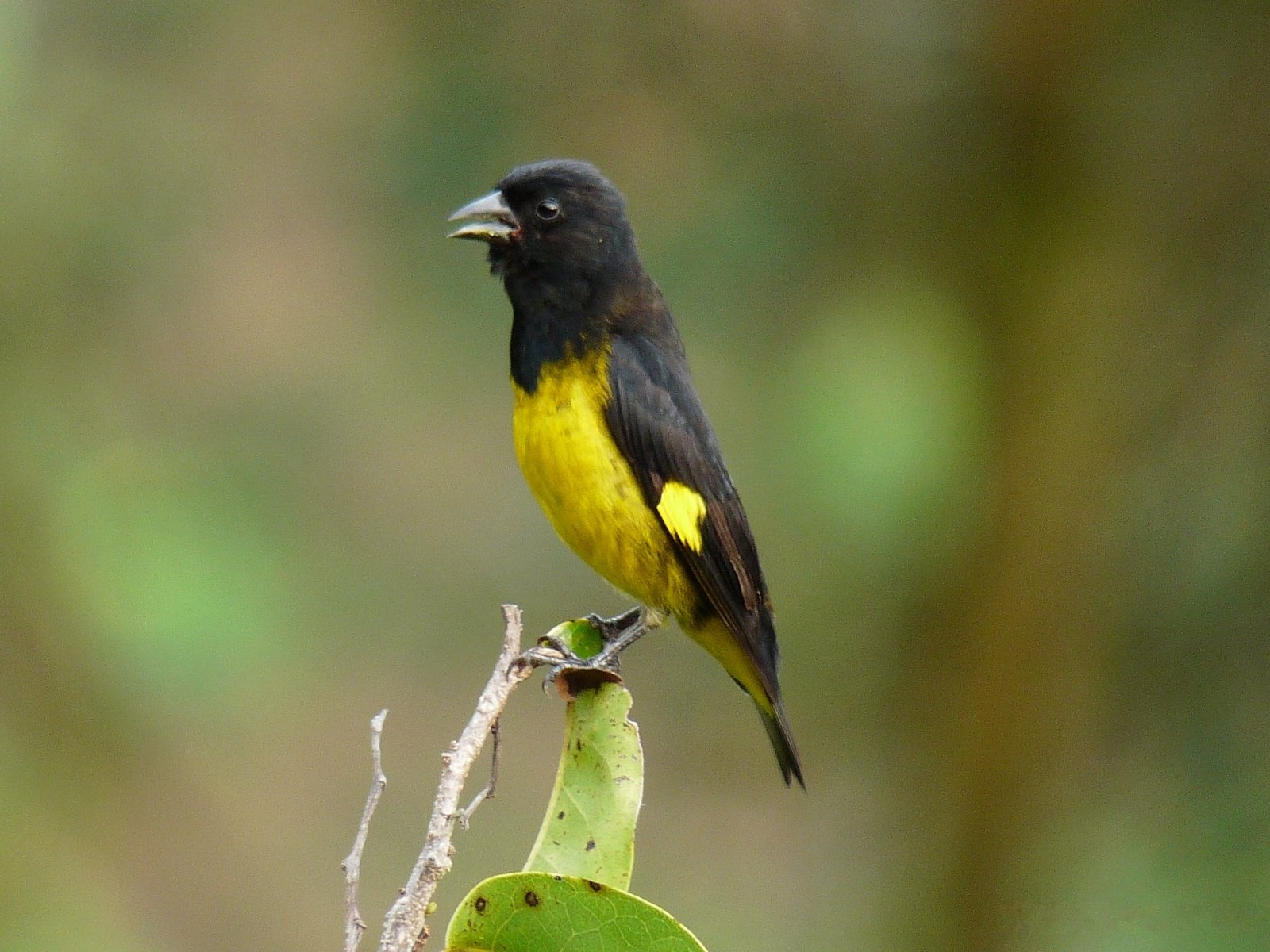
The Yellow-bellied Siskin is a siskin of montane forests from Costa Rica to Bolivia. The male is glossy black with a sharply demarcated yellow belly and a yellow wing patch. It occurs sparsely and irregularly; small flocks may appear suddenly and disappear again.
Voice
A rapid, long, twittering song with trills and a high, thin tsee call, also given in flight.
Recording: David Monroy Rengifo — CC BY-NC-SA 4.0 · xeno-canto
Identification
11 cm, with a short, pointed bill and a notched tail. The male has a glossy black head, throat, breast and upperparts; the belly and undertail coverts are bright yellow, sharply demarcated from the black breast. The wing shows a yellow patch at the base of the flight feathers, and there is yellow at the base of the outer tail feathers. The female is dark olive-green above and on the breast, with a yellower belly and the same yellow wing patch. Young birds resemble the female.
Confusion species
Hooded Siskin Spinus magellanicus has only a black head, with an olive-green back and a yellow breast. Black Siskin Spinus atratus of the puna is black on the belly too. Yellow-rumped Siskin Spinus uropygialis of the dry slopes of Peru and Bolivia has a yellow rump and scaly black upperparts. Andean Siskin Spinus spinescens has only a black crown. The female may be confused with that of Hooded Siskin, but is darker and more uniformly olive-green.
Habitat
Edges of humid montane forest and cloud forest, clearings with trees, coffee plantations and gardens in the highlands, mainly between about 1000 and 3000 m. It searches for seeds in treetops and shrubs, including those of alders. The nest is a small cup high in a tree.
Where the bird is most at home, classified by the vegetation units of the Andes and the west coast.


Range and movements
In Colombia locally in the three Andean ranges and the Sierra Nevada de Santa Marta. In Ecuador locally on both slopes and in the south. In Peru local and scarce, mainly in the north. In Bolivia in the Yungas. Absent from the Galápagos. Outside the guide area in Costa Rica, Panama and Venezuela.
- Resident
- dark = core range, pale = thinly spread
How and when to look
At montane forest edges and in coffee country, look for small flocks of black-and-yellow siskins in the treetops; because the species wanders, it may be present at a site one year and absent the next.
Conservation status
Least Concern. The species occurs sparsely and in fluctuating numbers; it is trapped locally as a cage bird.
Scientific name
Spinus xanthogastrus | (Du Bus de Gisignies, B-AL, 1855)
Du Bus de Gisignies, B-AL described the species in 1855 as Chrysomitris xanthogastra; because it was later moved to another genus, the author and year stand in brackets. The genus Spinus was introduced in 1816 by Koch. The genus name comes from Greek spinos, the name of a bird that can no longer be identified. The species name comes from Greek xanthos, 'yellow', and gastēr, 'belly', after the yellow belly. The specimen the first description was based on came from Ocaña, Colombia.