All species › Passerines › Finches, euphonias and allies › Thick-billed Siskin
Thick-billed Siskin | Spinus crassirostris
Dikbeksijs | Jilguero piquigrueso | Pintassilgo-de-bico-grosso
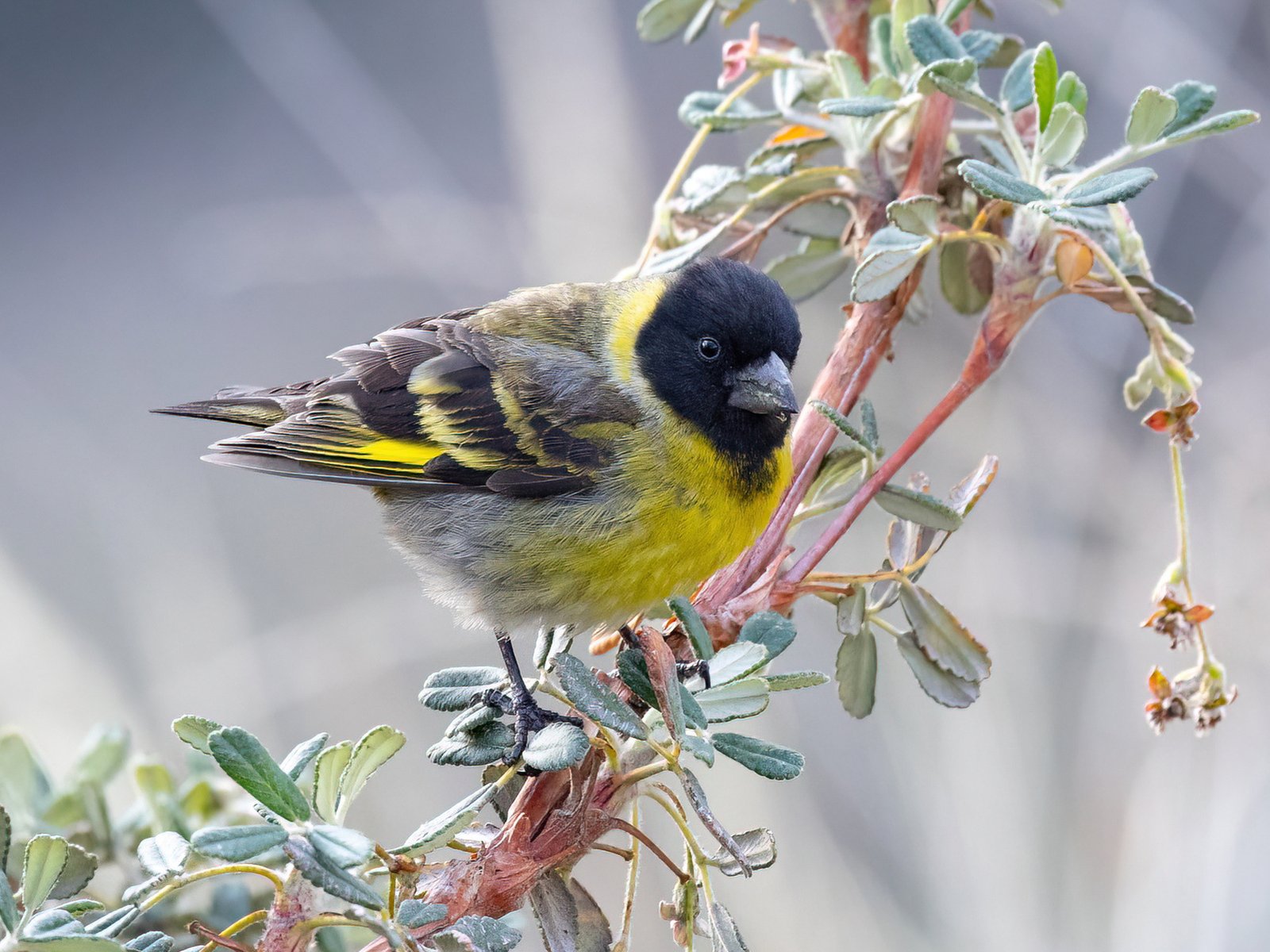
The Thick-billed Siskin is a large siskin of the high central Andes. It is closely tied to Polylepis woodland and scrub at high elevation. The heavy, conical bill separates it from the related Hooded Siskin, which it closely resembles in plumage.
Voice
The song is a rapid, varied series of twittering trills and wheezy notes, as in Hooded Siskin. The call is a short, clear whistle, and dry chit notes in flight.
Recording: Fabrice Schmitt — CC BY-NC-SA 4.0 · xeno-canto
Identification
13–14 cm, with a conspicuously thick, conical bill. The male has a black head and throat; the upperparts are greyish olive, the rump yellow and the underparts yellow, greyish on the flanks. The wings are black with a broad yellow band at the base of the flight feathers; the tail is black with a yellow base. The female lacks the hood and is greyish, with a grey head, greyish-yellow underparts and a narrower yellow wing band. Juveniles resemble the female.
Confusion species
Hooded Siskin Spinus magellanicus is smaller, with a clearly finer bill and a greener, streaked back; it usually lives lower, but the two species locally occur together. Black Siskin Spinus atratus is almost entirely black. Yellow-rumped Siskin Spinus uropygialis has a black back and breast. Female Hooded Siskins are greener and finer-billed.
Habitat
Polylepis woodland and groves, scrub with Gynoxys and other shrubs on rocky slopes, and the edges of fields in the higher valleys, mostly between 3000 and 4500 m. It eats seeds, especially of shrubs and Polylepis, and also buds. The nest is a cup of plant material in a tree or shrub.
Where the bird is most at home, classified by the vegetation units of the Andes and the west coast.


Range and movements
Absent from Colombia, Ecuador and the Galápagos. In Peru locally in the high Andes of the centre and the south. In Bolivia in the Andes of the west and centre. Outside the guide area in northern Chile and western Argentina.
- Resident
- dark = core range, pale = thinly spread
How and when to look
Search Polylepis groves and shrubby ravines at high elevation for small groups feeding on seeds in the canopy. Watch the bill: in a mixed group of siskins the heavy bill of this species stands out.
Conservation status
Least Concern. The species depends heavily on Polylepis woodland, which has been cleared in large parts of the Andes or is declining through grazing and fire.
Scientific name
Spinus crassirostris | (Landbeck, 1877)
Landbeck described the species in 1877 as Chrysomitris crassirostris; because it was later moved to another genus, the author and year stand in brackets. The genus Spinus was introduced in 1816 by Koch. The genus name comes from Greek spinos, the name of a bird that can no longer be identified. The species name comes from Latin crassus, 'thick', and rostrum, 'bill'. The specimen the first description was based on came from Uspallata and Portillo passes, Mendoza, Argentina.