All species › Passerines › Finches, euphonias and allies › Hooded Siskin
Hooded Siskin | Spinus magellanicus
Kapsijs | Jilguero encapuchado | Pintassilgo
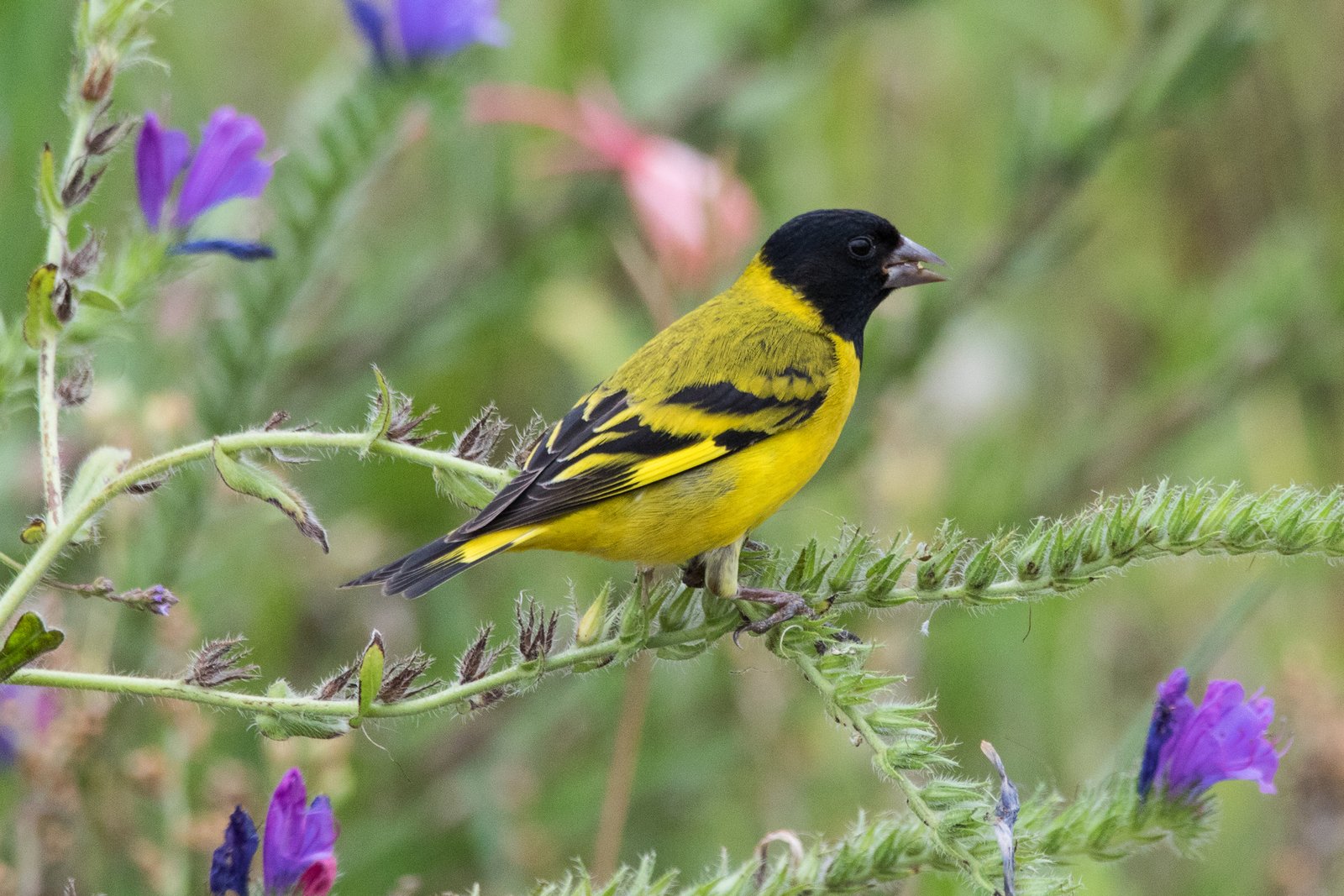
The Hooded Siskin is the most widespread siskin of South America and the commonest member of the genus in the guide area. The male has a black hood above a yellow body. Small groups search for seeds in semi-open country, from the coastal valleys to high in the Andes, and also visit villages, parks and gardens.
Voice
The song is a long, rapid, varied series of twittering trills, whistles and wheezy notes, often from a treetop or in song flight. The call is a thin, plaintive tsee-u; flocks in flight keep in contact with dry chit notes.
Recording: Étienne Leroy — CC BY-NC-SA 4.0 · xeno-canto
Identification
11–12 cm, with a short, pointed, conical bill and a slightly forked tail. The male has a black head and throat; the back is olive-green with dark streaks, and the rump is yellow. The underparts are bright yellow. The wings are black with a broad yellow band at the base of the flight feathers, conspicuous especially in flight; the tail is black with a yellow base. The female lacks the hood: the head and upperparts are greyish olive, the underparts dull greyish yellow, with the same yellow wing band. Juveniles resemble the female but are browner and faintly streaked.
Confusion species
Thick-billed Siskin Spinus crassirostris is larger, with a clearly thicker bill and a greyer back, and lives mainly high in Polylepis woodland. Olivaceous Siskin Spinus olivaceus is darker and greener, with olive-green underparts, and lives in humid montane forest on the eastern slope. Saffron Siskin Spinus siemiradzkii of the dry south-west is smaller and brighter saffron-yellow, with an unstreaked, yellowish-olive back. In the male Andean Siskin Spinus spinescens of Colombia and northern Ecuador only the crown is black, not the throat. Yellow-rumped Siskin Spinus uropygialis also has a black back and breast.
Habitat
Semi-open country with shrubs and trees: fields and terraces, hedgerows, dry scrub, riparian woodland, forest edges, parks and gardens, from sea level in Peru to about 4000 m. It eats mainly seeds of herbs and grasses (including composites), also buds and small insects, and often feeds on the ground or on thistles. The nest is a small cup of fine plant material in a tree or shrub.
Where the bird is most at home, classified by the vegetation units of the Andes and the west coast.


Range and movements
In Colombia in the south-west (Nariño). In Ecuador in the inter-Andean valleys and on the lower slopes, also in the dry south-west. In Peru widespread on the western slope, in the coastal valleys and in the inter-Andean valleys, locally on the eastern slope. In Bolivia widespread in the Andes and the valleys of the eastern slope. Absent from the Galápagos. Outside the guide area in parts of Venezuela and the Guianas, much of Brazil, Paraguay, Uruguay and Argentina.
- Resident
- dark = core range, pale = thinly spread
How and when to look
In villages, parks and field edges in the Andean valleys, look for small groups flying over with dry calls or perched on thistles and seeding herbs. Singing males often sit at the top of a tree or on a wire.
Conservation status
Least Concern. Common and well adapted to farmland. Locally trapped for the cage-bird trade.
Scientific name
Spinus magellanicus | (Vieillot, 1805)
Vieillot described the species in 1805 as Fringilla magellanica; because it was later moved to another genus, the author and year stand in brackets. The genus Spinus was introduced in 1816 by Koch. The genus name comes from Greek spinos, the name of a bird that can no longer be identified. The species name refers to the Strait of Magellan, from where the species was wrongly said to come; it is not the type locality. The specimen the first description was based on came from Buenos Aires, Argentina.