All species › Passerines › Finches, euphonias and allies › Saffron Siskin
Saffron Siskin | Spinus siemiradzkii
Saffraansijs | Jilguero azafranado | Pintassilgo-açafrão
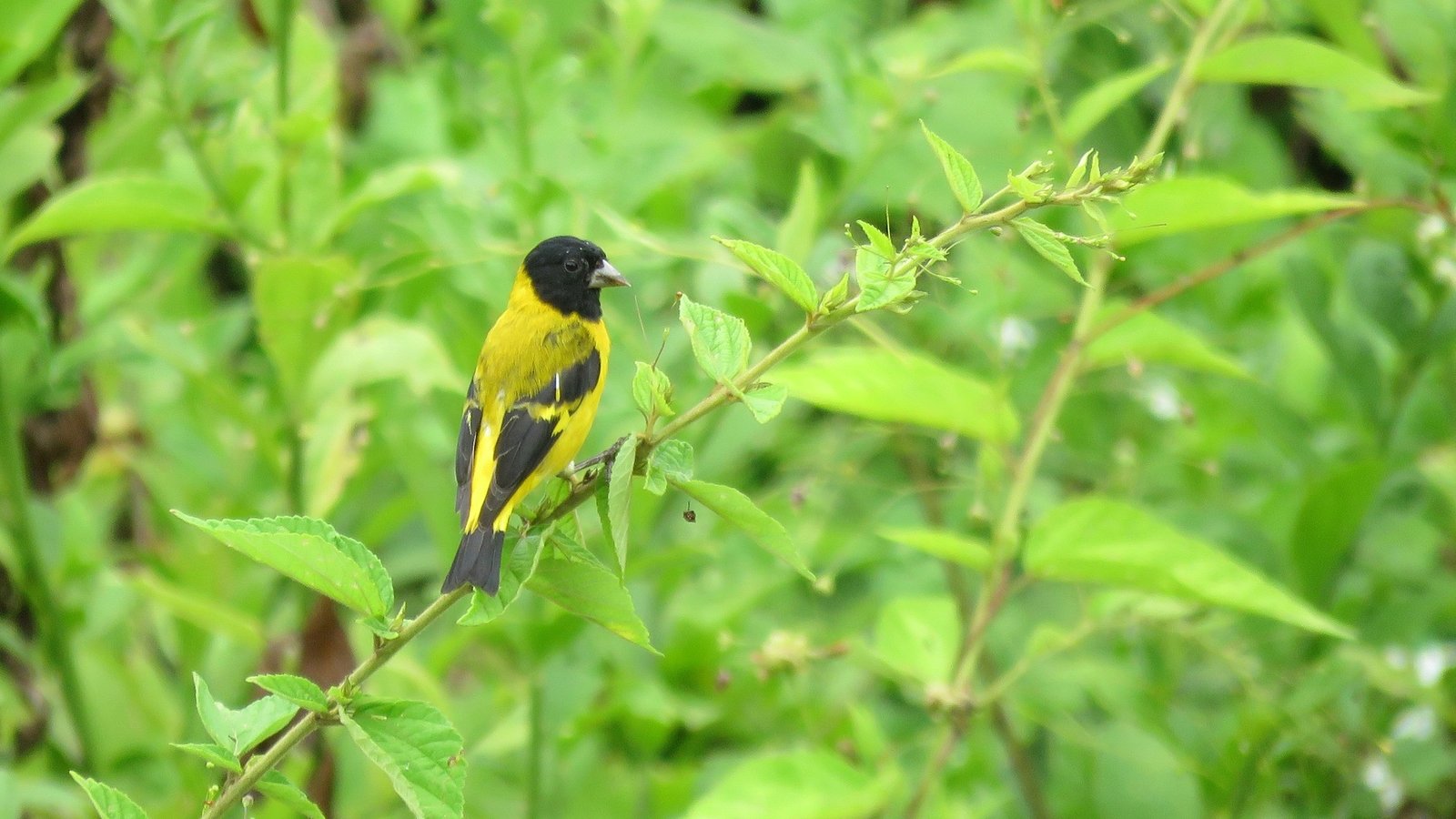
The Saffron Siskin is a small siskin found only in the Tumbesian region of south-western Ecuador and north-western Peru. The male is a brighter and more uniform saffron-yellow than the related Hooded Siskin. Small groups wander through dry forest and scrub and are strongly dependent on the rainy season.
Voice
The song is a rapid, varied series of twittering trills and whistles, similar to that of Hooded Siskin. The call is a thin whistle, and dry notes in flight.
Recording: John V. Moore — CC BY-NC-SA 4.0 · xeno-canto
Identification
10–11 cm, with a short, pointed bill. The male has a black head and throat; the back is yellowish olive and barely streaked, and the rump and underparts are bright saffron-yellow. The wings are black with a broad yellow band, and the tail is black with a yellow base. The female lacks the hood and is olive-yellow, with yellower underparts than the female Hooded Siskin and a yellow wing band. Juveniles resemble the female.
Confusion species
Hooded Siskin Spinus magellanicus occurs in the same region but is larger, with a greener, clearly streaked back and less bright yellow; it usually lives higher up. The female Lesser Goldfinch Spinus psaltria has a white wing patch instead of a yellow band. Yellow-finches such as Saffron Finch Sicalis flaveola are larger, with an orange forehead and no black in the wings.
Habitat
Edges of deciduous dry forest, thorn scrub, shrubby pastures and the surroundings of farms in the lowlands and low hills, mostly below 600 m. It eats seeds of herbs and grasses. Groups wander and are more numerous in wet years. The nest is a small cup in a shrub or tree.
Where the bird is most at home, classified by the vegetation units of the Andes and the west coast.


Range and movements
Absent from Colombia, Bolivia and the Galápagos. In Ecuador in the dry south-west, from the coast of Manabí and Guayas to El Oro and Loja. In Peru only in the far north-west, in Tumbes and locally adjacent areas. Not found outside the guide area.
- Resident
- dark = core range, pale = thinly spread
How and when to look
In the rainy season, search the edges of dry forest in south-western Ecuador and Tumbes for groups feeding on seeding herbs. Outside the breeding season they may be locally absent.
Conservation status
Least Concern. Formerly considered Vulnerable; the species has a small range, and Tumbesian dry forest is declining through logging and grazing. Locally trapped as a cage bird.
Scientific name
Spinus siemiradzkii | (Berlepsch & Taczanowski, 1884)
Berlepsch & Taczanowski described the species in 1884 as Chrysomitris siemiradzkii; because it was later moved to another genus, the author and year stand in brackets. The genus Spinus was introduced in 1816 by Koch. The genus name comes from Greek spinos, the name of a bird that can no longer be identified. The species name honours Józef Siemiradzki (1858–1933), a Polish geologist and palaeontologist who collected birds in Ecuador. The specimen the first description was based on came from Guayaquil, Ecuador.