All species › Passerines › Finches, euphonias and allies › Olivaceous Siskin
Olivaceous Siskin | Spinus olivaceus
Olijfgele sijs | Jilguero oliváceo | Pintassilgo-oliváceo
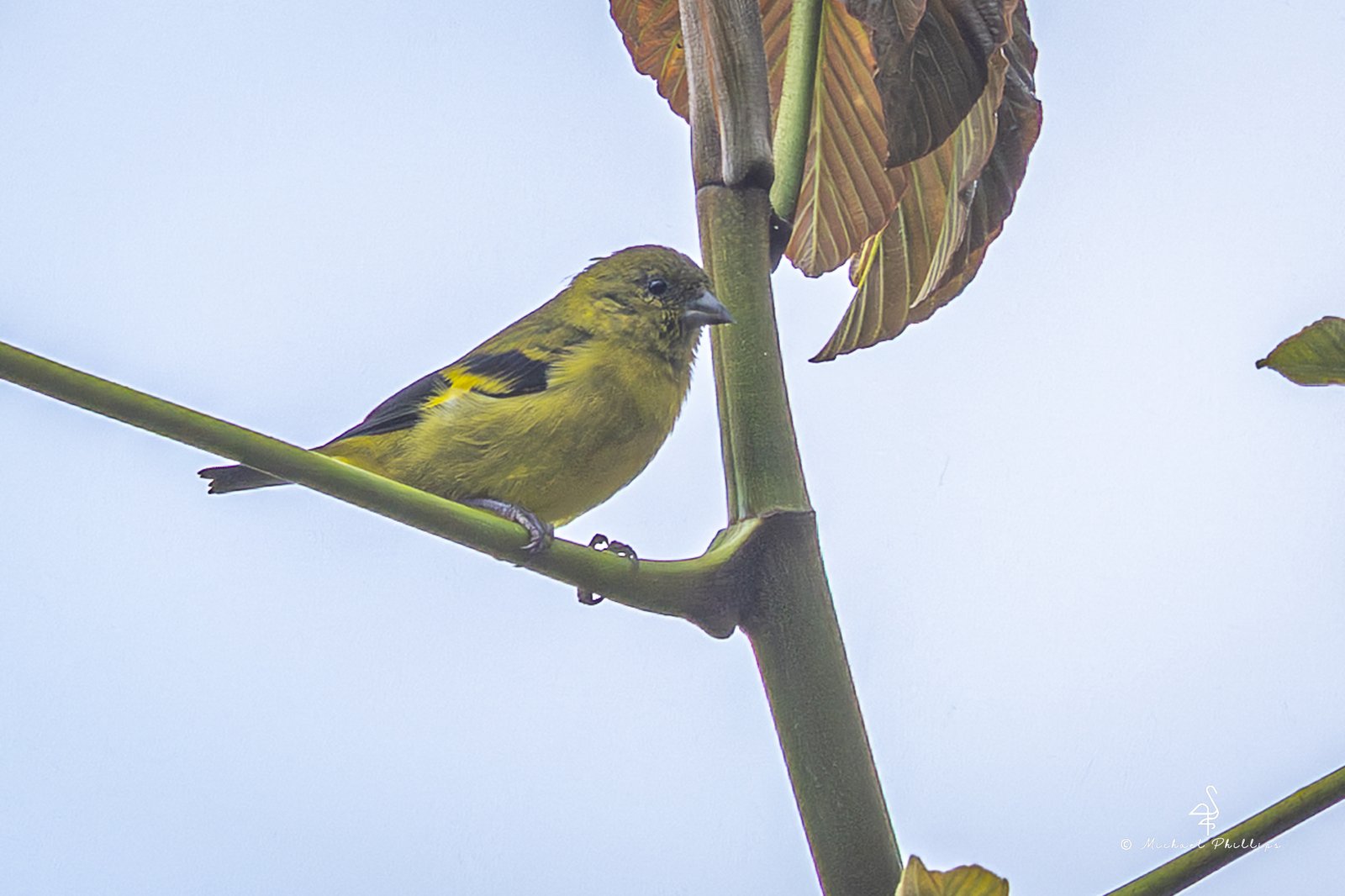
The Olivaceous Siskin is the siskin of the humid montane forest on the eastern slope of the Andes. It closely resembles Hooded Siskin but is darker and greener and lives in a different habitat. Small groups move through forest edges and clearings in cloud forest and lower montane forest.
Voice
The song is a rapid, varied series of twittering trills and whistles. The call is a thin, plaintive whistle, and dry notes in flight.
Recording: Mitch Lysinger — CC BY-NC-SA 4.0 · xeno-canto
Identification
11 cm, with a short, pointed bill. The male has a black head and throat; the upperparts are dark olive-green, the rump yellowish green and the underparts olive-yellow, greenish on the breast and flanks. The wings are black with a yellow band, and the tail is black with a yellow base. The female lacks the hood and is uniformly dark olive, with olive-yellow underparts and a yellow wing band. Juveniles resemble the female.
Confusion species
Hooded Siskin Spinus magellanicus has brighter yellow underparts and a paler, streaked back, and lives in open, drier country; where both occur, the colour of the underparts is the best feature. In the male Andean Siskin Spinus spinescens of the north only the crown is black. Yellow-bellied Siskin Spinus xanthogastrus is blacker, with a black breast and a yellow belly.
Habitat
Edges and clearings of humid montane forest and cloud forest, overgrown clearings with shrubs, and roadsides and pastures with scattered trees, roughly between 1000 and 3000 m. It eats seeds of herbs and trees, and also buds. The nest is a small cup in a tree or shrub.
Where the bird is most at home, classified by the vegetation units of the Andes and the west coast.


Range and movements
Not reliably recorded in Colombia. In Ecuador on the eastern slope of the Andes in the south. In Peru along almost the entire eastern slope. In Bolivia on the eastern slope of the Andes in the west and centre. Absent from the Galápagos. Not found outside the guide area.
- Resident
- dark = core range, pale = thinly spread
How and when to look
Along roads through montane forest on the eastern slope, for example in the Yungas and the mountains above the Amazonian foothills, look for small groups at forest edges and in trees around clearings.
Conservation status
Least Concern. Locally common; it benefits in part from clearings and forest edges, but depends on montane forest nearby.
Scientific name
Spinus olivaceus | Berlepsch & Sztolcman, 1894
Berlepsch & Sztolcman described the species in 1894 and placed it straight away in the genus where it still stands. The genus Spinus was introduced in 1816 by Koch. The genus name comes from Greek spinos, the name of a bird that can no longer be identified. The species name is Latin olivaceus, 'olive-coloured', after the olive-green plumage. The specimen the first description was based on came from Vitoc, Junín, Peru.