All species › Passerines › Finches, euphonias and allies › Black Siskin
Black Siskin | Spinus atratus
Zwarte sijs | Jilguero negro | Pintassilgo-preto
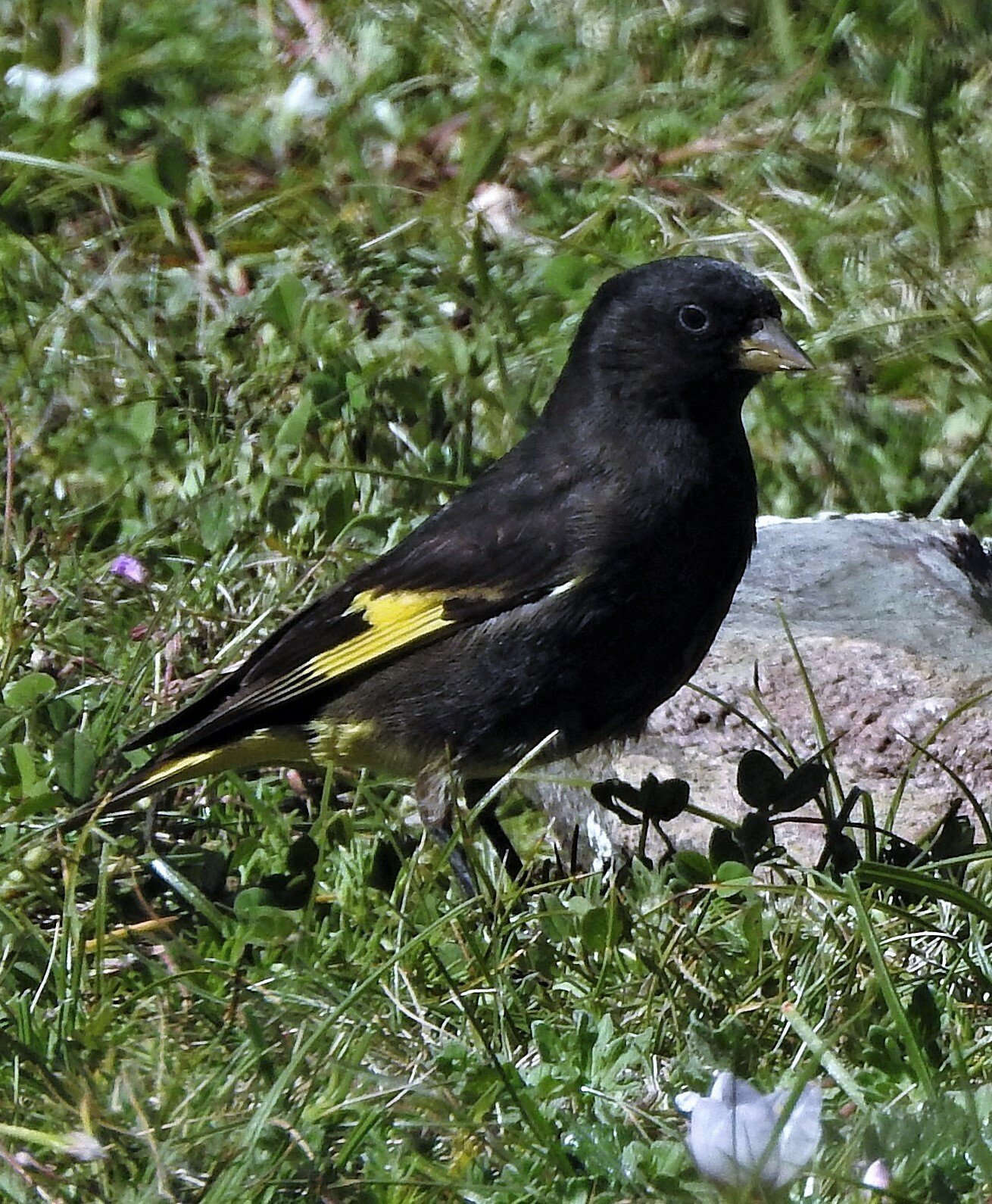
The Black Siskin is an almost entirely black siskin of the puna and altiplano. Only the yellow wing band, the yellow tail base and the yellow lower underparts break up the dark plumage. It lives at high elevation in rocky, open country and also nests in villages.
Voice
The song is a rapid, twittering series of trills and wheezy notes, similar to that of Hooded Siskin. The call is a clear, rising whistle, and dry notes in flight.
Recording: Pamela Jenny Carvajal Bacarreza — CC BY-NC-SA 4.0 · xeno-canto
Identification
12–13 cm, with a pointed, conical bill. The male is glossy black, with a broad, bright yellow band at the base of the flight feathers, yellow bases to the outer tail feathers, and a yellow lower belly and undertail coverts. The female is duller, sooty brown to blackish, with less yellow on the belly and tail, but with the same wing band. Juveniles are brownish and faintly streaked.
Confusion species
With its black plumage and yellow in wing and tail it is hardly confusable. Yellow-rumped Siskin Spinus uropygialis also has a black head, back and breast, but a yellow rump and a yellow belly. Thick-billed Siskin Spinus crassirostris and Hooded Siskin Spinus magellanicus have only a black hood and are otherwise yellow and olive. Black-hooded Sierra Finch Phrygilus atriceps has a black head, but a rufous-brown back and no yellow wing band.
Habitat
Open puna and altiplano with rocks, steep shrubby slopes, ravines, the surroundings of bofedales, and villages and farms, mostly between 3500 and 4800 m. It eats seeds of herbs and grasses, often on or near the ground. The nest is in a rock crevice, a hole in a wall or under a roof.
Where the bird is most at home, classified by the vegetation units of the Andes and the west coast.


Range and movements
Absent from Colombia, Ecuador and the Galápagos. In Peru in the high Andes of the centre and the south. In Bolivia on the altiplano and in the high Andes of the west. Outside the guide area in northern Chile and north-western Argentina.
- Resident
- dark = core range, pale = thinly spread
How and when to look
In puna villages and along rocky slopes, look for small groups flushing with their yellow wing bands. They often perch on roofs and walls and feed on the ground together with other seedeaters.
Conservation status
Least Concern. Locally fairly common; no major threats are known.
Scientific name
Spinus atratus | (d'Orbigny, ACVMD & de Lafresnaye, 1837)
D'Orbigny, ACVMD & de Lafresnaye described the species in 1837 as Carduelis atratus; because it was later moved to another genus, the author and year stand in brackets. The genus Spinus was introduced in 1816 by Koch. The genus name comes from Greek spinos, the name of a bird that can no longer be identified. The species name is Latin atratus, 'clothed in black', after the black plumage. The specimen the first description was based on came from La Paz, Bolivia.