All species › Passerines › Finches, euphonias and allies › Yellow-rumped Siskin
Yellow-rumped Siskin | Spinus uropygialis
Geelstuitsijs | Jilguero cordillerano | Pintassilgo-de-uropígio-amarelo
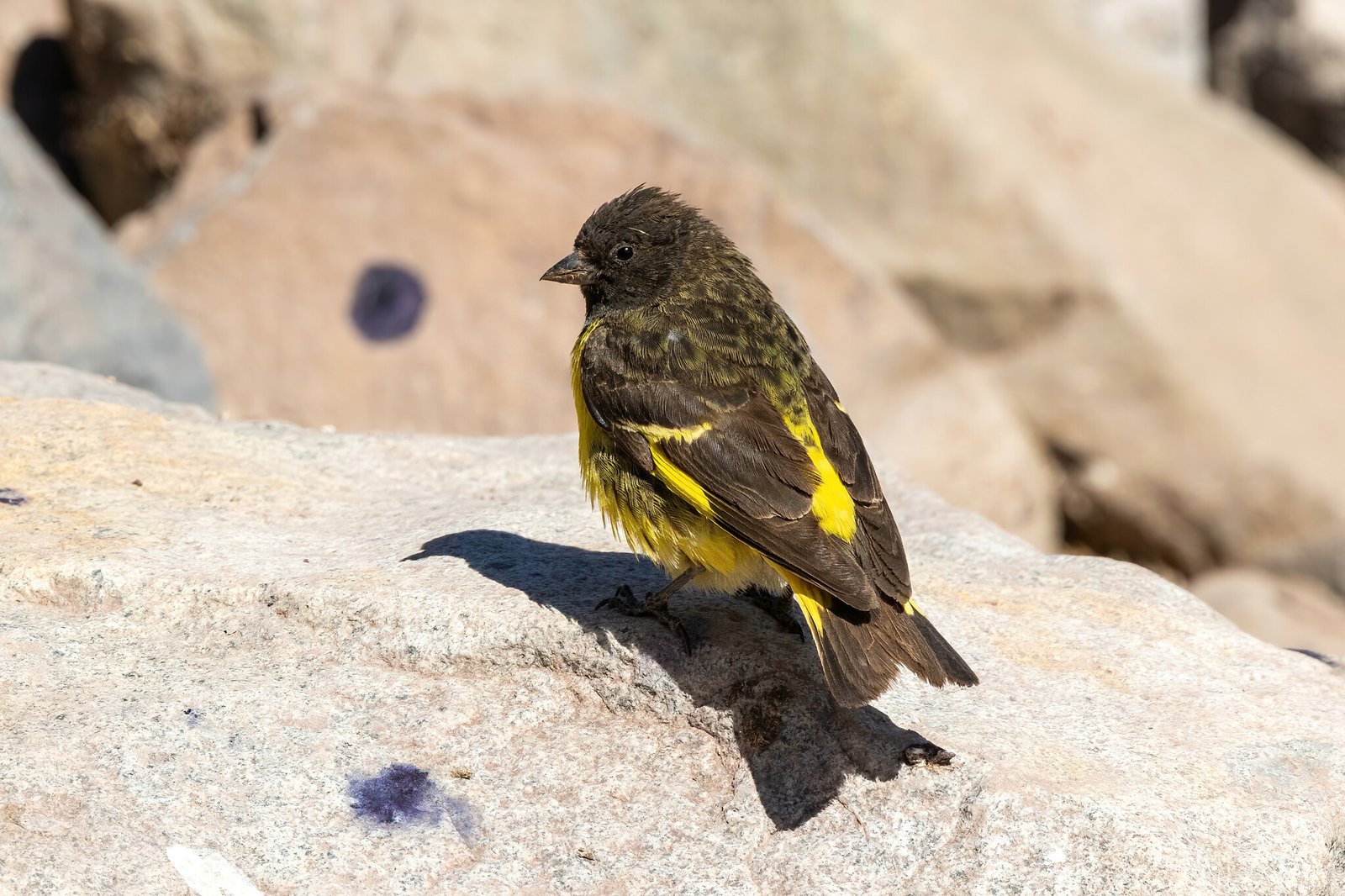
The Yellow-rumped Siskin is a siskin of the dry Andes of Chile and Argentina that reaches only the southern edge of the guide area. The male is darker than other black-hooded siskins, with a black head, breast and back and a bright yellow rump. In the guide area it is scarce and local.
Voice
The song is a long, rapid series of twittering trills, whistles and wheezy notes, similar to that of Hooded Siskin. The call is a clear whistle, and dry notes in flight.
Recording: Cristian Pinto — CC BY-NC-SA 4.0 · xeno-canto
Identification
13 cm, with a pointed, conical bill. The male has a black head, throat and breast; the back is black with olive-yellow fringes, giving a mottled look, and the rump is bright yellow. The belly and flanks are yellow. The wings are black with a broad yellow band, and the tail is black with a yellow base. The female is duller, with a greyish olive, mottled head and back and a less bright yellow rump. Juveniles are browner and streaked.
Confusion species
Hooded Siskin Spinus magellanicus and Thick-billed Siskin Spinus crassirostris have an olive or greyish-olive back and a yellow breast; the black is confined to the head and throat. Black Siskin Spinus atratus is almost entirely black, without a yellow rump and with only the lower belly yellow. Females can be recognised by the mottled back and the yellow rump.
Habitat
Shrubby mountain slopes, ravines with scrub, Polylepis groves, riparian thickets along streams and the edges of fields in dry valleys, roughly between 2500 and 4000 m. It eats seeds of herbs, shrubs and trees. The nest is a cup of plant material in a shrub or tree.
Where the bird is most at home, classified by the vegetation units of the Andes and the west coast.


Range and movements
Absent from Colombia, Ecuador and the Galápagos. In Peru scarce and local in the south-west. In Bolivia scarce in the south-west. Its occurrence at the northern edge of the range and its seasonal movements are poorly known. The main range lies outside the guide area, in Chile and western Argentina.
- Resident
- Summer visitor (c. Apr–Sep)
- Winter visitor (c. Oct–Mar)
- Passage (Mar–Apr, Oct–Nov)
- dark = core range, pale = thinly spread
How and when to look
In the far south of Peru and south-western Bolivia, search shrubby slopes and ravines for small groups of siskins and check them for a black back and a yellow rump.
Conservation status
Least Concern. Common within its main range; scarce in the guide area, with no specific threats known.
Scientific name
Spinus uropygialis | (Sclater, 1862)
Sclater described the species in 1862 as Chrysomitris uropygialis; because it was later moved to another genus, the author and year stand in brackets. The genus Spinus was introduced in 1816 by Koch. The genus name comes from Greek spinos, the name of a bird that can no longer be identified. The species name comes from Latin uropygium, 'rump', after the yellow rump. The specimen the first description was based on came from Chile.