All species › Passerines › Finches, euphonias and allies › Black-chinned Siskin
Black-chinned Siskin | Spinus barbatus
Zwartkinsijs | Jilguero golinegro | Pintassilgo-de-queixo-preto
The Black-chinned Siskin is the southernmost siskin of South America, a bird of the temperate forests, scrub and gardens of Chile and Argentina south to Tierra del Fuego and the Falkland Islands. In the guide area it is at most a rare vagrant; no confirmed records are known.
Voice
The song is a long, rapid series of twittering trills, whistles and wheezy notes. The call is a thin, plaintive whistle.
Recording: Cristian Pinto Fernandez — CC BY-NC-SA 4.0 · xeno-canto
Identification
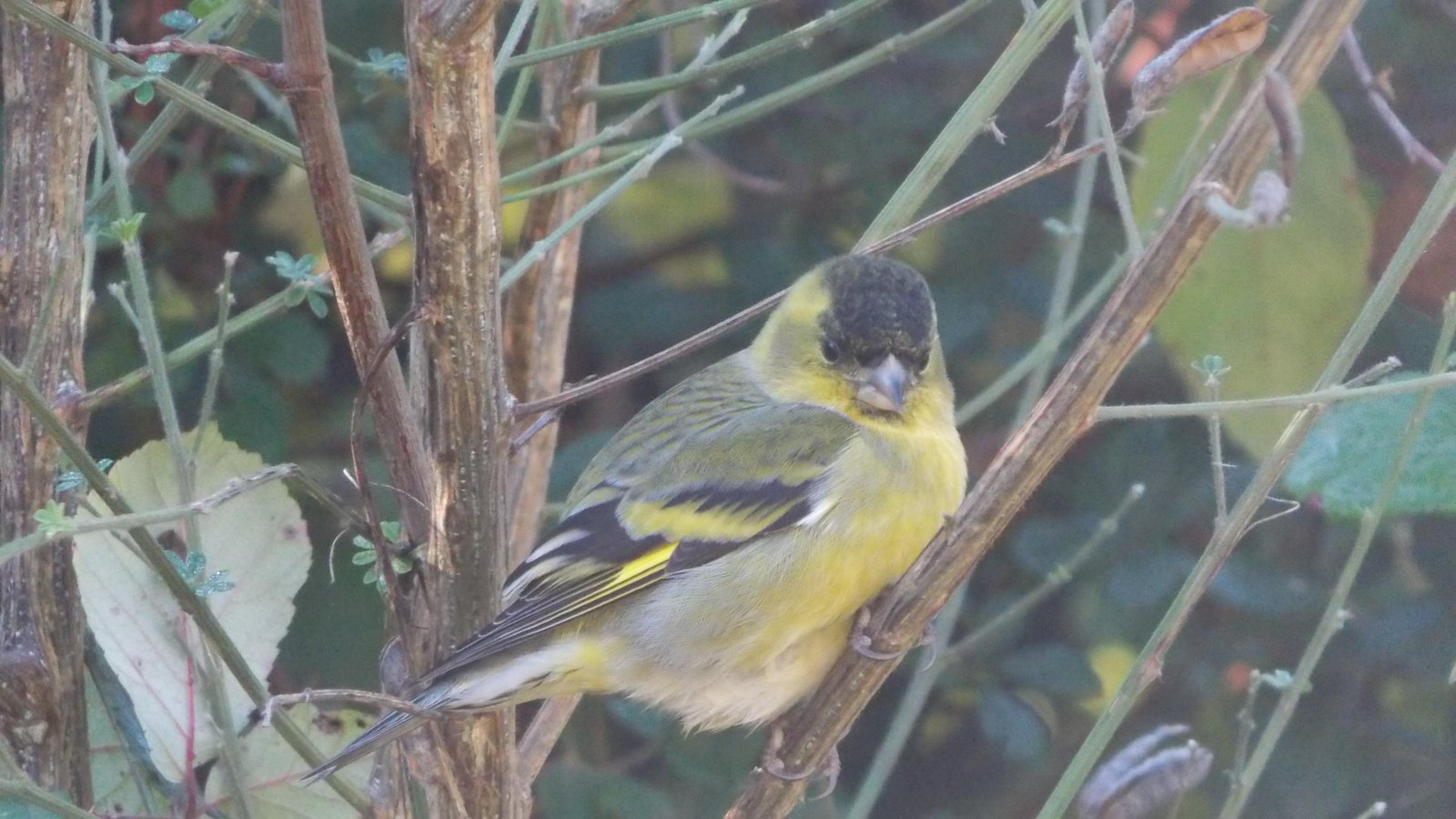
12–13 cm, with a pointed, conical bill. The male has a black crown and a small black chin patch; the rest of the head and the underparts are yellow to olive-yellow, and the back is olive-green with dark streaks. The wings are black with a broad yellow band, and the tail is black with a yellow base. The female lacks the black crown and chin and is greyish olive, with a yellow wing band.
Confusion species
The male Hooded Siskin Spinus magellanicus has a completely black head and throat instead of only a black crown and chin. Andean Siskin Spinus spinescens has a similar pattern but lives far to the north, in Colombia and Ecuador. Females of the various siskins can be separated in the field only with close attention.
Habitat
In its main range temperate broadleaf forest and forest edges, scrub, orchards, parks and gardens, from sea level to the tree line. It eats seeds of herbs and trees, and also buds. Any vagrant in the guide area would be expected first in gardens, field edges and riparian thickets in the south.
Where the bird is most at home, classified by the vegetation units of the Andes and the west coast.


Range and movements
Not reliably recorded in Colombia, Ecuador, Peru or Bolivia, nor on the Galápagos. The range lies outside the guide area, in central and southern Chile, western and southern Argentina, Tierra del Fuego and the Falkland Islands.
How and when to look
A siskin with a black crown and black chin in southern Peru or Bolivia deserves careful documentation with photographs; also consider escaped cage birds.
Conservation status
Least Concern. Common within its range and adapted to farmland.
Scientific name
Spinus barbatus | (Molina, 1782)
Molina described the species in 1782 as Fringilla barbata; because it was later moved to another genus, the author and year stand in brackets. The genus Spinus was introduced in 1816 by Koch. The genus name comes from Greek spinos, the name of a bird that can no longer be identified. The species name is Latin barbatus, 'bearded', after the black chin. The specimen the first description was based on came from Valparaíso, Chile.