All species › Passerines › Finches, euphonias and allies › Atlantic Canary
Atlantic Canary | Serinus canaria
Kanarie | Serín canario | Canário-belga
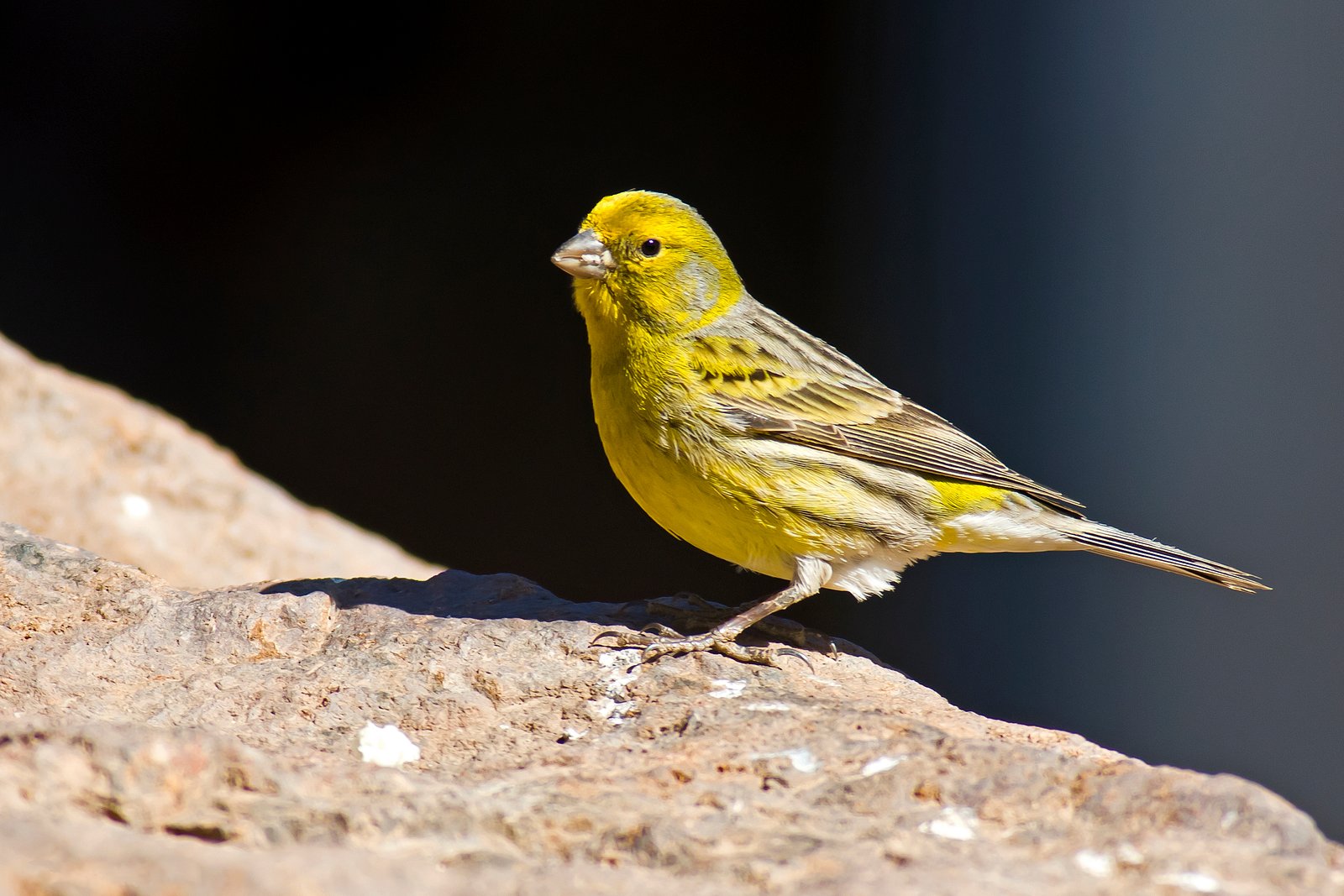
The Atlantic Canary is a finch of the Canary Islands, Madeira and the Azores that has been kept as a cage bird for centuries. In the guide area it occurs as escaped domestic birds in and around towns and villages. No self-sustaining, established population is known in the guide area.
Voice
The song is a long, varied series of rolls, trills and clear whistles; the call is a rising tsoo-eet.
Recording: Radek Grochowski — CC BY-NC-SA 4.0 · xeno-canto
Identification
12–13 cm, a small finch with a short, conical bill and a slightly forked tail. The wild form is grey-green and streaked above, with a yellow-green head and breast and a paler, streaked belly; the female is greyer and more heavily streaked. Domestic birds vary greatly: all yellow, orange-yellow, white, greenish or pied, sometimes crested, and are often larger and heavier than wild birds.
Confusion species
Saffron Finch Sicalis flaveola, locally also called 'canario', is larger, with an orange forehead and a greyish bill, and occurs wild in the guide area. Grassland Yellow Finch Sicalis luteola is streaked above and lives in open grassland. Lesser Goldfinch Spinus psaltria and other siskins show black and white or yellow in the wing.
Habitat
In the guide area in towns, villages, parks and gardens and sometimes in nearby fields and orchards. It eats seeds of grasses and herbs. In its native range it breeds in forest edges, scrub, vineyards and gardens; the nest is an open cup in a shrub or tree.
Where the bird is most at home, classified by the vegetation units of the Andes and the west coast.


Range and movements
In Colombia, Ecuador, Peru and Bolivia only isolated reports of escaped birds, mainly in and around towns; some of the reports may refer to Saffron Finches. Not known from the Galápagos. Outside the guide area wild in the Canary Islands, Madeira and the Azores, and feral on a few islands elsewhere in the world.
- Summer visitor (c. Apr–Sep)
- dark = core range, pale = thinly spread
How and when to look
A canary in the guide area is almost always an escaped cage bird; on yellow finches in towns, check the head and bill to rule out Saffron Finch.
Conservation status
Least Concern. In the guide area the species is introduced; there is no evidence of a lasting wild population.
Scientific name
Serinus canaria | (Linnaeus, 1758)
Linnaeus described the species in 1758 as Fringilla Canaria; because it was later moved to another genus, the author and year stand in brackets. The genus Serinus was introduced in 1816 by Koch. The genus name is New Latin for 'canary-yellow', from French serin, 'serin' or 'canary'. The species name refers to the Canary Islands, not necessarily the type locality. The specimen the first description was based on came from Canary Islands.