All species › Waders, gulls and terns › Skimmers, noddies, terns and gulls › Arctic Tern
Arctic Tern | Sterna paradisaea
Noordse stern | Charrán ártico | Trinta-réis-ártico
The Arctic Tern makes the longest annual migration of any bird: it breeds in the Arctic and winters in the waters around Antarctica, so experiencing two summers a year. On the way south and back part of the population passes through the Pacific off the west coast of South America. In the guide area it is seen mainly far offshore and only rarely from the coast.
Voice
A high, rasping kree-err and a short kik; higher and shriller than in Common Tern.
Recording: Stanislas Wroza — CC BY-NC-SA 4.0 · xeno-canto
Identification
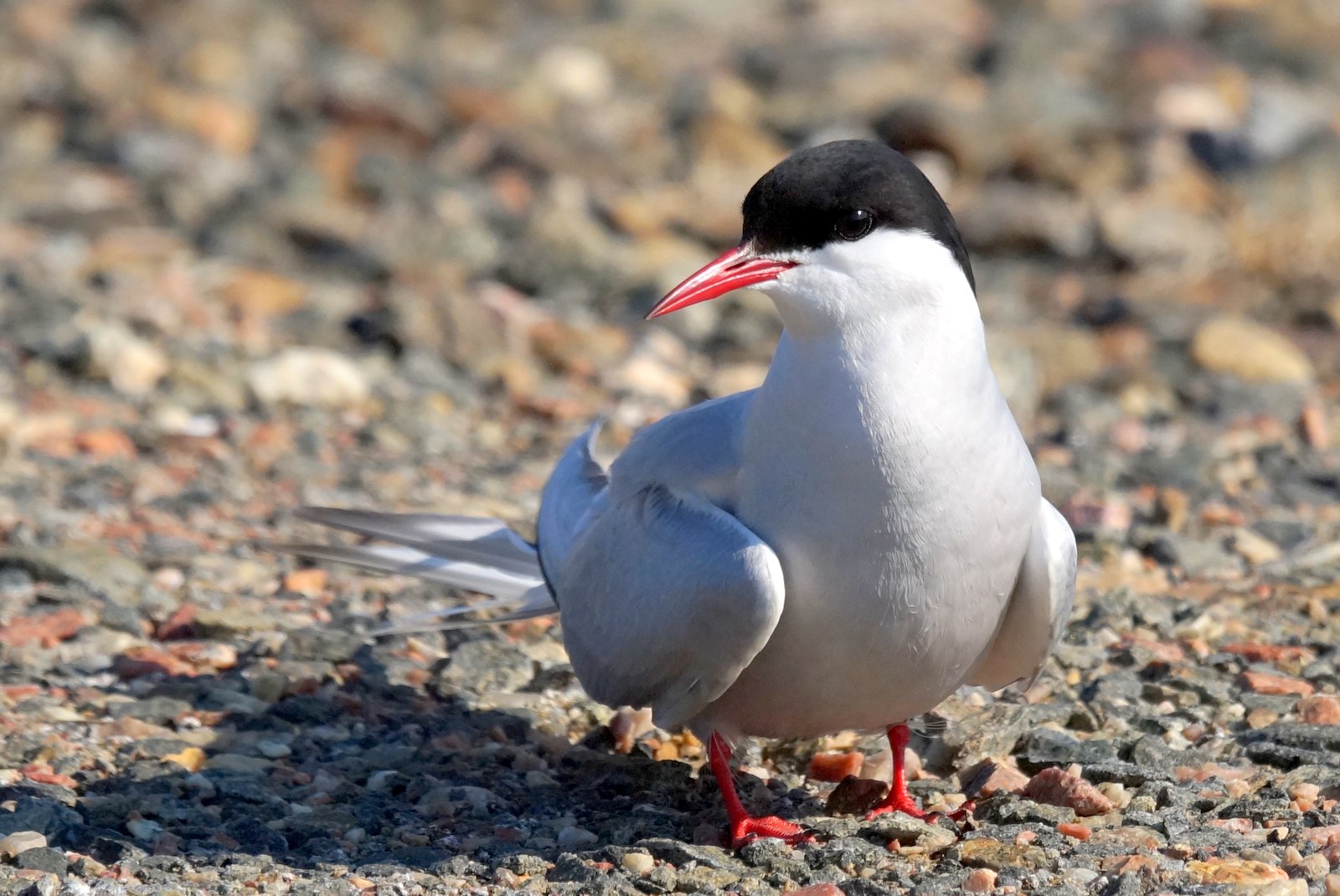
33–39 cm including the long tail streamers, a slender tern with a round head, a short neck, very short red legs and a fairly short bill. In breeding plumage, sometimes already visible in April–May, the cap is black, the bill entirely dark red and the underparts grey, with white cheeks. Outside the breeding season the forehead is white and the bill blackish, with a narrow dark bar on the forewing. From below all the primaries look translucent, with a narrow, sharp black trailing edge. Juveniles have a white forehead, a dark bar along the forewing, white secondaries and a shorter tail. The sexes are alike.
Confusion species
Common Tern Sterna hirundo has longer legs, a longer bill and a flatter head; from below only the inner primaries are translucent, and the trailing edge of the primaries is broader and more diffuse. South American Tern Sterna hirundinacea is larger, with a longer, heavier red bill. Snowy-crowned Tern Sterna trudeaui has a white head with a black eye mask and a yellow bill with a black band.
Habitat
On migration mainly over the open ocean, far offshore, where it feeds with other seabirds on small fish and zooplankton at the surface. It sometimes rests on floating objects or on the water. Rarely on beaches and in harbours; a few birds, mainly juveniles, have been seen on lakes high in the Andes. It does not breed in the guide area.
Where the bird is most at home, classified by the vegetation units of the Andes and the west coast.


Range and movements
In Colombia, Ecuador and Peru a passage migrant at sea off the Pacific coast; rarely seen from land. Rare around the Galápagos. There are a few records of birds on lakes in the Andes of Peru and Bolivia. Breeds around the North Pole in North America, Greenland, Europe and Asia and winters in the southern oceans as far as the Antarctic pack ice.
- Summer visitor (c. Apr–Sep)
- Winter visitor (c. Oct–Mar)
- Passage (Mar–Apr, Oct–Nov)
- dark = core range, pale = thinly spread
How and when to look
On pelagic trips off Ecuador and Peru, mainly in October–November and April–May; among groups of Common Terns look for birds with a shorter bill, a round head and translucent wings.
Conservation status
Least Concern. Local declines on the breeding grounds are linked to changes in food supply at sea and to predation in the colonies.
Scientific name
Sterna paradisaea | Pontoppidan, 1763
Pontoppidan described the species in 1763 and placed it straight away in the genus where it still stands. The genus Sterna was introduced in 1758 by Linnaeus. The genus name comes from Old English stearn, a word for a tern; the Frisians had a similar word. The species name comes from Late Latin paradisus, 'paradise'; why Pontoppidan chose it is not known. The specimen the first description was based on came from Christiansø, Denmark.