All species › Passerines › Crows, jays and magpies › Azure-naped Jay
Azure-naped Jay | Cyanocorax heilprini
Azuurnekgaai | Urraca nuquiazul | Gralha-de-nuca-azul
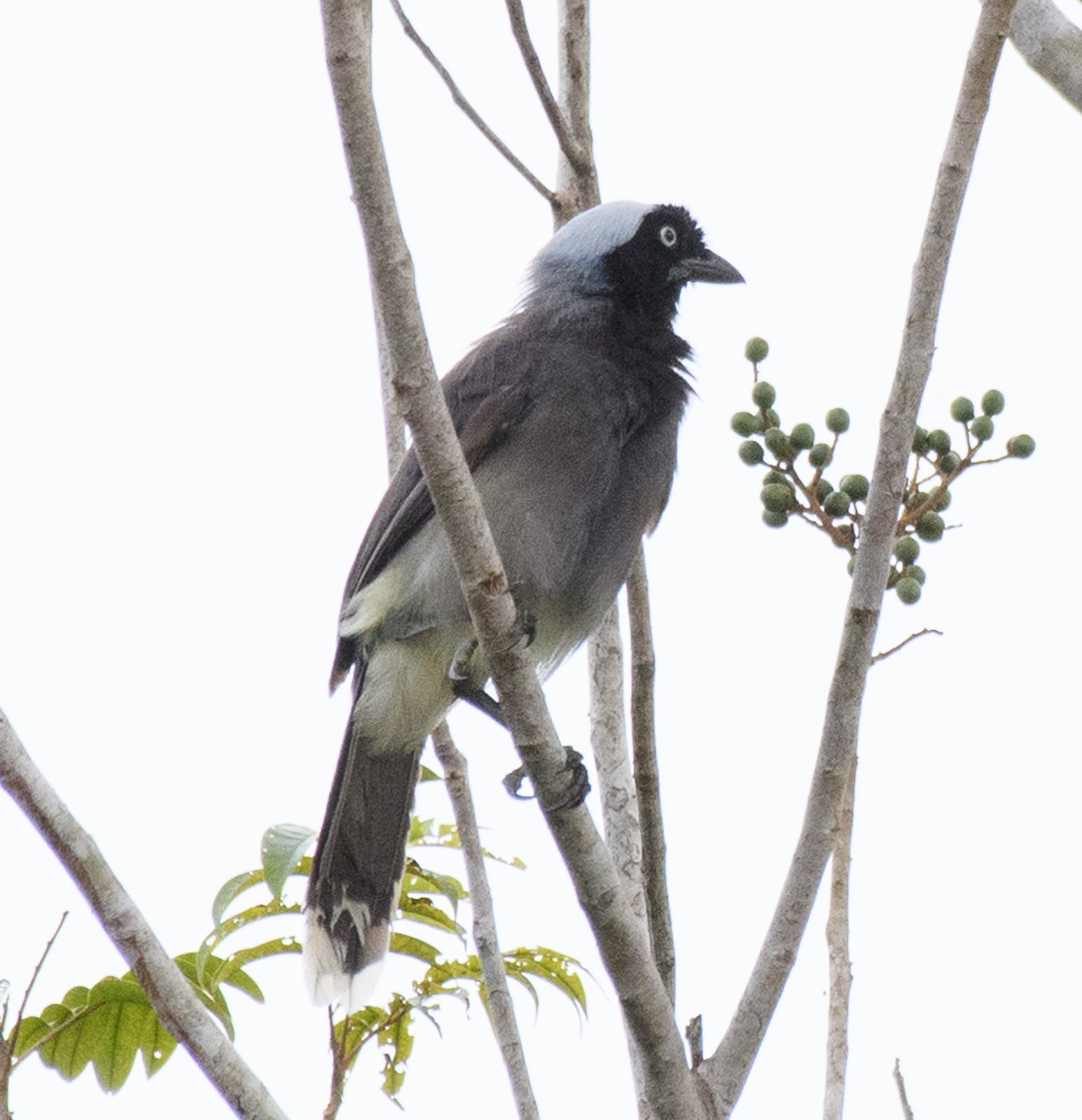
The Azure-naped Jay is a dark jay of the white-sand forests of the border region of Colombia, Venezuela and Brazil, with a pale blue nape and a short, forward-curled crest. It lives in groups in low forest on poor sandy soil and avoids the tall rainforest nearby. In the guide area it occurs only in the far east of Colombia.
Voice
Loud, hoarse and raw calls, often repeated in turn by several birds of the group.
Recording: Jaime Suárez — CC BY-NC-SA 4.0 · xeno-canto
Identification
33–36 cm, with a black bill, a long tail and a short, bushy crest of forward-curled feathers on the forehead. The forehead, crown and sides of the head are black, with a narrow blue moustachial stripe. The hindcrown and nape are bright pale blue, becoming whitish behind. The throat and breast are dark sepia to violet grey, and the belly shades from violet to white. The upperparts are dark violet brown, and the tail has a white tip. The iris is yellowish white, the legs black. The sexes are alike.
Confusion species
Violaceous Jay Cyanocorax violaceus occurs in the same part of Colombia, but lives along rivers and at forest edges; it is uniform violet blue, with a dark iris, no crest and no white tail tip.
Habitat
Low forest on white sand, forest edges and second growth on sandy soil, and open savanna woodland with scattered trees and shrubs, in the lowlands up to about 250 m. It avoids the tall terra firme rainforest and the flooded forest in the surroundings. It probably eats insects, other invertebrates and fruit, like other jays of the genus.
Where the bird is most at home, classified by the vegetation units of the Andes and the west coast.


Range and movements
In Colombia only in the far east: in southern Guainía and the extreme south-east of Vaupés, possibly also in south-eastern Vichada. Absent from Ecuador, Peru, Bolivia and the Galápagos. Outside the guide area in south-western Venezuela (Amazonas) and extreme north-western Brazil, along the upper Rio Negro.
- Resident
- dark = core range, pale = thinly spread
How and when to look
In the low white-sand forest of Guainía, where groups move through the shrub layer and along the forest edges.
Conservation status
Not Evaluated. Its habitat lies in a little-developed part of the Amazon and Orinoco basins and is largely intact, but the species is tied to white-sand forest, which occurs in scattered patches.
Scientific name
Cyanocorax heilprini | Gentry, 1885
Gentry described the species in 1885 and placed it straight away in the genus where it still stands. The genus Cyanocorax was introduced in 1826 by Boie. The genus name comes from Ancient Greek kuanos, 'dark blue', and korax, 'raven'. The species name honours Angelo Heilprin (1853-1907), Hungarian-born American geologist, palaeontologist and explorer, and a friend of the describer Gentry. The specimen the first description was based on came from Rio Negro (Amazon basin).