All species › Passerines › Crows, jays and magpies › Black-chested Jay
Black-chested Jay | Cyanocorax affinis
Zwartborstgaai | Chara pechinegra | Gralha-de-peito-preto
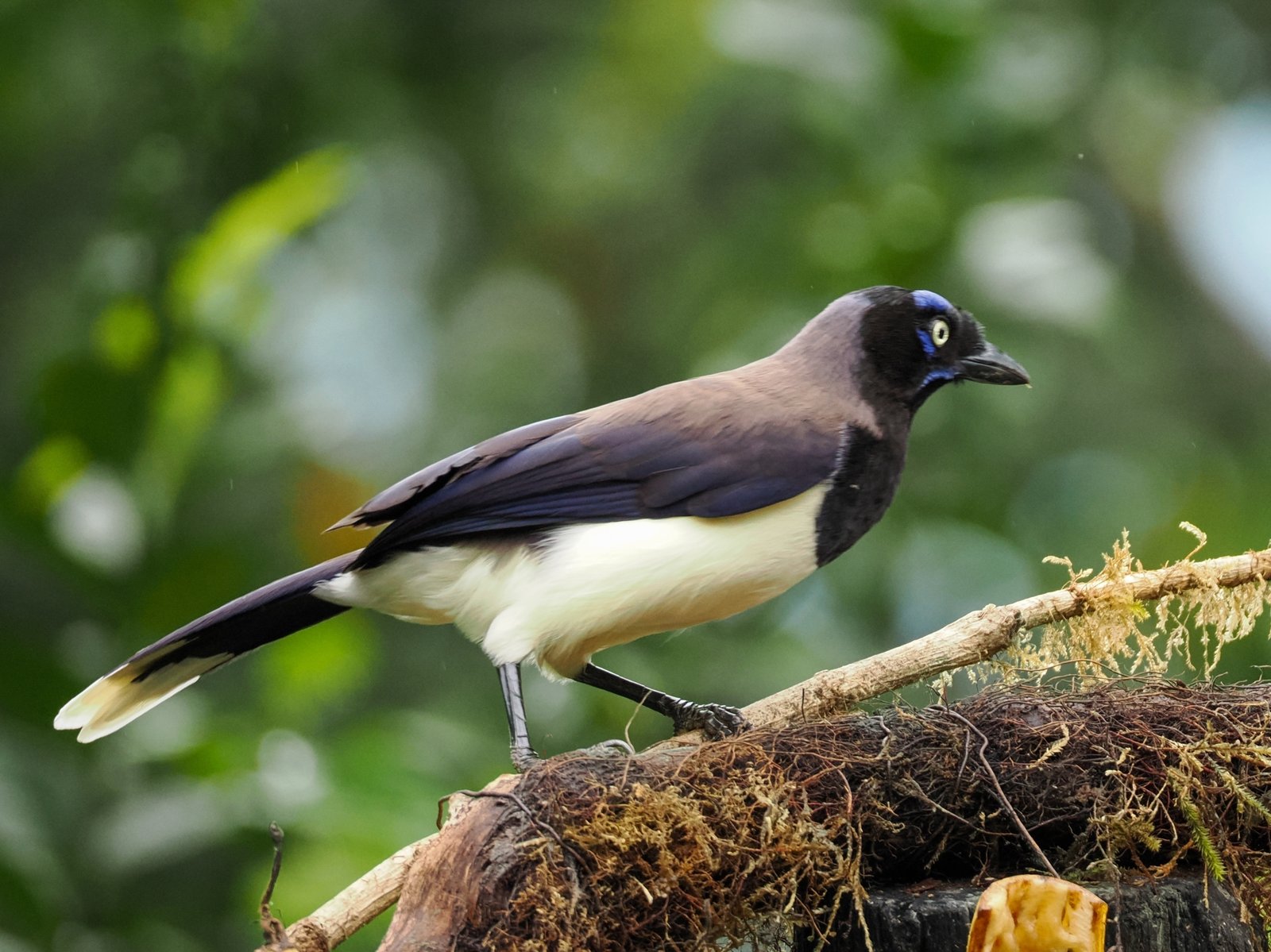
The Black-chested Jay is a large jay of northern Colombia, with a black head and breast, a yellow iris and a white tail tip. Groups move noisily through forest edges, secondary growth and shade coffee. It is a Central American species that in the guide area reaches only northern Colombia.
Voice
Very varied: loud, clear calls such as choo-choo or kyoow, metallic clicks, rattles and hoarse notes; groups often call together.
Recording: Johan Chaves — CC BY-NC-SA 4.0 · xeno-canto
Identification
33–35 cm, with a heavy black bill and a long tail. The head, throat and breast are black, with a small bright blue spot above and below the eye. The back, wings and tail are dark violet blue, the tail with a broad white tip. The belly and undertail coverts are creamy white. The iris is yellow, the legs black. The sexes are alike; young birds are duller, with a dark iris.
Confusion species
Within its range the only jay with this pattern. Violaceous Jay Cyanocorax violaceus lives east of the Andes, is uniform violet blue with a pale nape and lacks the white belly and tail tip. Green Jay Cyanocorax yncas is green and yellow and lives in montane forest.
Habitat
Forest edges, secondary forest, open and semi-open woodland, gallery forest, drier woodland in the Caribbean lowlands and wooded farmland such as shade coffee, from sea level to about 2000 m. It eats insects, other invertebrates, eggs, small vertebrates and fruit. The nest is a cup of twigs in a tree.
Where the bird is most at home, classified by the vegetation units of the Andes and the west coast.


Range and movements
In Colombia in the north and north-west: the Caribbean lowlands, the Sierra Nevada de Santa Marta, the Serranía de Perijá, the middle and lower Magdalena valley, Urabá and the northern West and Central Andes. Absent from Ecuador, Peru, Bolivia and the Galápagos. Outside the guide area in south-eastern Costa Rica, Panama and north-western Venezuela.
- Resident
- dark = core range, pale = thinly spread
How and when to look
On the lower slopes of the Sierra Nevada de Santa Marta, such as around Minca, where groups move noisily through coffee plantations and forest edges.
Conservation status
Least Concern. Fairly common; the species tolerates secondary forest and wooded farmland.
Scientific name
Cyanocorax affinis | Pelzeln, 1856
Pelzeln described the species in 1856 and placed it straight away in the genus where it still stands. The genus Cyanocorax was introduced in 1826 by Boie. The genus name comes from Ancient Greek kuanos, 'dark blue', and korax, 'raven'. The species name is Latin for 'related', for its kinship with other jays. The specimen the first description was based on came from Bogotá, Colombia.