All species › Passerines › Crows, jays and magpies › White-tailed Jay
White-tailed Jay | Cyanocorax mystacalis
Witstaartgaai | Urraca coliblanca | Gralha-de-cauda-branca
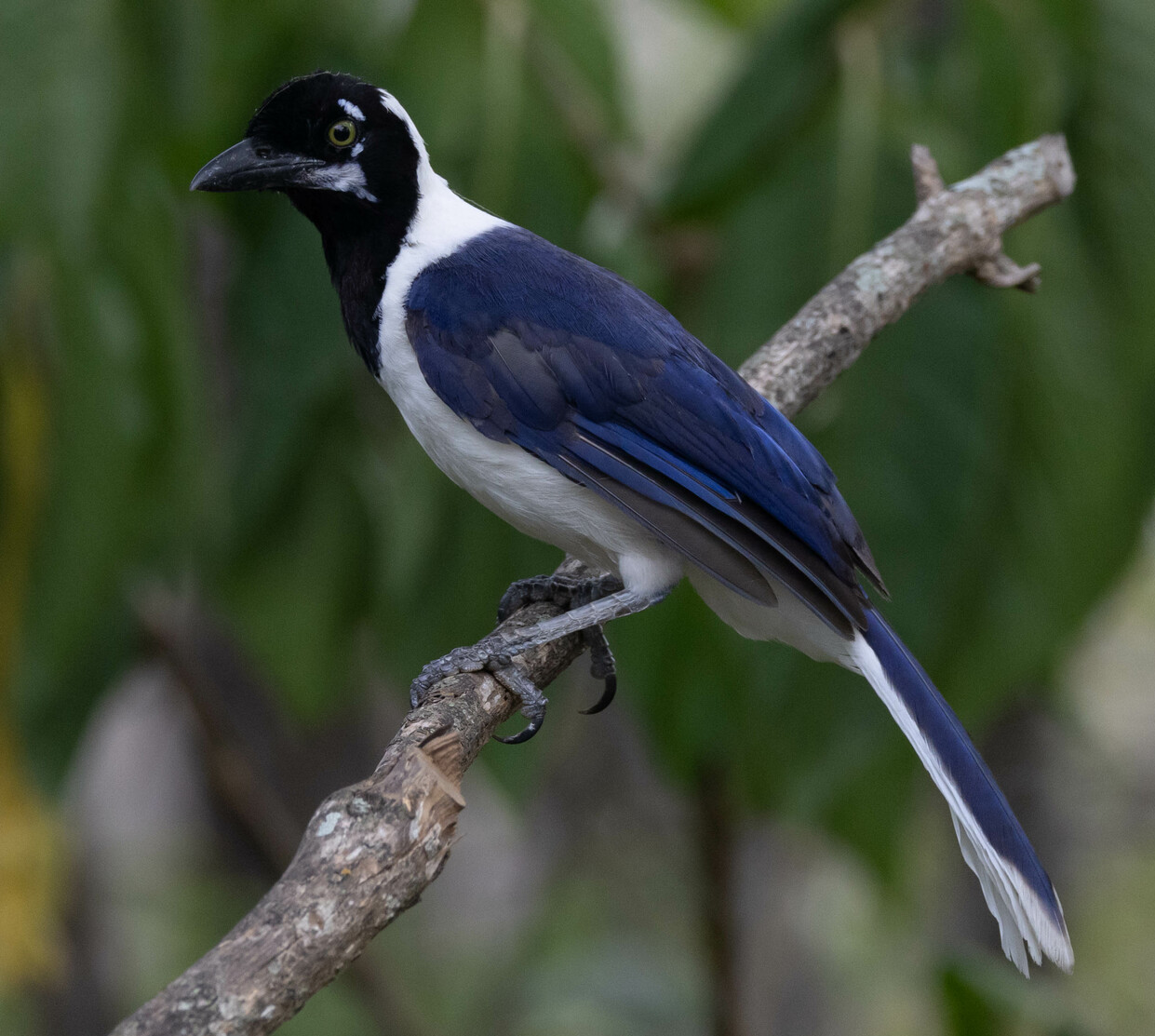
The White-tailed Jay is a jay of the Tumbesian dry forest of south-western Ecuador and north-western Peru, and occurs nowhere else. With its black-and-white head, blue back and largely white tail it is unmistakable within its range. It lives in family groups that move noisily through dry forest and scrub.
Voice
Varied: loud, hoarse calls such as chak and kyeew, rattling series and softer, mewing notes; groups often call together.
Recording: Leonardo Ordóñez-Delgado — CC BY-NC-SA 4.0 · xeno-canto
Identification
32–33 cm, with a heavy black bill and a long tail. The forehead, face, throat and breast are black, with a white spot above the eye and a white moustachial stripe below it. The hindcrown and nape are white, the back and wings bright blue. The underparts are white. The tail is white, with blue central feathers. The iris is yellow, the legs black. The sexes are alike; young birds have a brown iris and at first lack the white marks by the eye.
Confusion species
Within its range it cannot be confused with any other jay. Green Jay Cyanocorax yncas is green and yellow and lives in humid Andean montane forest, not in lowland dry forest.
Habitat
Tumbesian dry forest, thorn scrub, woodland along dry river valleys and wooded farmland, from sea level to about 1200 m, locally higher. It eats insects, other invertebrates, eggs, small vertebrates and fruit, mainly in the middle and lower levels of the forest. The nest is a cup of twigs in a tree or shrub.
Where the bird is most at home, classified by the vegetation units of the Andes and the west coast.


Range and movements
In Ecuador in the south-west, from Guayas south through El Oro and Loja. In Peru in the north-west, from Tumbes and Piura south to La Libertad. Absent from Colombia, Bolivia and the Galápagos. A species endemic to the guide area.
- Resident
- dark = core range, pale = thinly spread
How and when to look
In the dry forest of the Jorupe reserve in Loja and in the dry forests of Tumbes and Piura, where groups move through the lower levels of the forest in the morning.
Conservation status
Least Concern. Most of the Tumbesian dry forest has been cleared or browsed by goats, but the species persists in degraded woodland and wooded farmland.
Scientific name
Cyanocorax mystacalis | (de Sparre, 1835)
De Sparre described the species in 1835 as Pica mystacalis; because it was later moved to another genus, the author and year stand in brackets. The genus Cyanocorax was introduced in 1826 by Boie. The genus name comes from Ancient Greek kuanos, 'dark blue', and korax, 'raven'. The species name comes from Latin mystacalis, 'moustached', for the white moustachial stripe. The specimen the first description was based on came from Guayaquil, Ecuador.