All species › Passerines › Crows, jays and magpies › Green Jay
Green Jay | Cyanocorax yncas
Incagaai | Chara verde | Gralha-verde
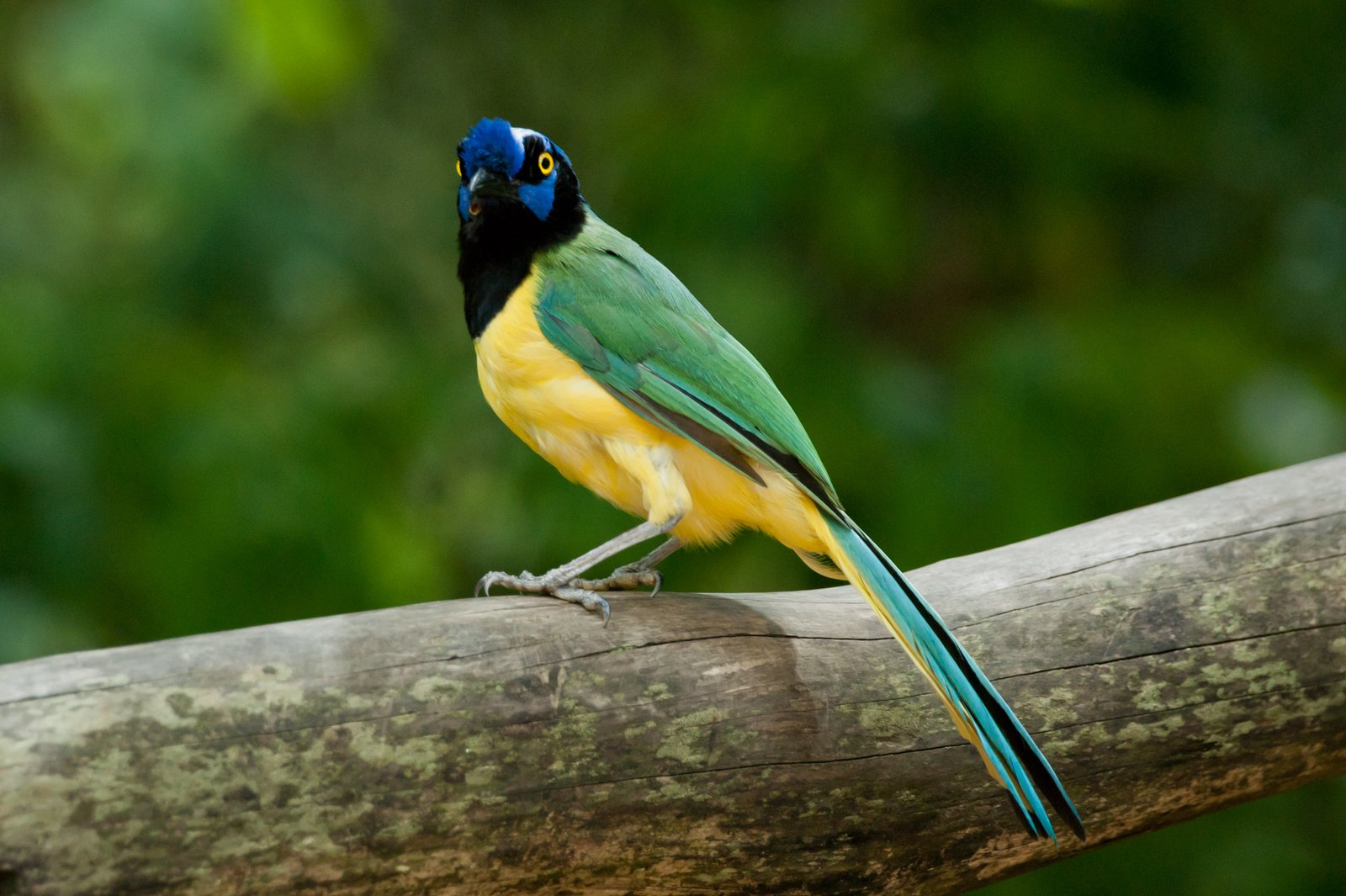
The Green Jay is a colourful, noisy jay in green, yellow, blue and black that roams the montane forest of the Andes in small groups. Andean birds differ clearly from those in Mexico and Central America in colour, eye colour and voice, and some authors treat them as a separate species. In the guide area it is one of the most conspicuous birds of the cloud forest.
Voice
Very varied. Frequently heard are a rapid series of harsh, hoarse chee-chee-chee calls, metallic, ringing notes and dry rattles. Groups are noisy but can also stay silent for long periods.
Recording: Juan Freile — CC BY-NC-SA 4.0 · xeno-canto
Identification
29–34 cm, with a long, graduated tail. The back, wings and central tail feathers are bright green, the underparts and outer tail feathers yellow. The face, throat and breast are black; above the bill stands a stiff, erect tuft of blue feathers. In Andean birds the crown and nape are white to pale yellowish white, edged with blue; there are blue patches above and below the eye. The iris is yellow, the bill and legs black. The sexes are alike; young birds have a duller head and a dark iris.
Confusion species
Unmistakable within its range. Turquoise Jay Cyanolyca turcosa and White-collared Jay Cyanolyca viridicyanus live in the same montane forest, but are blue with a black mask and lack the yellow and green.
Habitat
Humid montane forest and cloud forest, forest edges, secondary forest and semi-open country with trees, also coffee plantations and gardens at the forest edge, at roughly 1200 to 2800 m. It eats insects, other invertebrates, small vertebrates, eggs and fruit, foraging at all levels of the forest.
Where the bird is most at home, classified by the vegetation units of the Andes and the west coast.


Range and movements
In Colombia in all three cordilleras and in the north in the Serranía de Perijá; in Ecuador mainly on the eastern slope of the Andes; in Peru on the eastern slope; in Bolivia on the eastern slope in the north and centre of the country. Absent from the Galápagos. Outside the guide area in the mountains of Venezuela; related birds live from southern Texas to Honduras.
- Resident
- dark = core range, pale = thinly spread
How and when to look
Along mountain roads and at lodges in cloud forest, where groups often move noisily along the forest edge and also visit fruit feeders, such as on the eastern slope in Ecuador and in the Yungas of Peru and Bolivia.
Conservation status
Least Concern. Common and tolerant of partial deforestation.
Scientific name
Cyanocorax yncas | (Boddaert, 1783)
Boddaert described the species in 1783 as Corvus yncas; because it was later moved to another genus, the author and year stand in brackets. The genus Cyanocorax was introduced in 1826 by Boie. The genus name comes from Ancient Greek kuanos, 'dark blue', and korax, 'raven'. The species name refers to the Incas, and thus to Peru, where the species was described from. The specimen the first description was based on came from Chilpes, Junín, Peru.