All species › Passerines › Crows, jays and magpies › Curl-crested Jay
Curl-crested Jay | Cyanocorax cristatellus
Kroeskopgaai | Urraca de cresta rizada | Gralha-do-campo
The Curl-crested Jay is a large jay of the cerrado of central South America, with a tall, forward-curled crest on the forehead. Groups of a few to about ten birds move noisily through savanna woodland and along gallery forest. In the guide area it occurs only in the far east of Bolivia.
Voice
Loud, hoarse calls, such as a repeated kyaa or chaa, often by the whole group; also gurgling and clicking notes.
Recording: Robson Silva e Silva — CC BY-NC-SA 4.0 · xeno-canto
Identification
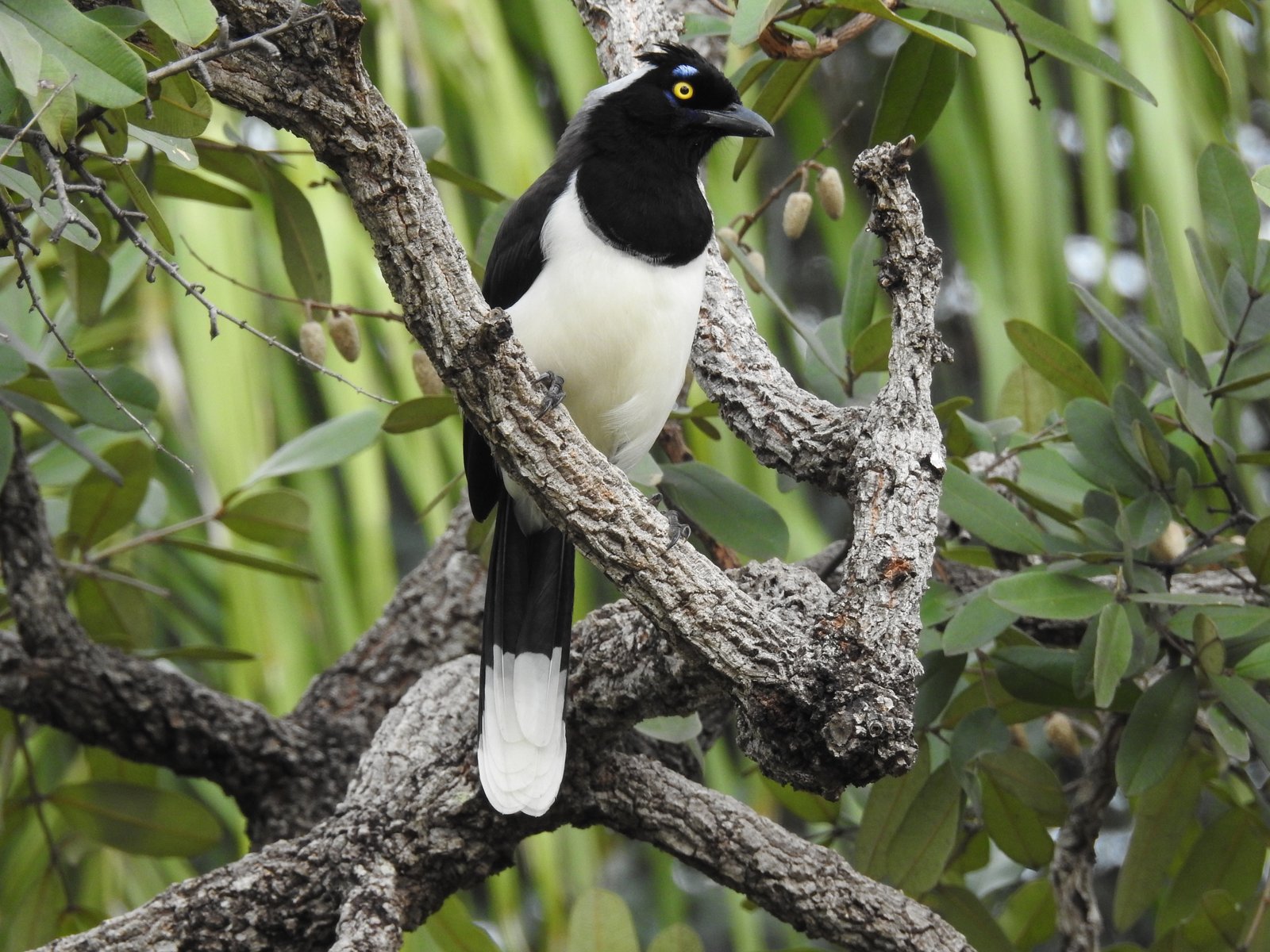
33–35 cm, with a heavy black bill, a long tail and an erect crest of stiff, curled black feathers on the forehead. The head, throat and upper breast are black; the nape, back, wings and basal part of the tail are dark purplish blue. The rest of the underparts and the distal half of the tail are creamy white. Legs black. The sexes are alike; young birds are duller, with a shorter crest.
Confusion species
Plush-crested Jay Cyanocorax chrysops has a short, velvety crest instead of a tall curl, pale blue spots around the eye and only a white tail tip. Purplish Jay Cyanocorax cyanomelas is uniform dull purplish brown, with no white on the underparts or tail.
Habitat
Cerrado, savanna with scattered trees, open dry woodland, gallery forest and forest edges, also wooded pasture, in the lowlands below about 1000 m. It eats insects, other invertebrates, fruit, seeds and eggs, in trees and on the ground. The nest is a cup of twigs in a tree.
Where the bird is most at home, classified by the vegetation units of the Andes and the west coast.


Range and movements
In Bolivia only in eastern Santa Cruz, in the cerrado and savannas along the Brazilian border. Absent from Colombia, Ecuador, Peru and the Galápagos. Outside the guide area in the cerrado of central and eastern Brazil and in north-eastern Paraguay.
- Resident
- dark = core range, pale = thinly spread
How and when to look
In the cerrado of eastern Santa Cruz, such as in Noel Kempff Mercado National Park, where groups fly calling from one clump of trees to the next.
Conservation status
Least Concern. Large parts of the cerrado are being converted to fields and pasture, but the species tolerates semi-open country with trees.
Scientific name
Cyanocorax cristatellus | (Temminck, 1823)
Temminck described the species in 1823 as Corvus cristatellus; because it was later moved to another genus, the author and year stand in brackets. The genus Cyanocorax was introduced in 1826 by Boie. The genus name comes from Ancient Greek kuanos, 'dark blue', and korax, 'raven'. The species name is a Latin diminutive of cristatus, 'crested', for the short curled frontal crest. The specimen the first description was based on came from Brazil.