All species › Passerines › Crows, jays and magpies › Purplish Jay
Purplish Jay | Cyanocorax cyanomelas
Purpergaai | Urraca morada | Gralha-do-pantanal
The Purplish Jay is a large, dark jay with a black head and breast and otherwise dull purplish-brown plumage, of the dry forests and savannas of eastern and southern Bolivia. It lives in noisy groups that forage together and defend their territory. In the guide area it reaches the north-western limit of its range: in Peru it is known only from the Pampas del Heath.
Voice
Loud, hoarse and rasping calls, such as a repeated chaa or kraa; groups often call together.
Recording: Guilherme Melo — CC BY-NC-SA 4.0 · xeno-canto
Identification
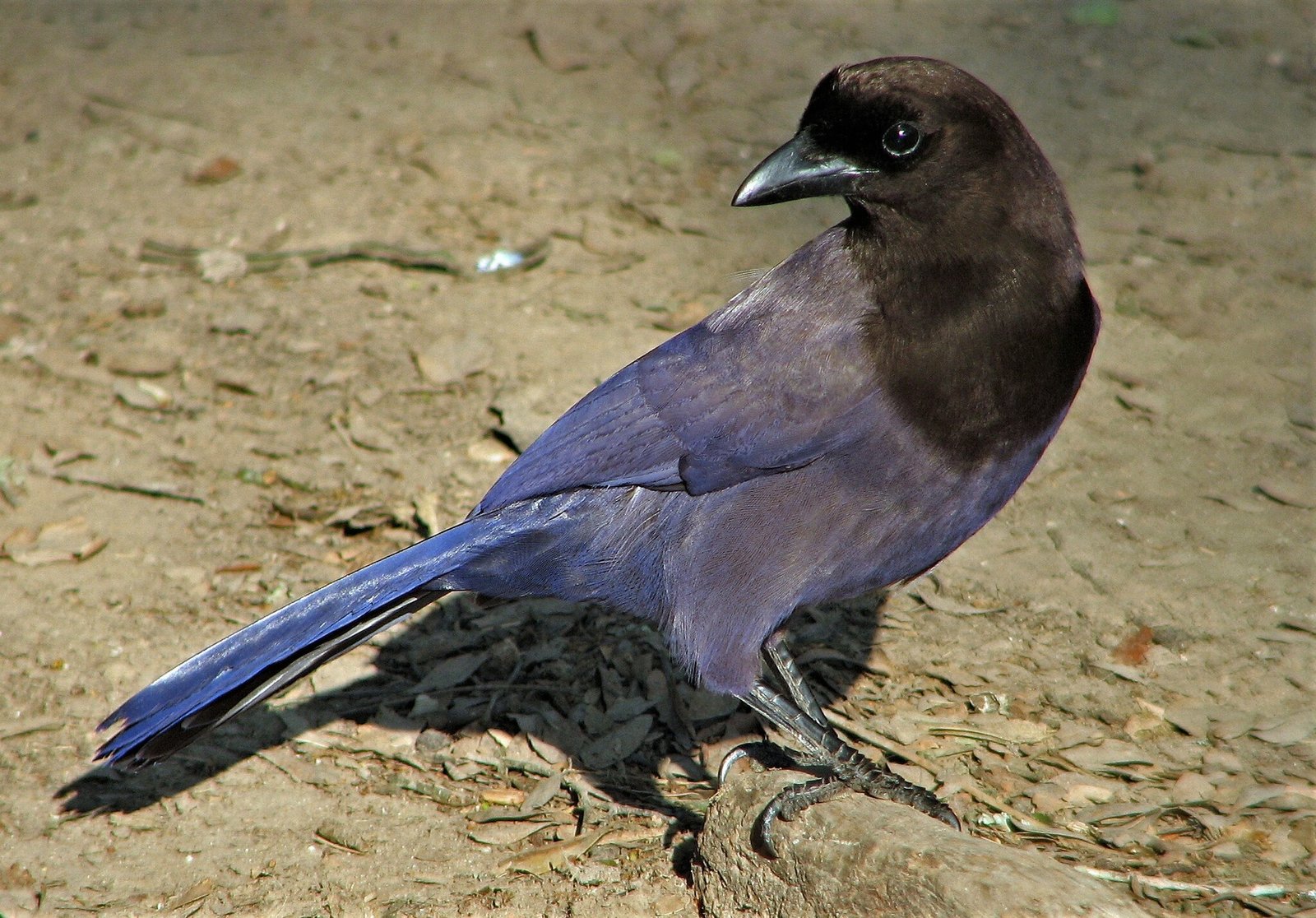
35–37 cm, with a heavy black bill and a long tail. The head, throat, nape and breast are sooty black. The rest of the body is dull purplish brown to dark violet grey, the wings and tail with a bluish-purple sheen. The legs and iris are dark. The sexes are alike; young birds are duller.
Confusion species
Violaceous Jay Cyanocorax violaceus is bluer, with a pale bluish-white nape, and lives further north in the Amazonian lowlands. Plush-crested Jay Cyanocorax chrysops has a small crest of short, velvety black feathers, a yellow iris, creamy-white underparts and a white tail tip. Curl-crested Jay Cyanocorax cristatellus has a tall, curled crest, white underparts and a white distal half to the tail.
Habitat
Dry forest and Chaco, semi-open woodland, cerrado, gallery forest along rivers, forest edges and wooded farmland, mainly below 1000 m, locally higher in the Andean foothills. It eats insects, other invertebrates, eggs, small vertebrates, fruit and seeds, foraging both in trees and on the ground. The nest is a cup of twigs in a tree.
Where the bird is most at home, classified by the vegetation units of the Andes and the west coast.


Range and movements
In Bolivia in the lowlands of the east and south, including Beni, Santa Cruz, Chuquisaca and Tarija, and on the lower eastern slope of the Andes. In Peru only in the far south-east, in the savannas of the Pampas del Heath in Madre de Dios. Absent from Colombia, Ecuador and the Galápagos. Outside the guide area in south-western Brazil (Pantanal), Paraguay and northern Argentina.
- Resident
- dark = core range, pale = thinly spread
How and when to look
In the dry forests of the Chiquitania and around Santa Cruz in Bolivia, where groups move along forest edges and farmyards and make themselves heard with their hoarse calls.
Conservation status
Least Concern. Common and tolerant of partial deforestation and farming.
Scientific name
Cyanocorax cyanomelas | (Vieillot, 1818)
Vieillot described the species in 1818 as Pica cyanomelas; because it was later moved to another genus, the author and year stand in brackets. The genus Cyanocorax was introduced in 1826 by Boie. The genus name comes from Ancient Greek kuanos, 'dark blue', and korax, 'raven'. The species name comes from Greek kuanos, 'dark blue', and melas, 'black', for the dark purplish-blue plumage. The specimen the first description was based on came from Paraguay.