All species › Passerines › Crows, jays and magpies › Violaceous Jay
Violaceous Jay | Cyanocorax violaceus
Violetgaai | Urraca violácea | Gralha-violácea
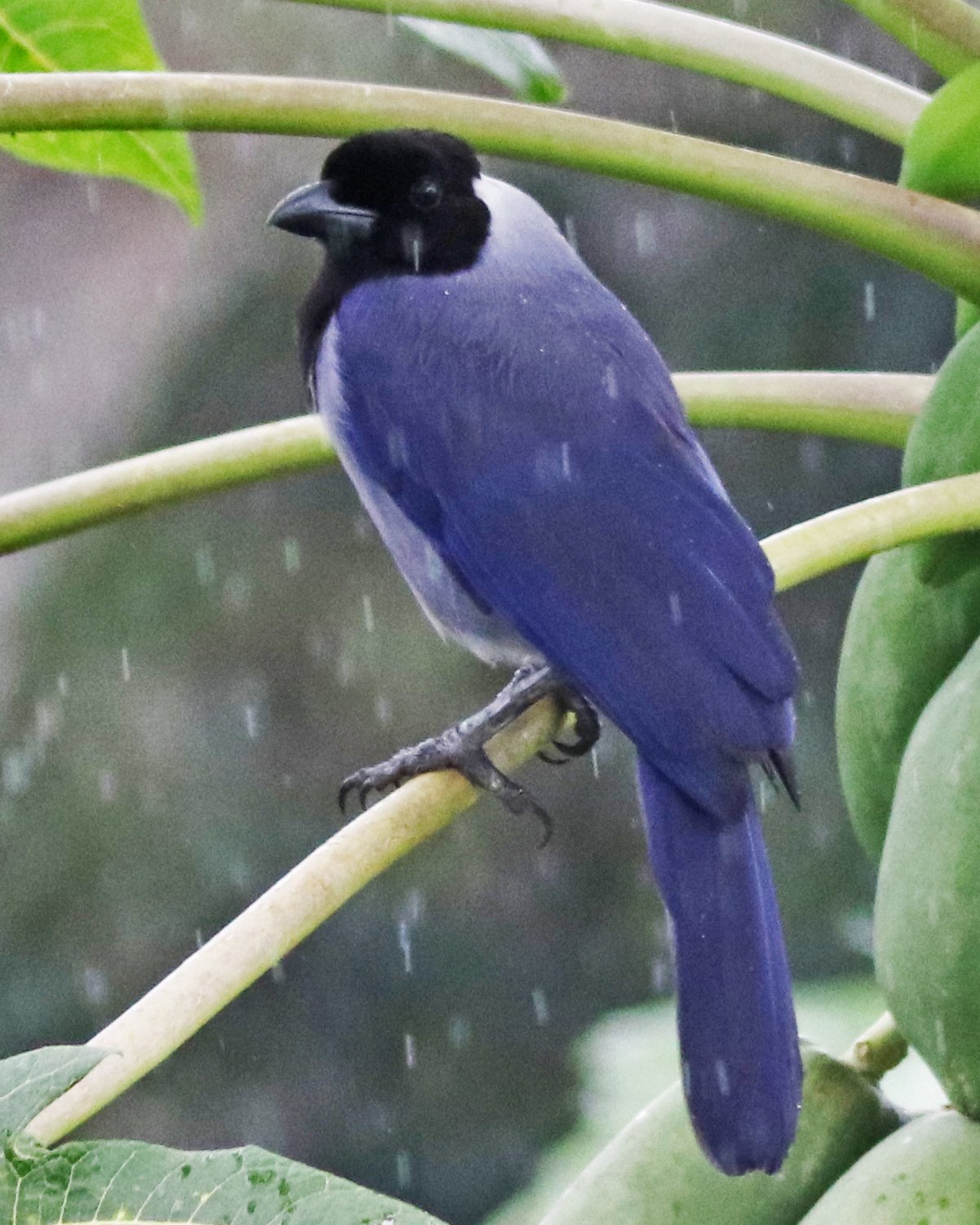
The Violaceous Jay is a large, dull violet-blue jay with a black head and breast and a pale nape, of the lowlands of western Amazonia. Groups of five to ten birds move noisily along riverbanks, forest edges and clearings. Its harsh, falling call is one of the regular sounds along the rivers of the Amazonian lowlands.
Voice
A loud, hoarse, falling dyeeer or chaaow, often repeated by several birds in turn; also shorter, raw notes.
Recording: Juan Freile — CC BY-NC-SA 4.0 · xeno-canto
Identification
35–37 cm, with a heavy black bill and a fairly long tail. The head, throat and upper breast are black; the hindcrown and nape are pale bluish white and form an obvious pale patch. The rest of the body is dull violet blue, the underparts somewhat paler and greyer. The legs and iris are dark. The sexes are alike; young birds are duller, with a less pale nape.
Confusion species
Purplish Jay Cyanocorax cyanomelas is duller and browner purple, without a pale nape; it lives further south and occurs nearby in Bolivia and south-eastern Peru. Azure-naped Jay Cyanocorax heilprini of the far east of Colombia has a white tail tip and a pale iris.
Habitat
Forest edges, várzea and other riverine forest, riverbanks, clearings, secondary forest and semi-open country with trees, also around villages; mainly below 1000 m, locally to about 1500 m in the Andean foothills. It eats insects, other invertebrates, eggs, small vertebrates and fruit. The nest is a cup of twigs in a tree.
Where the bird is most at home, classified by the vegetation units of the Andes and the west coast.


Range and movements
In Colombia in the lowlands east of the Andes, from Meta and Vichada south to Amazonas. In Ecuador throughout the Amazonian lowlands. In Peru throughout the Amazonian lowlands and up into the Andean foothills. In Bolivia in the north, in Pando, Beni and northern La Paz. Absent from the Galápagos. Outside the guide area in southern Venezuela and western Brazilian Amazonia.
- Resident
- dark = core range, pale = thinly spread
How and when to look
Along rivers in the Amazonian lowlands, from a boat or at riverside lodges, where groups fly noisily from tree to tree.
Conservation status
Least Concern. Common; forest edges and clearings along rivers favour the species.
Scientific name
Cyanocorax violaceus | Du Bus de Gisignies, B-AL, 1847
Du Bus de Gisignies, B-AL described the species in 1847 and placed it straight away in the genus where it still stands. The genus Cyanocorax was introduced in 1826 by Boie. The genus name comes from Ancient Greek kuanos, 'dark blue', and korax, 'raven'. The species name comes from Latin violaceus, 'violet', for the violet-blue plumage. The specimen the first description was based on came from Pebas, Loreto, Peru.