All species › Passerines › Tyrant flycatchers and allies › Baird's Flycatcher
Baird's Flycatcher | Myiodynastes bairdii
Bairds tiran | Mosquero de Baird | Bem-te-vi-de-baird
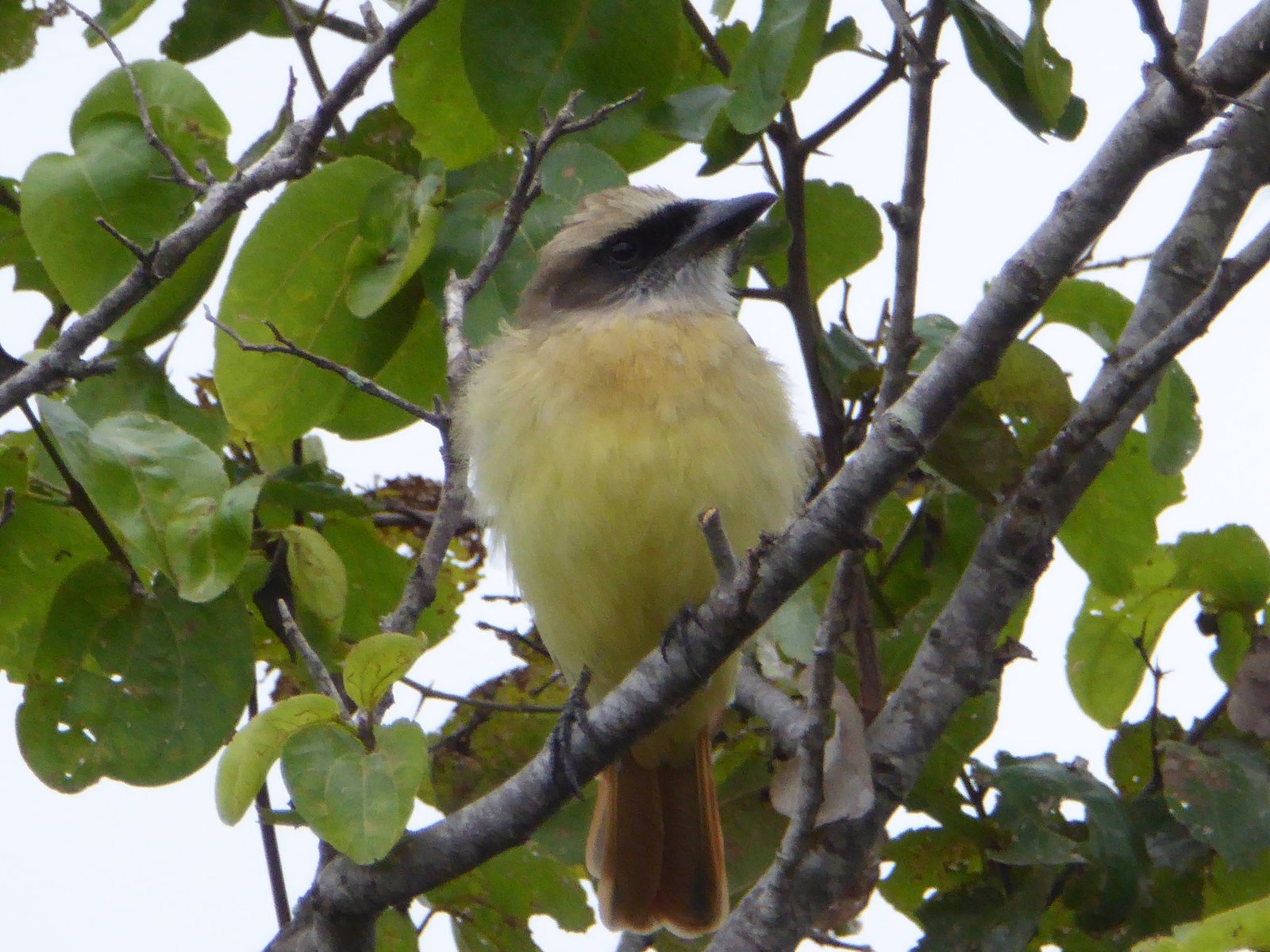
Baird's Flycatcher is the largest Myiodynastes and a characteristic species of the Tumbesian region in south-western Ecuador and north-western Peru. With its sandy-brown back, rufous tail and black mask it differs from the other members of the genus. It lives in dry forest and scrub.
Voice
Loud, somewhat shrill and squeaky calls, given singly or repeated in short series, often from a high perch.
Recording: Leonardo Ordóñez-Delgado — CC BY-NC-SA 4.0 · xeno-canto
Identification
23–24 cm. A large flycatcher with a heavy black bill. Upperparts sandy to greyish-brown with a concealed yellow crown patch. A broad black mask runs from the bill to behind the eye and is bordered above by a narrow pale supercilium. The throat is whitish, the breast pale yellow with faint dusky scaling, the belly light yellow. Rump and tail are rufous, the flight feathers have broad rufous edges. Sexes alike.
Confusion species
Streaked Flycatcher Myiodynastes maculatus is smaller and has a streaked back and heavily streaked underparts. Boat-billed Flycatcher Megarynchus pitangua and Great Kiskadee Pitangus sulphuratus have a black crown with a white supercilium and no rufous tail. Rufous Flycatcher Myiarchus semirufus is smaller, with a slender bill, and lacks the black mask.
Habitat
Dry deciduous forest, thorn scrub, forest edges and semi-open country with tall trees, also along dry river valleys, from sea level to about 1500 m. It sallies from a perch for large insects and also eats fruit. Little is known about the nest; related species nest in cavities and crevices.
Where the bird is most at home, classified by the vegetation units of the Andes and the west coast.


Range and movements
Colombia: absent. Ecuador: in the west and south-west, from Manabí south through Guayas and El Oro to Loja. Peru: in the north-west, mainly in Tumbes, Piura and Lambayeque. Bolivia: absent. Absent from the Galápagos. The species does not occur outside the guide area.
- Resident
- dark = core range, pale = thinly spread
How and when to look
Search in the dry forest of the Tumbesian region, for example in south-western Ecuador or in the reserves of Tumbes and Piura. It often perches in the open on a high branch or on a wire.
Conservation status
Least Concern. Locally fairly common, but restricted to a small area in which dry forest is declining through logging and grazing.
Scientific name
Myiodynastes bairdii | (Gambel, 1847)
Gambel described the species in 1847 as S[aurophagus] bairdii; because it was later moved to another genus, the author and year stand in brackets. The genus Myiodynastes was introduced in 1857 by Bonaparte. The genus name comes from Greek muia, 'fly', and dunastēs, 'ruler'. The species name honours Spencer Fullerton Baird (1823–1887), American naturalist, first curator and later head of the Smithsonian Institution. The specimen the first description was based on came from Guayaquil, Ecuador.