All species › Passerines › Tyrant flycatchers and allies › Streaked Flycatcher
Streaked Flycatcher | Myiodynastes maculatus
Gestreepte tiran | Papamoscas rayado | Bem-te-vi-rajado
The Streaked Flycatcher is a large, heavily streaked flycatcher of forest edges and semi-open woodland in the lowlands, ranging from Mexico to Argentina. Besides resident birds in the north, southern birds that migrate to Amazonia in the austral winter also occur in the guide area. It nests in tree cavities.
Voice
A sharp, loud eek or kip, often repeated, and at dawn a repeated, melodious song of a few clear notes.
Recording: Juan Freile — CC BY-NC-SA 4.0 · xeno-canto
Identification
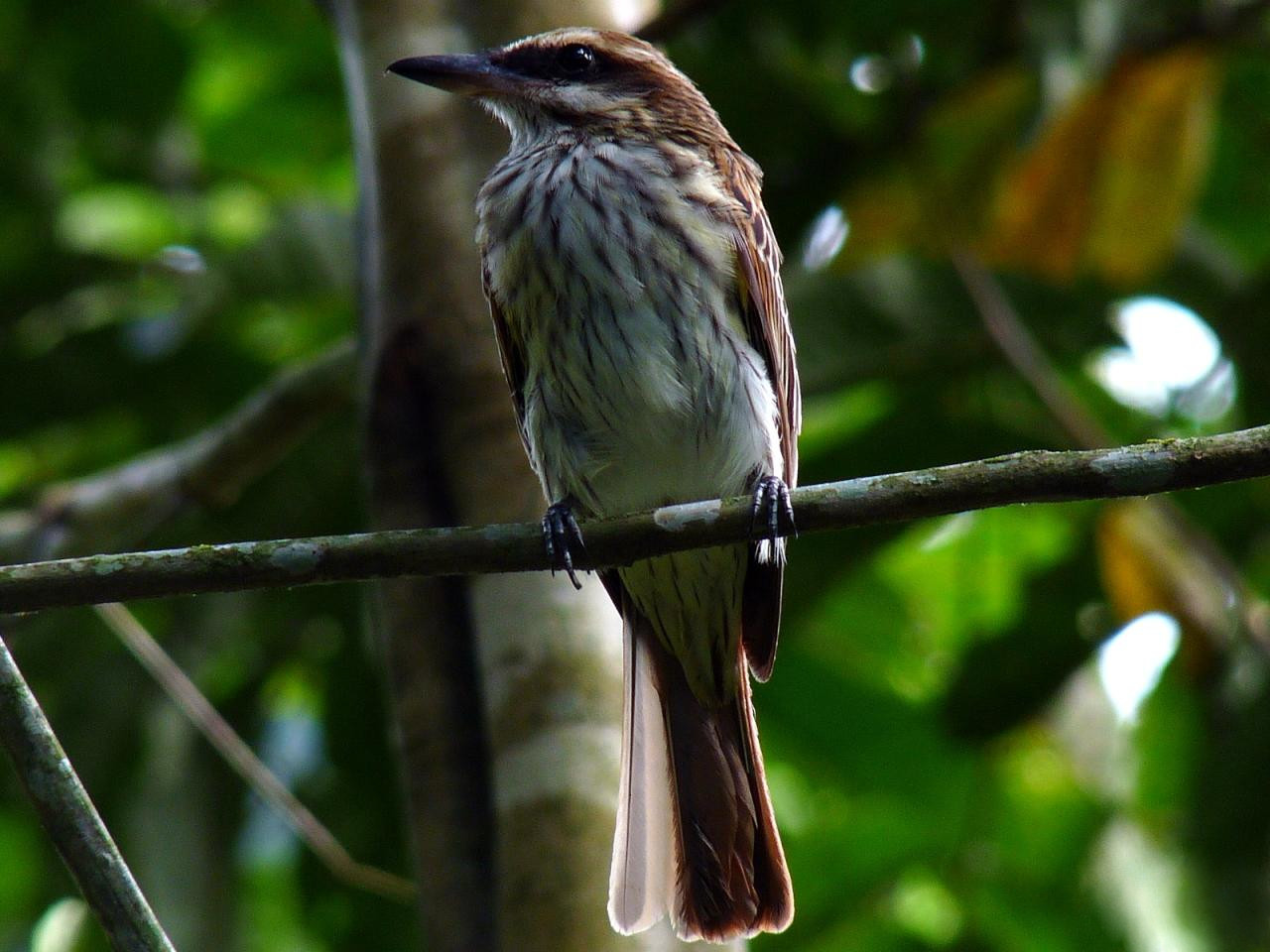
20–21 cm. A robust flycatcher with a heavy bill, the base of the lower mandible pale. Upperparts brown with dark streaks; rump and tail rufous. A dark mask and a dark malar stripe are separated by a white cheek stripe; the supercilium is white. The underparts are white to yellowish-white with broad dark brown streaks on throat, breast and flanks. A yellow crown patch is usually concealed. Sexes alike; southern birds are darker and more heavily marked.
Confusion species
Sulphur-bellied Flycatcher Myiodynastes luteiventris, a winter visitor and passage migrant, has yellower underparts, a darker mask, a blackish chin and an almost entirely dark bill. Variegated Flycatcher Empidonomus varius and Piratic Flycatcher Legatus leucophaius are smaller, with a short bill. Baird's Flycatcher Myiodynastes bairdii has an unstreaked, sandy-brown back.
Habitat
Forest edges, open woodland, gallery forest, várzea, secondary forest and gardens and plantations with tall trees, in the guide area mostly below 1500 m. It sallies from a perch for large insects and eats much fruit. It nests in tree cavities, woodpecker holes and sometimes nest boxes or cavities in buildings.
Where the bird is most at home, classified by the vegetation units of the Andes and the west coast.


Range and movements
Colombia: widespread in the lowlands west and east of the Andes. Ecuador: in the western lowlands as a resident and in the east mainly as an austral winter visitor. Peru: in the north-west and in the Amazonian lowlands, in the east mainly as a winter visitor. Bolivia: in the north and east, as a breeder and passage migrant. Absent from the Galápagos. Outside the guide area from Mexico to Venezuela, the Guianas, Brazil, Paraguay and northern Argentina.
- Resident
- dark = core range, pale = thinly spread
How and when to look
Search forest edges and open woodland with tall trees in the lowlands; it often sits for long periods in the canopy and reveals itself by its call.
Conservation status
Not Evaluated. Widespread and common over a very large range.
Scientific name
Myiodynastes maculatus | (Müller, 1776)
Müller described the species in 1776 as Muscicapa maculata; because it was later moved to another genus, the author and year stand in brackets. The genus Myiodynastes was introduced in 1857 by Bonaparte. The genus name comes from Greek muia, 'fly', and dunastēs, 'ruler'. The species name comes from Latin maculatus, 'spotted'. The specimen the first description was based on came from Cayenne, French Guiana.