All species › Passerines › Antbirds › Bamboo Antshrike
Bamboo Antshrike | Cymbilaimus sanctaemariae
Bamboemierklauwier | Batará de bambú | Choca-do-bambu
The Bamboo Antshrike is a finely barred antshrike that lives almost exclusively in stands of Guadua bamboo in south-western Amazonia. It is closely related to Fasciated Antshrike, but differs in eye colour, song and habitat. In the guide area it occurs in south-eastern Peru and northern Bolivia.
Voice
The song is a loud, slightly falling run of about eight to fifteen metallic, ringing notes. Calls are a sharp single note, often repeated, a thin dry rattle and a whining, questioning note.
Recording: Felipe Arantes — CC BY-NC-SA 4.0 · xeno-canto
Identification
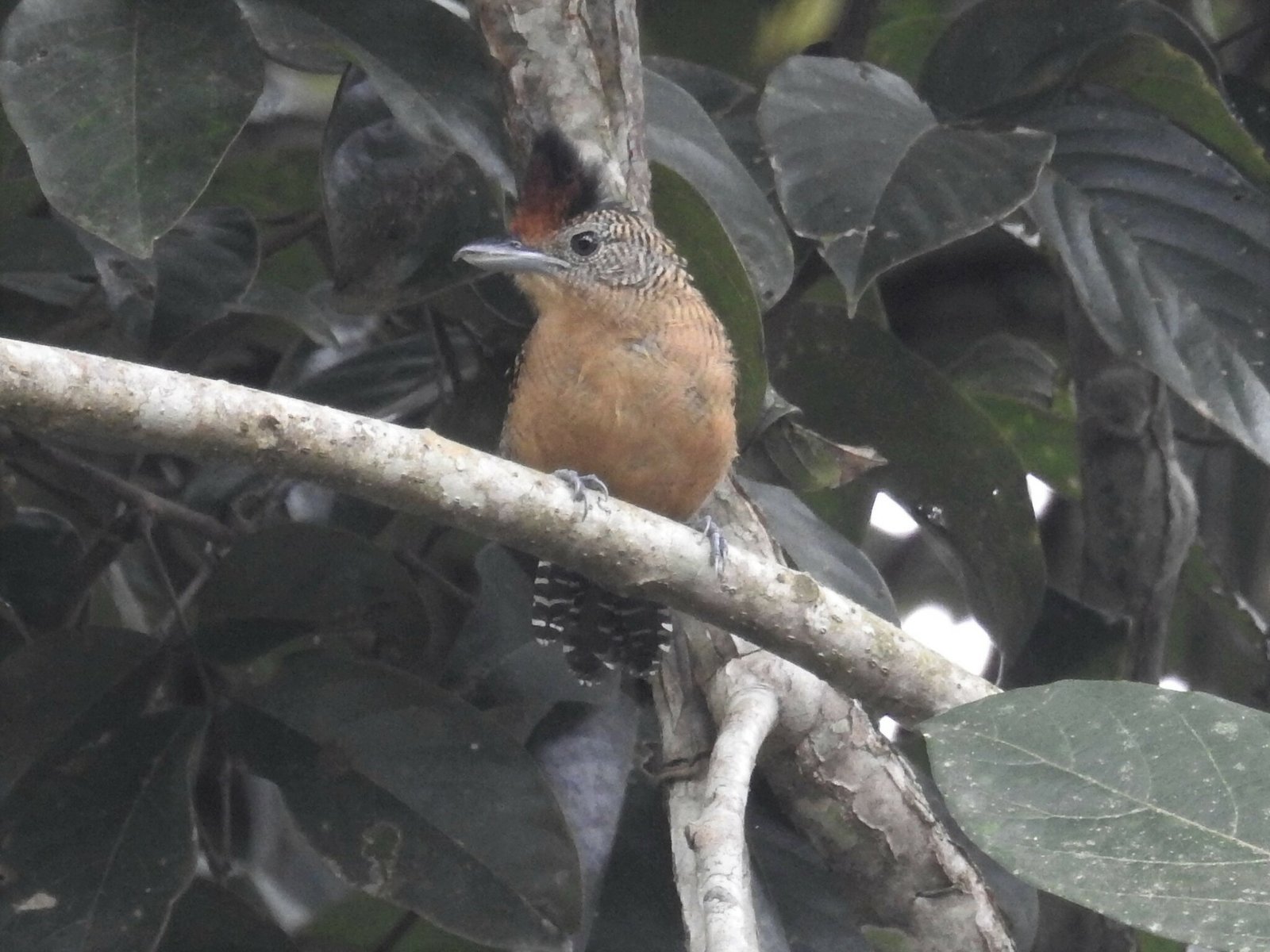
16–17 cm, with a heavy, hook-tipped bill, a small crest and a dark brown eye. The male has a black forehead and crown; the rest of the body is finely barred black and white. The female has a rufous crown with black-tipped crest feathers, finely barred dark brown and pale yellowish-brown upperparts and tail, a buffy-white throat and cinnamon-buff underparts with dark barring on the sides and flanks.
Confusion species
Fasciated Antshrike Cymbilaimus lineatus has a red eye, is not tied to bamboo and sings a short series of soft, rising whistles; the female is more heavily barred below. Undulated Antshrike Frederickena unduliger is larger, with wavy rather than barred markings, and lives closer to the ground. Barred Antshrike Thamnophilus doliatus has a pale eye, a less heavy bill and coarser barring; the female is plain rufous above.
Habitat
Dense stands of Guadua bamboo in humid lowland and foothill forest, up to about 1450 m. It forages in pairs in the understorey and mid-storey among the bamboo stems, searching for large insects and other arthropods. Little is known about the nest.
Where the bird is most at home, classified by the vegetation units of the Andes and the west coast.


Range and movements
Peru: in the south-east, mainly in Madre de Dios and Cusco, extending into Ucayali, Junín and Puno. Bolivia: in the north (Pando, La Paz and Beni). Absent from Colombia, Ecuador and the Galápagos. Outside the guide area in south-western Amazonian Brazil.
- Resident
- dark = core range, pale = thinly spread
How and when to look
Search bamboo stands along roads and trails at Manu and Tambopata. The loud, metallic song gives away a pair hidden among the stems.
Conservation status
Least Concern. Numbers are thought to be declining, although no direct threats are known; the species depends on bamboo forest.
Scientific name
Cymbilaimus sanctaemariae | Gyldenstolpe, 1941
Gyldenstolpe described the species in 1941 and placed it straight away in the genus where it still stands. The genus Cymbilaimus was introduced in 1840 by Gray. The genus name combines Latin cymba, 'small boat' (especially Charon's), with the genus Lanius, 'shrike'; Cabanis and Heine (1860) took the second part to be Greek laimos, 'throat'. The species name sanctaemariae is Medieval Latin for 'of Saint Mary', Mother of God (Spanish Madre de Dios). The specimen the first description was based on came from confluence of the Río Madre de Dios and Río Beni, Bolivia.