All species › Passerines › Antbirds › Fasciated Antshrike
Fasciated Antshrike | Cymbilaimus lineatus
Zebramierklauwier | Batará lineado | Papa-formiga-barrado
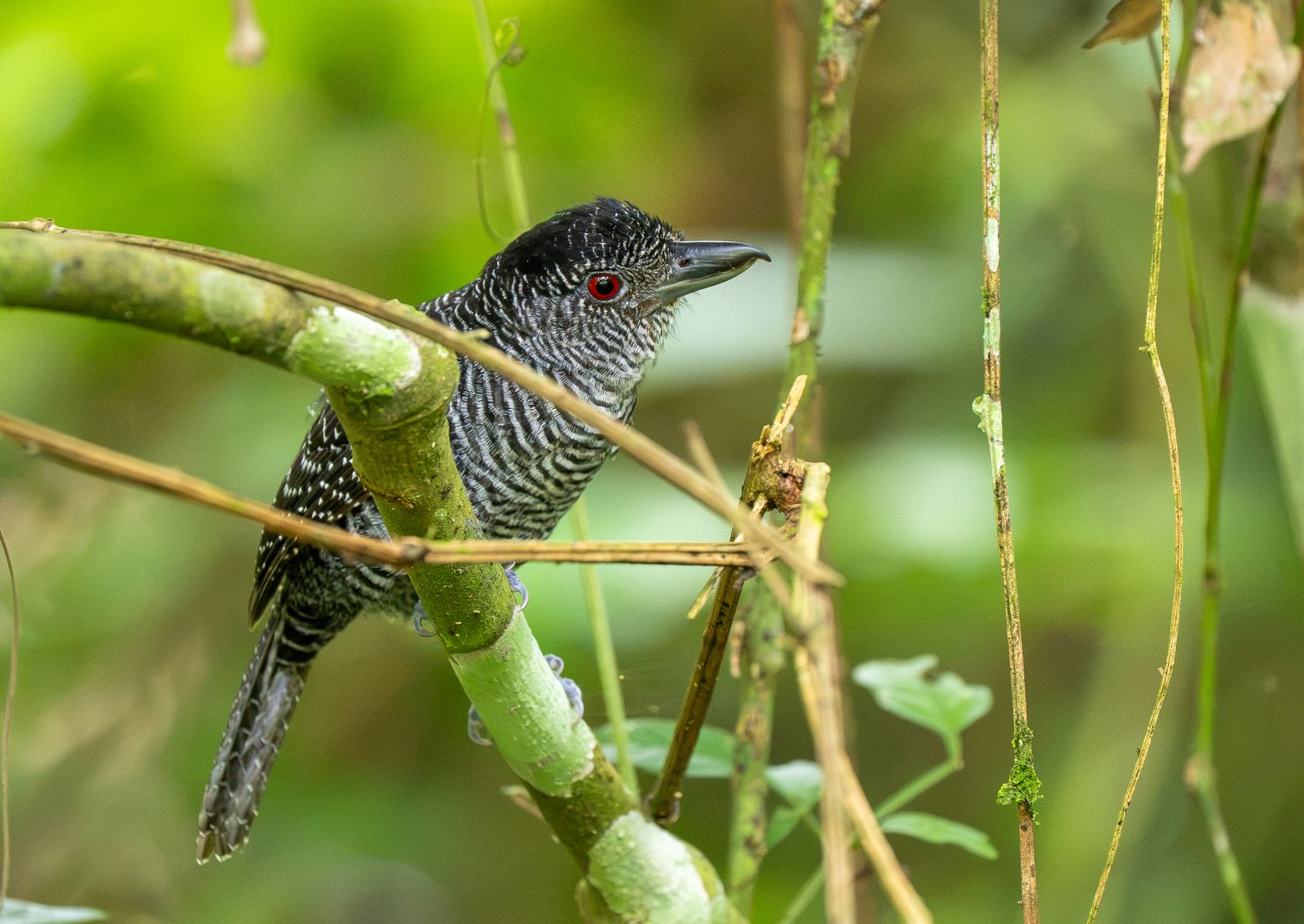
The Fasciated Antshrike is a finely barred antshrike with a heavy, hooked bill and a red eye. It lives in pairs in dense tangles of vines and leaves at mid-levels in the forest. In the guide area it occurs on both sides of the Andes, from the Chocó to the Amazonian lowlands of Bolivia.
Voice
The song is a short series of four to eight soft, mellow, slightly rising whistles, often repeated, like cuu-cuu-cuu-cuu. Also a dry, grating call.
Recording: Carlos Andrés Pinto Quinche — CC BY-NC-SA 4.0 · xeno-canto
Identification
17–18 cm, with a heavy, hook-tipped bill, a small crest and a red eye. The male is black with narrow white bars over the whole body and a black crown. The female has a chestnut crown, black-and-buff barred upperparts and buff underparts with narrow black bars.
Confusion species
Bamboo Antshrike Cymbilaimus sanctaemariae in south-eastern Peru and northern Bolivia has a dark eye, lives in bamboo and sings a loud, metallic, falling series. Undulated Antshrike Frederickena unduliger is larger, wavy rather than barred, and lives closer to the ground. Barred Antshrike Thamnophilus doliatus has a pale eye and a less heavy bill; the male is more coarsely barred and the female plain rufous above. Lined Antshrike Thamnophilus tenuepunctatus has a pale eye, a smaller bill and streaks on the head.
Habitat
Vine and leaf tangles in the mid-storey and lower canopy of humid lowland and foothill forest, forest edges and older secondary forest, from sea level to about 1200 m. It lives in pairs and searches dead leaves and vines for large insects such as katydids and caterpillars; it sometimes joins mixed flocks. The nest is an open cup suspended in a horizontal fork.
Where the bird is most at home, classified by the vegetation units of the Andes and the west coast.


Range and movements
Colombia: in the Pacific lowlands, the north and the middle Magdalena Valley, and in the Amazonian lowlands east of the Andes. Ecuador: in the west, especially the north-west, and in the eastern lowlands. Peru: in the Amazonian lowlands and the foothills of the eastern slope. Bolivia: in the north and centre (Pando, Beni, La Paz and Santa Cruz). Absent from the Galápagos. Outside the guide area from Honduras through Central America and in Venezuela, the Guianas and Amazonian Brazil.
- Resident
- dark = core range, pale = thinly spread
How and when to look
Listen for the soft, rising whistles and then search vine tangles at mid-levels. The bird often stays still in the same spot for a long time.
Conservation status
Least Concern. Fairly common and tolerates older secondary forest and forest edges; declining locally through deforestation.
Scientific name
Cymbilaimus lineatus | (Leach, 1814)
Leach described the species in 1814 as Lanius lineatus; because it was later moved to another genus, the author and year stand in brackets. The genus Cymbilaimus was introduced in 1840 by Gray. The genus name combines Latin cymba, 'small boat' (especially Charon's), with the genus Lanius, 'shrike'; Cabanis and Heine (1860) took the second part to be Greek laimos, 'throat'. The species name lineatus is Latin for 'lined, striped'. The specimen the first description was based on came from Berbice, Guyana.