All species › Passerines › Antbirds › Lunulated Antbird
Lunulated Antbird | Oneillornis lunulatus
Maanvlekmiervogel | Hormiguero lunado | Mãe-de-taoca-lunulada
The Lunulated Antbird is an antbird of the western Amazonian lowlands that forages almost exclusively at army-ant swarms. It catches the insects that flee ahead of the advancing ants. Together with the White-throated Antbird it forms the genus Oneillornis; the two replace each other on either side of the Ucayali.
Voice
The song starts with a separate introductory note, followed by a rapid, decelerating series of popping notes that rises and falls and turns into soft, rising whistles. Calls are a long, often interrupted chirr and a short chup.
Recording: GABRIEL LEITE — CC BY-NC-SA 4.0 · xeno-canto
Identification
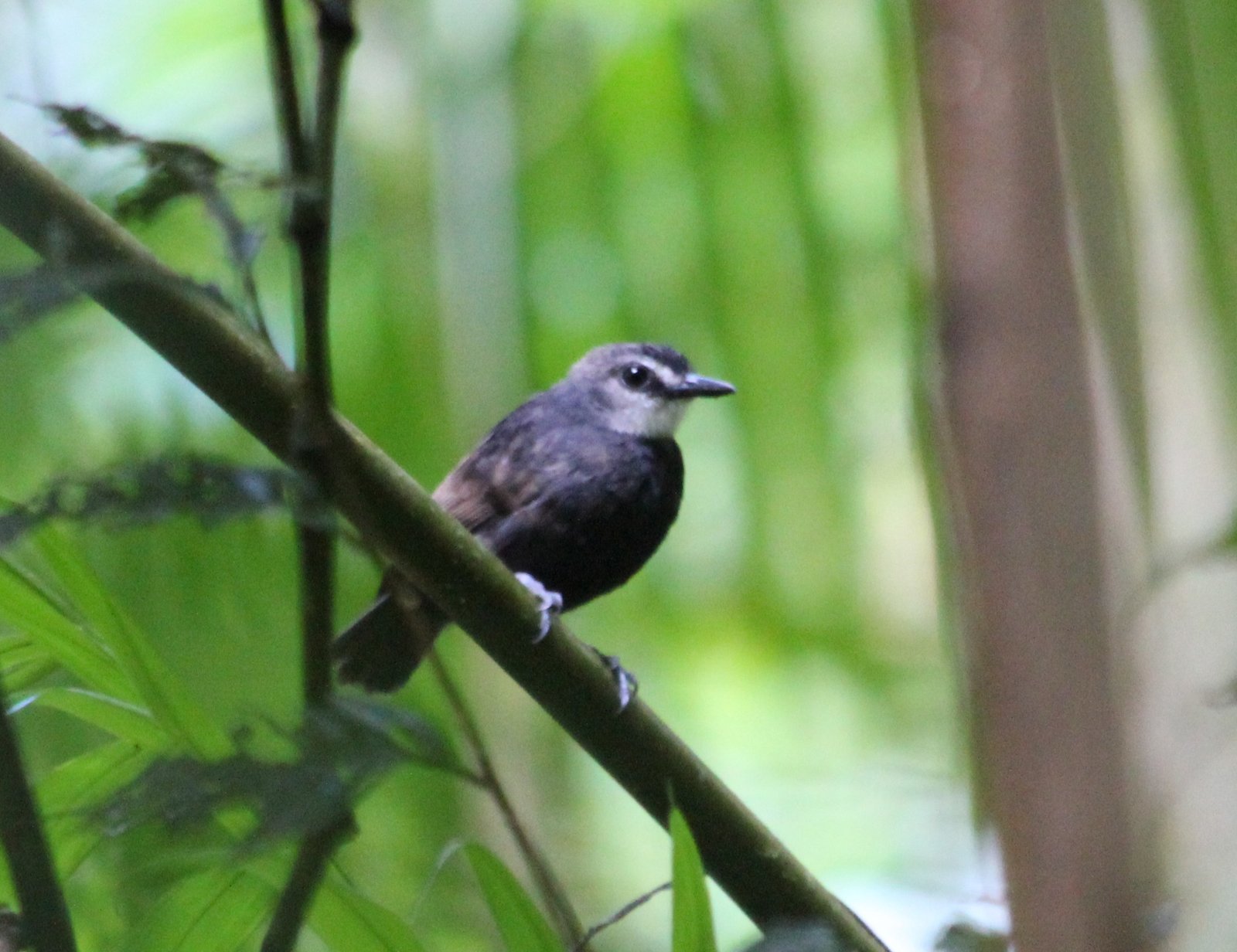
14 cm, with a short tail and bare, pale skin around the eye. The male is mostly grey, with a broad white supercilium, white ear coverts, a white chin and throat and a blackish-grey tail. The female has the same white supercilium and throat, but is olive-brown; the feathers of the crown and back have blackish edges and pale buff tips, producing a pattern of small crescents. The female's tail is dark greyish brown with a few white bars, and the underparts are olive-brown, yellower in the centre of the breast.
Confusion species
White-throated Antbird Oneillornis salvini lives east of the Ucayali; the male has a white-barred tail and the female is more rufous, with black barring on the back and tail. White-cheeked Antbird Gymnopithys leucaspis has white underparts and chestnut-brown upperparts. Hairy-crested Antbird Rhegmatorhina melanosticta has a grey crest, a black face and a bluish-white eye-ring.
Habitat
Understorey of humid várzea forest and of transitional forest between várzea and terra firme, below 300 m in Ecuador, locally to about 950 m in Peru. It forages low above the ground at army-ant swarms, catching flushed insects and other arthropods. Usually in pairs or family groups. Little is known about its breeding.
Where the bird is most at home, classified by the vegetation units of the Andes and the west coast.


Range and movements
Colombia: absent. Ecuador: in the eastern lowlands, from Sucumbíos to Morona-Santiago, locally. Peru: in the northern and central Amazonian lowlands, west of the Napo and the Ucayali. Bolivia: absent. Absent from the Galápagos. The species does not occur outside the guide area.
- Resident
- dark = core range, pale = thinly spread
How and when to look
In várzea and transitional forest in eastern Ecuador and north-eastern Peru, look for an army-ant swarm; the Lunulated Antbird then perches low on vertical stems above the ants, often with other ant-followers.
Conservation status
Least Concern. The range is fairly small and the species depends on undisturbed forest with army ants; deforestation is the main threat.
Scientific name
Oneillornis lunulatus | (Sclater & Salvin, 1873) (GBIF: Gymnopithys lunulatus)
Sclater & Salvin described the species in 1873 as Pithys lunulata; because it was later moved to another genus, the author and year stand in brackets. The genus Oneillornis was introduced in 2014 by Isler, Bravo & Brumfield. The genus name honours the American ornithologist and bird artist John P. O'Neill (born 1942), with Greek ornis, 'bird'. The species name comes from Latin lunulatus, 'with small crescents', for the crescent-shaped markings. The specimen the first description was based on came from Sarayacu, Río Ucayali, Peru.