All species › Passerines › Antbirds › White-throated Antbird
White-throated Antbird | Oneillornis salvini
Witkeelmiervogel | Hormiguero gorjiblanco | Mãe-de-taoca-de-cauda-barrada
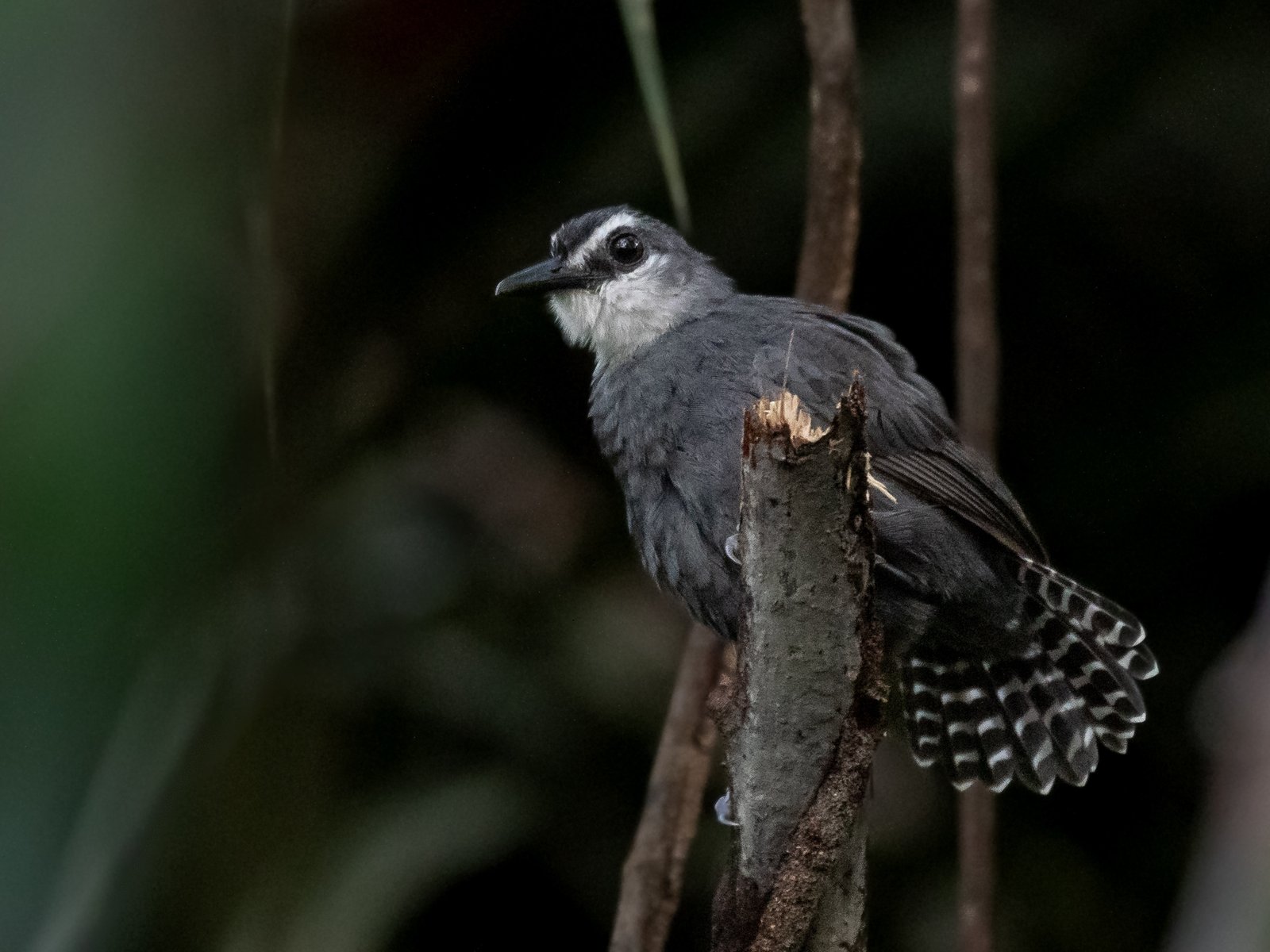
The White-throated Antbird is a regular follower of army-ant swarms in south-western Amazonia. It perches low on thin, vertical stems above the ant front and catches the insects that are flushed. It is the eastern counterpart of the Lunulated Antbird, with which it has been treated as one species.
Voice
The song is a series of clear whistles that first rises and then falls, ending in rasping notes. Calls are a rasping chirr and a short chip.
Recording: Guilherme Melo — CC BY-NC-SA 4.0 · xeno-canto
Identification
14 cm, with a short tail and bare, pale skin around the eye. The male is slate-grey, with a white throat, a white stripe behind the eye and a black-and-white barred tail. The female is rufous-brown, with black barring on the back and tail, a white throat and a pale supercilium; the underparts are warm rusty brown.
Confusion species
Lunulated Antbird Oneillornis lunulatus lives west of the Ucayali; the male has a plain tail and the female is more olive-brown, with pale crescent-shaped feather tips. Hairy-crested Antbird Rhegmatorhina melanosticta has a crest, a black face and a bluish-white eye-ring. White-plumed Antbird Pithys albifrons has white plumes on the face and rufous underparts. Black Antbird Cercomacroides serva has a longer, plain tail and does not follow ants.
Habitat
Understorey of humid terra firme and floodplain lowland forest, also in forest with bamboo, up to about 1000 m at the foot of the Andes, usually lower. It follows army-ant swarms and catches flushed insects, spiders and other arthropods. Usually in pairs or family groups. Little is known about its breeding.
Where the bird is most at home, classified by the vegetation units of the Andes and the west coast.


Range and movements
Colombia: absent. Ecuador: absent. Peru: in the south-east, south of the Amazon and east of the Ucayali, including Ucayali, Madre de Dios and Cusco. Bolivia: in the north (Pando, Beni and La Paz). Absent from the Galápagos. Outside the guide area in western Amazonian Brazil.
- Resident
- dark = core range, pale = thinly spread
How and when to look
At Manu and Tambopata the White-throated Antbird attends almost every large army-ant swarm. Locate the swarm by the rasping of the ant-followers and look low in the understorey.
Conservation status
Least Concern. Fairly common in undisturbed forest; as an obligate ant-follower the species is sensitive to forest fragmentation.
Scientific name
Oneillornis salvini | (Berlepsch, 1901) (GBIF: Gymnopithys salvini)
Berlepsch described the species in 1901 as Pithys salvini; because it was later moved to another genus, the author and year stand in brackets. The genus Oneillornis was introduced in 2014 by Isler, Bravo & Brumfield. The genus name honours the American ornithologist and bird artist John P. O'Neill (born 1942), with Greek ornis, 'bird'. The species name honours the English ornithologist and entomologist Osbert Salvin (1835–1898), co-author of the Biologia Centrali-Americana. The specimen the first description was based on came from San Mateo, Yungas of Cochabamba, Bolivia.