All species › Passerines › Antbirds › Chestnut-backed Antbird
Chestnut-backed Antbird | Poliocrania exsul
Bruinrugmiervogel | Hormiguero dorsicastaño | Formigueiro-de-dorso-castanho
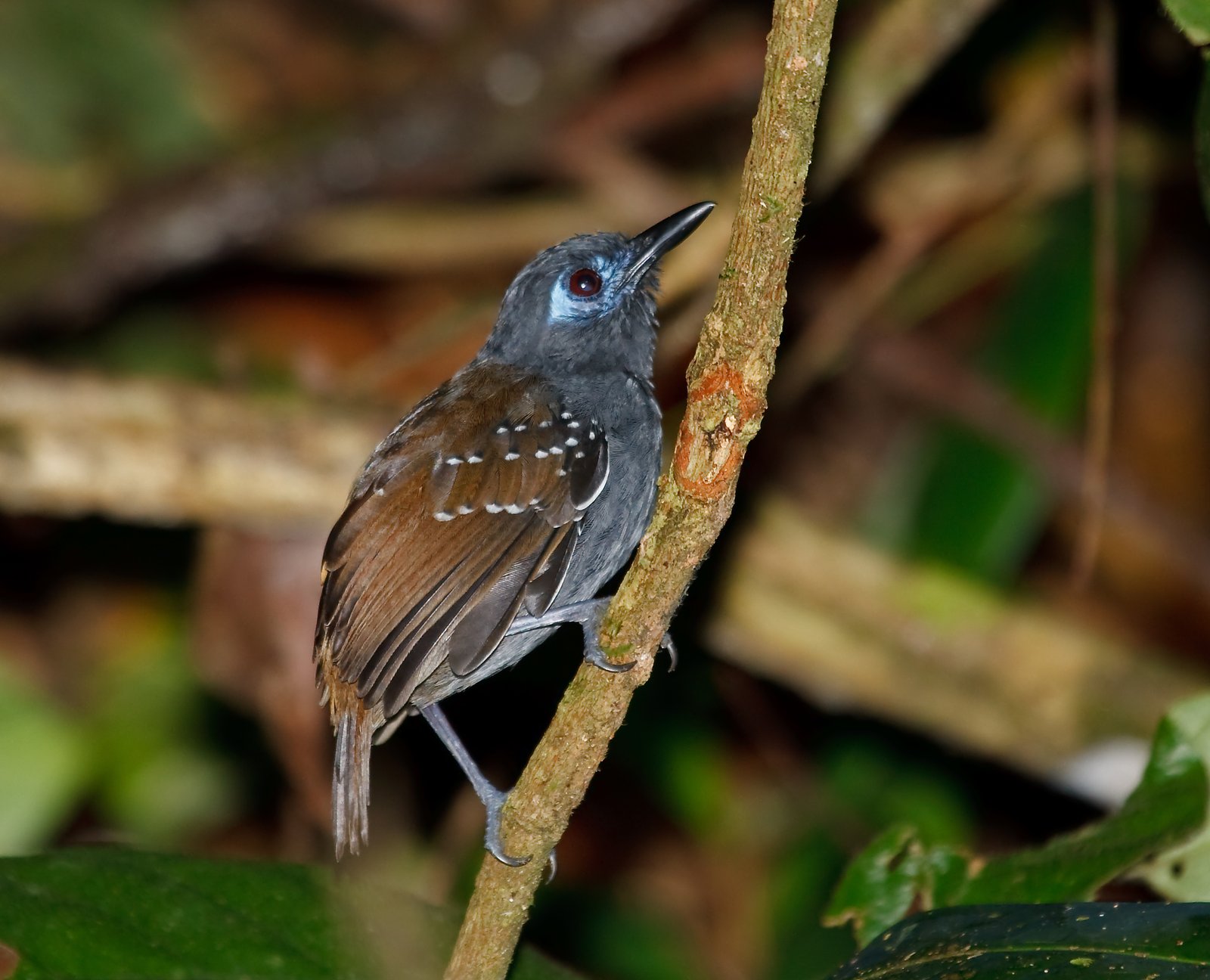
The Chestnut-backed Antbird is a stocky, short-tailed antbird of the understorey of humid lowland forest, with a chestnut body, a blackish head and blue bare skin around the eye. It is mainly noticed by its short, clear whistled song of two or three notes. In the guide area it lives west of the Andes.
Voice
The song is a short series of two or three clear whistles, the last one loudest, roughly pee-peeyu. Also a harsh, grating cherr and soft chipping calls.
Recording: Juan Freile — CC BY-NC-SA 4.0 · xeno-canto
Identification
14 cm, with a short tail. The male has a blackish head, throat and breast, a chestnut back, wings and tail and a dark brown belly; blue bare skin surrounds the eye. Birds in western Ecuador and south-western Colombia have small white or buff dots on the wing coverts. The female has the same dark head and brown upperparts, but the throat and breast are rufous-brown instead of black. Young birds are duller and browner.
Confusion species
Esmeraldas Antbird Sipia nigricauda and Stub-tailed Antbird Sipia berlepschi are grey to black, with white dots on the wings and without blue skin around the eye. Dull-mantled Antbird Sipia laemosticta and Magdalena Antbird Sipia palliata have a grey head and breast, white wing dots and a red iris. Zeledon's Antbird Hafferia zeledoni is larger and uniform black (male) or brown (female), also with blue skin around the eye.
Habitat
Dense understorey of humid lowland and foothill forest, especially at forest edges, in clearings, along streams and in tall secondary forest, also in shady plantations; from sea level to about 900 m. It hops on the ground and low in shrubbery, taking insects and spiders, and sometimes follows army ants. The nest is a loose cup on or just above the ground.
Where the bird is most at home, classified by the vegetation units of the Andes and the west coast.


Range and movements
Colombia: in the Pacific lowlands from Chocó to Nariño and in the north through Urabá and Córdoba into the lower Cauca Valley and the middle Magdalena Valley. Ecuador: in the western lowlands and foothills, south to about Los Ríos and Bolívar. Absent from Peru, Bolivia and the Galápagos. Outside the guide area from Honduras to Panama.
- Resident
- dark = core range, pale = thinly spread
How and when to look
In the understorey of humid forest in the Chocó or north-western Ecuador, listen for the short whistled song; the birds often come close to a trail, but stay in dense cover.
Conservation status
Not evaluated in the current classification. In the guide area fairly common in humid forest and rather tolerant of secondary forest, but sensitive to deforestation in the Chocó and western Ecuador.
Scientific name
Poliocrania exsul | (Sclater, 1859) (GBIF: Myrmeciza exsul)
Sclater described the species in 1859 as Myrmeciza exsul; because it was later moved to another genus, the author and year stand in brackets. The genus Poliocrania was introduced in 2013 by Bravo, Isler & Brumfield. The genus name comes from Greek polios, 'ash-grey', and kranion, 'head, skull'. The species name comes from Latin exsul, 'exile'; why Sclater chose this name is not known. The specimen the first description was based on came from Panama and Nicaragua.