All species › Passerines › Antbirds › Plain Antvireo
Plain Antvireo | Dysithamnus mentalis
Bosmiervireo | Batarito cabecigrís | Choquinha-lisa
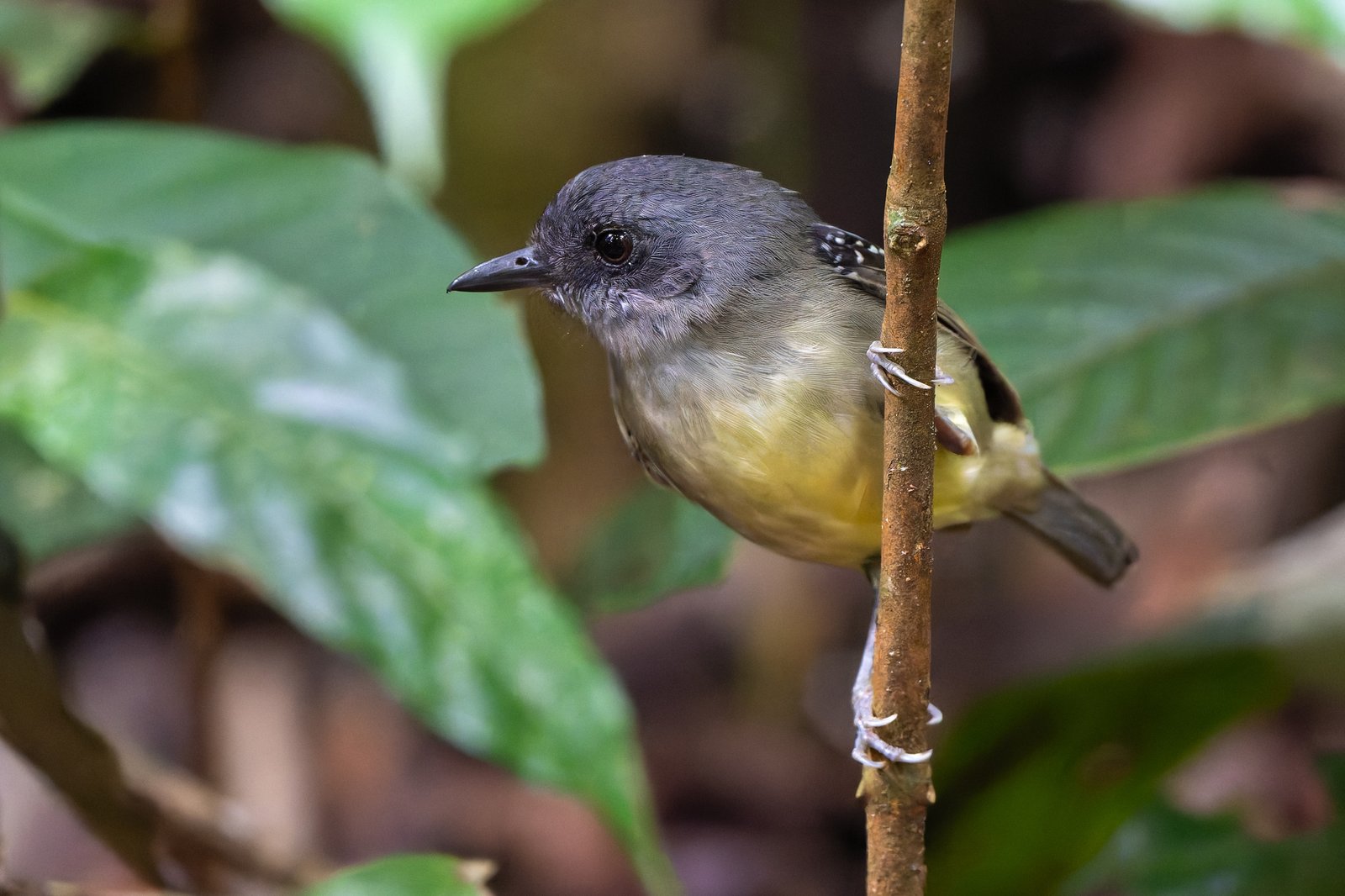
The Plain Antvireo is a small, stocky antbird with a large head and a fairly heavy, slightly hooked bill, whose slow movements recall a vireo. It is the most widespread antvireo in the guide area and a regular member of mixed flocks in the understorey of foothill and montane forest.
Voice
The song starts with a few even, countable notes on the same pitch, which then become shorter, fall and turn into an accelerating roll. Calls are a nasal, musical note and quickly rising short series.
Recording: Nick Talbot — CC BY-NC-SA 4.0 · xeno-canto
Identification
11–12 cm, with a large head, a short tail and a fairly heavy, slightly hooked bill. The male has a grey crown and a dark, almost black ear patch that stands out as a mask; the upperparts are greyish olive, with a hidden white patch between the shoulders and narrow pale tips to the wing coverts. The underparts are whitish to pale grey, with pale yellow on the belly. The female has a cinnamon-brown crown, a pale eye-ring and a less dark ear patch, more olive upperparts and more yellow below.
Confusion species
Spot-crowned Antvireo Dysithamnus puncticeps lives lower, in the Pacific lowlands, and has a white-spotted crown and streaked breast. Females of White-streaked Antvireo Dysithamnus leucostictus and Bicolored Antvireo Dysithamnus occidentalis are larger, with rufous upperparts and white-streaked grey underparts. Slaty Antwren Myrmotherula schisticolor is slimmer, with a thinner bill; the male has a black throat and breast.
Habitat
Understorey and lower mid-storey of humid foothill and montane forest, forest edges and older secondary forest, roughly between 300 and 2000 m, locally lower in western Ecuador and Colombia. After a short pause it picks insects and spiders from leaves and twigs, usually in mixed flocks. The nest is a deep cup, suspended in a horizontal twig fork, low in the vegetation.
Where the bird is most at home, classified by the vegetation units of the Andes and the west coast.


Range and movements
Colombia: in all three Andean ranges, the Sierra Nevada de Santa Marta, on the Pacific slope and in the foothills. Ecuador: on both slopes of the Andes and in the western foothills and adjacent lowlands. Peru: along the whole eastern slope of the Andes. Bolivia: on the eastern slope in the Yungas, south to Santa Cruz. Absent from the Galápagos. Outside the guide area from southern Mexico through Central America to Venezuela and in eastern Brazil, Paraguay and north-eastern Argentina.
- Resident
- dark = core range, pale = thinly spread
How and when to look
In mixed flocks in the understorey of foothill and montane forest, for example along forest trails on the eastern slope, look for a quietly perched grey bird with a dark mask. It moves slowly and often sits still for a while before taking prey.
Conservation status
Least Concern. Common in a large range; it tolerates older secondary forest but disappears where the forest is cleared completely.
Scientific name
Dysithamnus mentalis | (Temminck, 1823)
Temminck described the species in 1823 as Myothera mentalis; because it was later moved to another genus, the author and year stand in brackets. The genus Dysithamnus was introduced in 1847 by Cabanis. The genus name combines Greek duō, 'to plunge', and thamnos, 'bush'. The species name comes from Latin mentum, 'chin', meaning 'of the chin', for the markings on chin and throat. The specimen the first description was based on came from Curitiba, Paraná, Brazil.